Grow Lights
To make an adjustable grow light, the design will have a number of grow light modules. These are arrays of three white LEDs, each array will be switched on and off accordingly. An npn transistor will act as the switch, the microcontroller output will bias the transistor to either saturation (LEDs on) or cut-off (LEDs off).
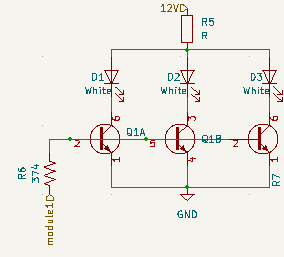
The table below summarizes the list of components for two modules.
| Component | Vendor | Quantity | Cost (Unit) |
|---|---|---|---|
| White LED | Digikey | 6 | $1.00 |
| 12Ω resistor | Digikey | 2 | $0.96 |
| Dual NPN transistors (for two modules) | Digikey | 1 | $0.26 |
| 374Ω resistor | Digikey | 2 | $0.10 |
| Total | ----------- | ----------- | $8.38 |
Each module is capable of producing 600 lumens of light. Ideally, the prototype will be able to provide sufficient light for as many types of plants possible: low, medium and high light plants. However, due to budget constraints, the prototype might be limited to only low light or medium light plants. The table below evaluates the price required to attain each objective. Buying components in bulk reduces the total price.
| Objective | Lumens Required | Required Number of Modules | Cost |
|---|---|---|---|
| Low-Light | 538-2690 | 4 | $12.28 |
| Mid-Light | 8,070 | 14 | $41.27 |
| High-Light | 10,760 | 18 | $52.52 |
Some key journal entries to refer to for more information are:
- Light Intensity: identifies preliminary light intensity objectives
- Light Intensity II: identifies light intensity units and previous design flaws
- Light Intensity III: consolidates the final design
- Transistors: describes the switching mechanism
- Optimal Light for Plant Growth: identifies different wavelengths of light to aim for
- Design Analysis: final tweaks and the resulting design