Personalization Enablers
Target Audience: software developers
Personalization Enablers proposed in the XR2Learn ecosystem aim to provide tools for personalizing education scenarios in XR by enabling adaptive learning components that dynamically adjust to users based on their proficiency level, affective state (emotions), and challenge level of an educational scenario.
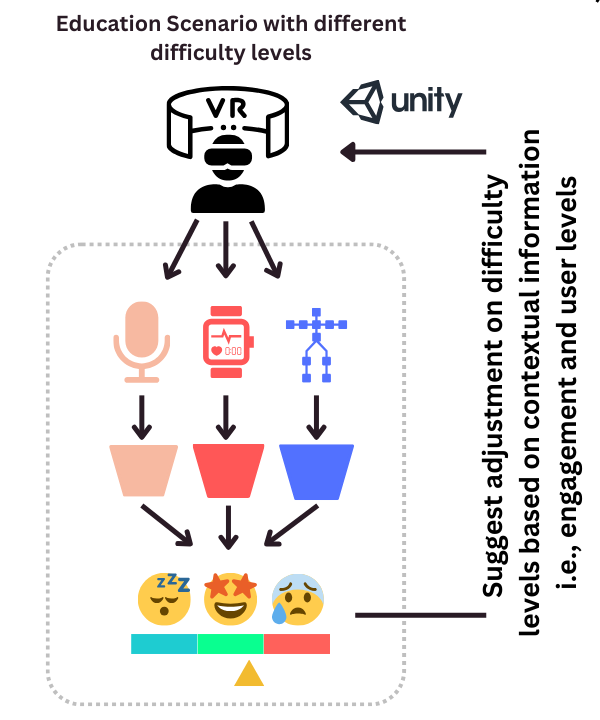
Figure: Personalization adaptation workflow illustrating how user proficiency, affective state, and scenario difficulty are used to dynamically adapt XR learning experiences.
Personalization Enablers are organized into five main domains based on their functionalities. The figure below illustrates a high-level diagram of the proposed components. All the components within the different domains are cross-platform applications that can be hosted on a local or remote machine.
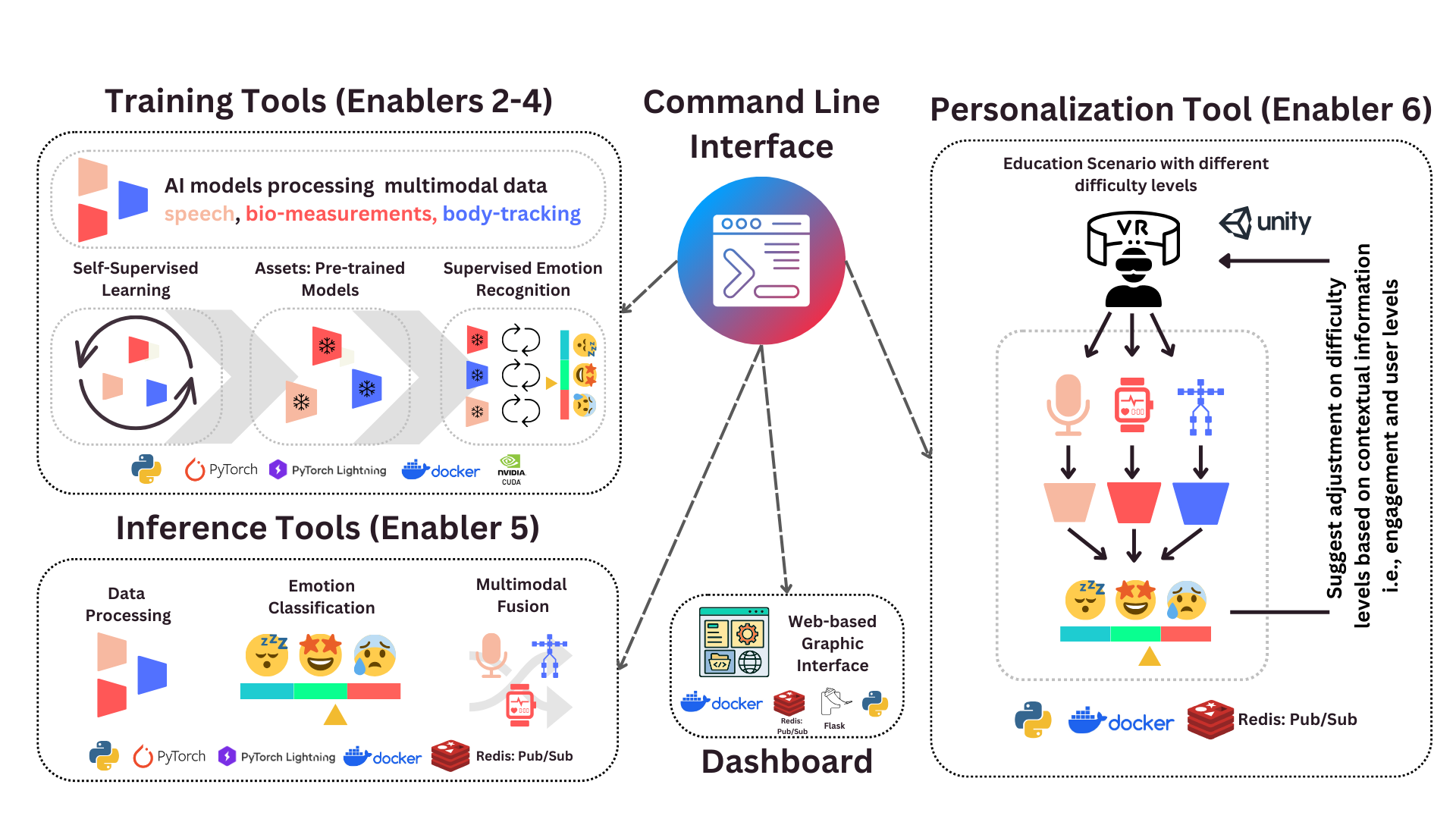
Figure: High-level architecture of the XR2Learn personalization enablers.
These enablers enable adaptive and emotion-aware XR learning experiences, supporting personalized education and training across diverse learner profiles and contexts.
The enablers’ architecture is designed to support flexible and scalable personalization in XR environments:
- Modularity: Each enabler can be deployed independently or combined with others.
- Scalability: Components can scale from small pilots to large multi-user deployments.
- Flexibility: The architecture supports different sensing modalities, learner models, and adaptation strategies.
-
Deployment: Enablers can be integrated into existing XR pipelines or used as standalone services.
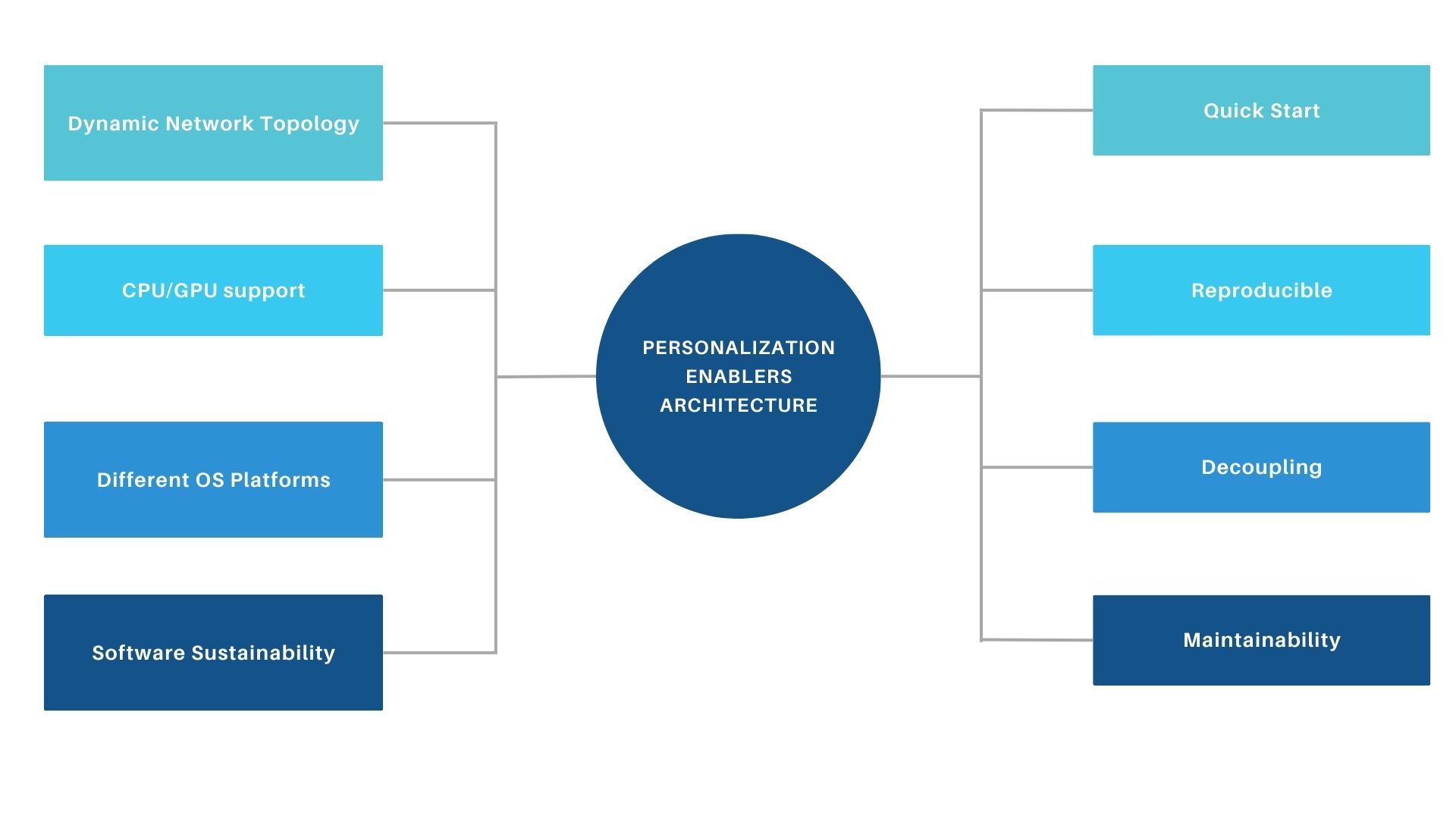
Figure: Distributed and modular deployment architecture of the personalization enablers, illustrating how components can be deployed on different machines depending on computational requirements.
In the proposed architecture, five domains have been implemented to cover the Personalization enablers' functionalities:
- Training Tools
- Inference Tools
- Personalization Tool
- Command Line Interface (CLI)
- Personalization Dashboard
- XR2Learn platform overview
- Magic XRoom
- Technical Support Services
Return to XR2Learn wiki home page

|
Wiki - Immerse yourself in the world of XR2Learn |