Letian Huang1
Dongwei
Ye1
Jialin Dan1
Chengzhi
Tao1
Huiwen Liu2
Kun Zhou3,4
Bo Ren2
Yuanqi Li1
Yanwen Guo1
Jie Guo*
1
1State Key Lab for Novel Software Technology, Nanjing
University
2TMCC, College of Computer Science, Nankai University
3State Key Lab of CAD&CG, Zhejiang University
4Institute of Hangzhou Holographic Intelligent Technology




[2025.08.04] 🎈 We release the code.
[2025.07.23] 
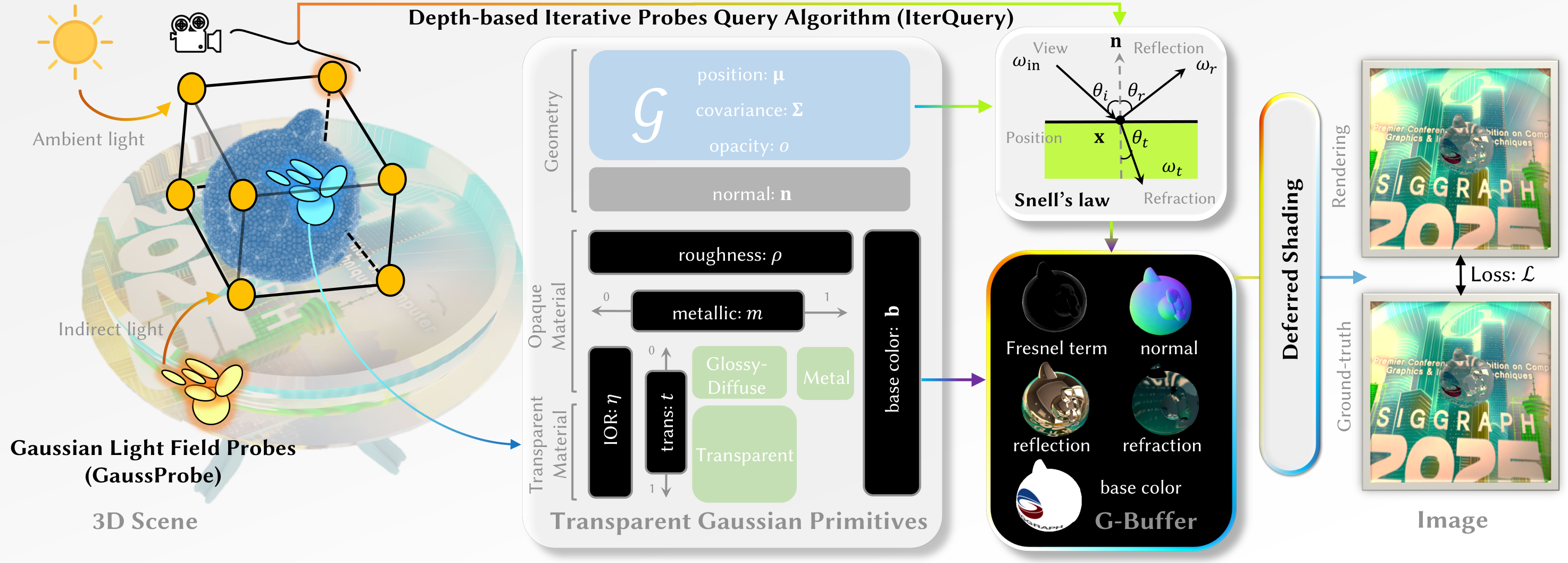
We propose TransparentGS, a fast inverse rendering pipeline for transparent objects based on 3D-GS. The main contributions are three-fold: efficient transparent Gaussian primitives for specular refraction, GaussProbe to encode ambient light and nearby contents, and the IterQuery algorithm to reduce parallax errors in our probe-based framework.
The overview of our TransparentGS pipeline. Each 3D scene is firstly separated into transparent objects and opaque environment using SAM2 [Ravi et al. 2024] guided by GroundingDINO [Liu et al. 2024]. For transparent objects, we propose transparent Gaussian primitives, which explicitly encode both geometric and material properties within 3D Gaussians. And the properties are rasterized into maps for subsequent deferred shading. For the opaque environment, we recover it with the original 3D-GS, and bake it into GaussProbe surrounding the transparent object. The GaussProbe are then queried through our IterQuery algorithm to compute reflection and refraction.
If you find this work useful in your research, please cite:
@article{transparentgs,
    author = {Huang, Letian and Ye, Dongwei and Dan, Jialin and Tao, Chengzhi and Liu, Huiwen and Zhou, Kun and Ren, Bo and Li, Yuanqi and Guo, Yanwen and Guo, Jie},
    title = {TransparentGS: Fast Inverse Rendering of Transparent Objects with Gaussians},
    journal = {ACM Transactions on Graphics (TOG)},
    number = {4},
    volume = {44},
    month = {July},
    year = {2025},
    pages = {1--17},
    url = {https://doi.org/10.1145/3730892},
    publisher = {ACM New York, NY, USA}
}- Release the rendering code.
- Release the dataset of transparent objects that we captured ourselves.
- Support the shadow mapping.
- Release the code of segmentation code.
- Release the training/reconstruction code.
- Real-time rendering and navigation of scenes that integrate traditional 3DGS, triangle meshes and reconstructed meshes (Highly robust to complex occlusions).
- Secondary light effects (e.g., reflection and refraction).
- Rendering with non-pinhole camera models (e.g., fisheye or panorama).
- Material editing (e.g., IOR and base color).
- Compatible with 2DGS and supporting scene-level
$360^{\circ}$ shadow mapping (shown as follows).


Because this repository is built upon 3DGS, it is recommended to follow 3DGS's software requirements (as follows); otherwise, the setup/build may fail (e.g., issue #3).
- Conda (recommended for easy setup)
- C++ Compiler for PyTorch extensions (we used Visual Studio 2019 for Windows)
- CUDA SDK 11 for PyTorch extensions, install after Visual Studio (we used 11.8, known issues with 11.6)
- C++ Compiler and CUDA SDK must be compatible
Clone the repository and create an anaconda environment using
git clone git@github.com:LetianHuang/transparentgs.git --recursive
cd transparentgs

SET DISTUTILS_USE_SDK=1 # Windows only
conda env create --file environment.yml
conda activate transparentgs
About the Eigen C++ library
It is notable that the Eigen C++ library eigen==3.4.0 should be downloaded with https://gitlab.com/libeigen/eigen/-/archive/3.4.0/eigen-3.4.0.zip and put into the specified path shown in setup.py:
/usr/include/eigen3
/usr/local/include/eigen3
# or
C:/Program Files/eigen3
C:/Program Files (x86)/eigen3
If, for some reason, it doesn't work, you can try downloading it from this Google Drive link.
The repository contains several submodules, thus please check it out with
pip install . # Thanks to https://github.com/ashawkey/raytracing
pip install submodules/diff-gaussian-rasterization
pip install submodules/simple-knn
pip install submodules/diff-gaussian-rasterization-fisheye
pip install submodules/diff-gaussian-rasterization-panorama
pip install submodules/diff-surfel-rasterization # Newly Added
pip install submodules/diff-gaussian-rasterization_light # Newly Added
pip install submodules/nvdiffrast
or choose a faster version (1. integrated with Speedy-Splat, using SnugBox and AccuTile; 2. Employ CUDA scripting for computational acceleration of 64 probes).
pip install .
pip install submodules-speedy/diff-gaussian-rasterization
pip install submodules/simple-knn
pip install submodules-speedy/diff-gaussian-rasterization-fisheye
pip install submodules-speedy/diff-gaussian-rasterization-panorama
pip install submodules/diff-surfel-rasterization  # fast version (TODO)
pip install submodules/diff-gaussian-rasterization_light # fast version (TODO)
pip install submodules-speedy/compute-trilinear-weights
pip install submodules/nvdiffrastFirst, create a models folder inside the project path by
mkdir modelsThe data structure will be organised as follows:
transparentgs/
│── models/
│   ├── 3dgs/
│   │   ├── drjohnson.ply
│   │   ├── playroom_lego_hotdog_mouse.ply
│   │   ├── Matterport3D_h1zeeAwLh9Z_3.ply
│   │   ├── ...
│   ├── 2dgs/ (Newly Added)
│   │   ├── garden.ply
│   │   ├── ...
│   ├── mesh/
│   │   ├── ball.ply
│   │   ├── mouse.ply
│   │   ├── bunny.ply
│   │   ├── ...
│   ├── probes/
│   │   ├── playroom_lego_hotdog_mouse/
│   │   │   ├── probes/
│   │   │   │   ├── 000_depth.exr
│   │   │   │   ├── 000.exr
│   │   │   │   ├── 333_depth.exr
│   │   │   │   ├── 333.exr
│   │   │   │   ├── ...
│   │   │   ├── probe.json
│   │   ├── ...
|   ├── meshgs_proxy/
│   │   ├── mouse.ply
│   │   ├── ...
We release several ready-to-use scenes. Please download the assets from Google Drive and move the 3dgs (or 2dgs, Newly Added) and mesh folders into models/ folder.
To create a custom scene, simply follow the provided instructions to set it up. Instructions on the above data structure are as follows:
- Scenes in the
3dgsfolder should be in.plyformat and reconstructed using traditional 3DGS, op43dgs (for reconstruction from non-pinhole cameras) or Mip-Splatting (for anti-alias). - Objects in the
meshfolder could be in any triangle mesh format (e.g,.obj,.plyor.glb), including both traditional and reconstructed ones. - Probes in the
probesfolder could be baked usingStep I: Bake GaussProbeor similar formats. Theprobes.jsonfile specifies the positions of the probes, while theprobes/directory stores the corresponding RGB panorama and depth panorama in EXR format. - The
meshgs_proxyfolder is a byproduct ofStep I: Bake GaussProbe. It contains the object converted into 3DGS format and can be used as a proxy of the mesh inmeshto assemble a new scene (mesh+3DGS). Note: modifying the files inmeshgs_proxydoes not affect the final rendering results (i.e.,Step II: Boot up the renderer). To change the proxy configuration, you can adjust the scene’s position under the 3dgs directory and rerunStep I: Bake GaussProbe. - (Newly Added) Scenes in the
2dgsfolder should be in.plyformat and reconstructed using 2DGS.
The first step is to bake probes for the scene that has already been set up:
python probes_bake.py --W 800 --H 800 --gs_path ./models/3dgs/playroom_lego_hotdog_mouse.ply --probes_path ./models/probes/playroom_lego_hotdog_mouse --mesh ./models/mesh/mouse.ply --begin_id 0Command Line Arguments for probes_bake.py
path to the trained 3D Gaussians directory as the environment (used to bake GaussProbe).
output path of GaussProbe to be baked
path to the mesh
width of the RGBD panorama
height of the RGBD panorama
number of probes (1/8/64). In theory, any positive integer is allowed, but the released code only supports these three fixed values.
only to prevent OOM (Out of Memory); when GPU memory is insufficient, the process can exit and resume baking from the specified ID.
bounding box scale ratio for the mesh
the voxel size (pitch), which determines the resolution of the mesh voxelization.
Next, boot the renderer to start rendering:
python renderer.py --W 960 --H 540 --gs_path ./models/3dgs/playroom_lego_hotdog_mouse.ply --probes_path ./models/probes/playroom_lego_hotdog_mouse --mesh ./models/mesh/mouse.ply --meshproxy_pitch 0.1Command Line Arguments for renderer.py
path to the mesh
the original design supports either environment map or GaussProbe. However, since a single probe with zero iteration is equivalent to the environment map, this design has been deprecated.
path to the trained 3D Gaussians directory as the environment (used to bake GaussProbe).
GUI width
GUI height
default GUI camera radius from center
default GUI camera fovy (can be modified in the GUI)
path of the baked GaussProbe
number of probes (1/8/64). In theory, any positive integer is allowed, but the released code only supports these three fixed values. (can be modified in the GUI)
count of iterations (0-10). In theory, any non-negative integer is allowed, but the released code only supports these eleven fixed values. (can be modified in the GUI)
the voxel size (pitch), which determines the resolution of the mesh voxelization.
Additionally, we offer an optional all-in-one pipeline script that produces the same effect as executing Step I and Step II independently:
python full_render_pipeline.py --W 960 --H 540 --probesW 800 --probesH 800 --gs_path ./models/3dgs/playroom_lego_hotdog_mouse.ply --probes_path ./models/probes/playroom_lego_hotdog_mouse --mesh ./models/mesh/mouse.ply --meshproxy_pitch 0.1
# equal to
# 1. python probes_bake.py --W 800 --H 800 --gs_path ./models/3dgs/playroom_lego_hotdog_mouse.ply --probes_path ./models/probes/playroom_lego_hotdog_mouse --mesh ./models/mesh/mouse.ply --begin_id 0 --meshproxy_pitch 0.1
# 2. python renderer.py --W 960 --H 540 --gs_path ./models/3dgs/playroom_lego_hotdog_mouse.ply --probes_path ./models/probes/playroom_lego_hotdog_mouse --mesh ./models/mesh/mouse.ply --meshproxy_pitch 0.1
or for 2DGS (Newly Added):
python full_render_pipeline.py --W 960 --H 540 --probesW 800 --probesH 800 --gs_path ./models/2dgs/garden.ply --probes_path ./models/probes/garden_ball --mesh ./models/mesh/ball.ply --meshproxy_pitch 0.1 --numProbes 64
# equal to
# 1. python probes_bake.py --W 800 --H 800 --gs_path ./models/2dgs/garden.ply --probes_path ./models/probes/garden_ball --mesh ./models/mesh/ball.ply --begin_id 0 --numProbes 64
# 2. python renderer.py --W 960 --H 540 --gs_path ./models/2dgs/garden.ply --probes_path ./models/probes/garden_ball --mesh ./models/mesh/ball.ply --meshproxy_pitch 0.1 --numProbes 64
Command Line Arguments for renderer.py
path to the mesh
the original design supports either environment map or GaussProbe. However, since a single probe with zero iteration is equivalent to the environment map, this design has been deprecated.
path to the trained 3D Gaussians directory as the environment (used to bake GaussProbe).
GUI width
GUI height
default GUI camera radius from center
default GUI camera fovy (can be modified in the GUI)
path of the baked GaussProbe
number of probes (1/8/64). In theory, any positive integer is allowed, but the released code only supports these three fixed values. (can be modified in the GUI)
count of iterations (0-10). In theory, any non-negative integer is allowed, but the released code only supports these eleven fixed values. (can be modified in the GUI)
the voxel size (pitch), which determines the resolution of the mesh voxelization.
width of the RGBD panorama
height of the RGBD panorama
only to prevent OOM (Out of Memory); when GPU memory is insufficient, the process can exit and resume baking from the specified ID.
bounding box scale ratio for the mesh
if using this argument, it will be equivalent to running renderer.py.
The following GUI usage tutorial is provided based on the current release. It is recommended to watch this in conjunction with the video available on the project homepage.

Bear resemblance to raytracing.
- drag rotate: move with the left mouse button.
- drag translation: move with the middle mouse button
- move closer: move with the wheel
- Options: the main ways to control, aside from moving the camera.
- Debug: display the camera pose.
Common G-buffers in typical renderers (depth, mask, normal, position), with special attention to:
- reflect: the reflection component (mesh).
 also works for 2DGS

- refract: the refraction component (mesh).

- render: the weighted sum of the reflection and refraction components using the Fresnel term (mesh).
 also works for 2DGS

- gs_render: the rendering result obtained using only traditional Gaussian primitives (3DGS).

- semantic: the result of hybrid rendering with Gaussians and meshes (mesh + 3DGS). Pixels belonging to the mesh are replaced with a uniform color that represents the same semantic label (e.g., purple).

- 2dgs_render: (Newly Added, only work for
2dgs) the rendering result obtained using 2DGS.
- 2dgs_normal: (Newly Added, only work for
2dgs) the normal map obtained using 2DGS.
- 2dgs_depth: (Newly Added, only work for
2dgs) the depth map obtained using 2DGS.
- 2dgs_relighting: (Newly Added, only work for
2dgs) the relighting result with shadow obtained using 2DGS.


Select the camera model.
- pinhole: the regular camera model which 3DGS also supports.
- fisheye: It can support a field of view (FOV) of up to 180°.

- panorama: It can support a field of view (FOV) of 360°.


Select the background of the mesh.
- black: black color as the background
- white: white color as the background
- 3DGS: Hybrid rendering of 3DGS and transparent objects (
reflect,refract,render,normal).
Select whether to apply normal smoothing.
- raw: no

- smooth: yes


As changing the number of probes involves I/O overhead, it is not recommended to modify it through the GUI. It is advisable to configure it beforehand using terminal arguments. Additionally, increasing the number of probes demands more GPU memory.
Modify the count of iterations of IterQuery (0-10). In theory, any non-negative integer is allowed, but the released code only supports these eleven fixed values. Setting it to zero clearly demonstrates the superiority of the IterQuery.
Modifying the field of view (FOV), particularly for fisheye cameras, allows reaching up to a 180° viewing angle.

This mainly affects gbuffers with refract or render properties. When the IOR is approximately 1, the result is almost identical to the background, demonstrating the high quality of IterQuery (especially with 64 probes).
Note that only the scale of the 3dgs primitives is modified, not the overall scene scaling. Therefore, reducing the scale allows us to observe the gaps between Gaussians.
Control the sampling rate of mesh ray tracing.
Modify the color of the mesh.
We release several self-captured scenes for reconstruction purposes. Please download the transparent object dataset from Google Drive.
Please refer to grounded_sam2.
The environtment of this part is the same as the renderer/viewer.
Assume that you have already segmented the scene using the segmentation module we have released, and that you have reconstructed the opaque environment with the original 3D Gaussian Splatting, resulting in the mask directory and env_gs.ply, respectively. In other words, you should have obtained a dataset with a structure similar to the dataset we have released.
A simple example is as follows:
python simple_full_recon_pipeline.py \
    -s {DATA_PATH} \
    -m {MODEL_PATH} \
    --probesW {resolution of probes} \
    --probesH {resolution of probes} \
    --numProbes 64 \
    --meshproxy_pitch 0.1 \
    --scale_ratio {scale ratio of aabb} \
    --skip_base {skip baking if you have baked} \
    --viewer {use this argument if you wanna see the rendering result} \
    --viewer_mode {view the coarse or fine version} \
    --sdf_end_iter {iterations for the SDF} \
    --mesh_end_iter {iterations for the mesh proxy part} \
    --mesh_r {image resolution for the mesh proxy part} \
    ... # the same as the original 3DGS
More details and explanations on this part will be released soon, subject to our available time. In addition, we would like to sincerely thank our collaborators for taking the time out of their busy schedules to help organize this part.


This project is built upon 3DGS, GaussianShader, GlossyGS, op43dgs, raytracing, nvdiffrast, instant-ngp, SAM2, GroundingDINO, SAM, GroundedSAM, 2DGS, GS$^{3}$, NeuS, NeTO and so on. Please follow the licenses. We thank all the authors for their great work and repos. We sincerely thank our colleagues for their valuable contributions to this project.