One Neo4j graph. Two knowledge modes. Answers that flat RAG cannot reliably give.
1. Ingestion pipeline — drop PDFs in the bulk-upload UI and watch them become a versioned Neo4j knowledge graph (lightweight parser, parallel NER + LLM extraction, batched writes, live job status).
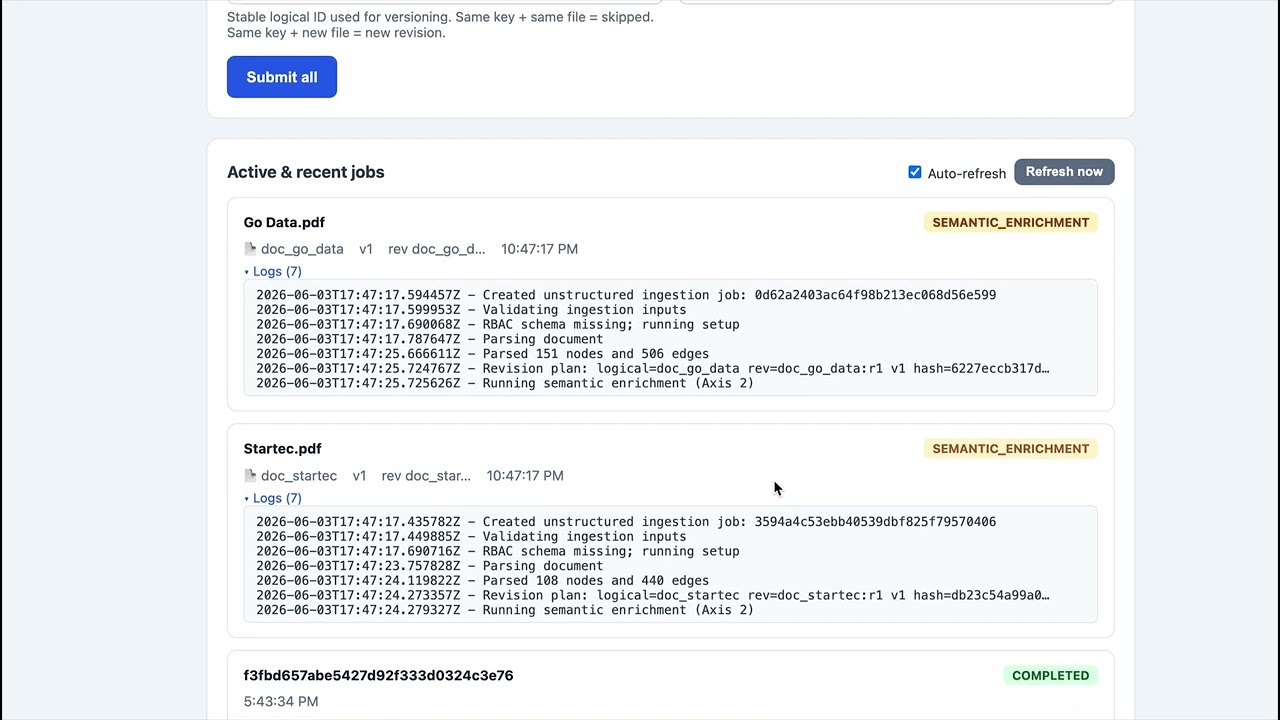
▶️ Watch: https://youtu.be/K4XIat6xpEw
2. Retrieval + eval run — the 30-case eval suite answered live in the chat UI: 20 unstructured document questions + 10 structured analytics questions (bar/line/doughnut charts), each validated with an on-screen PASS/FAIL banner. Final score: 30/30.
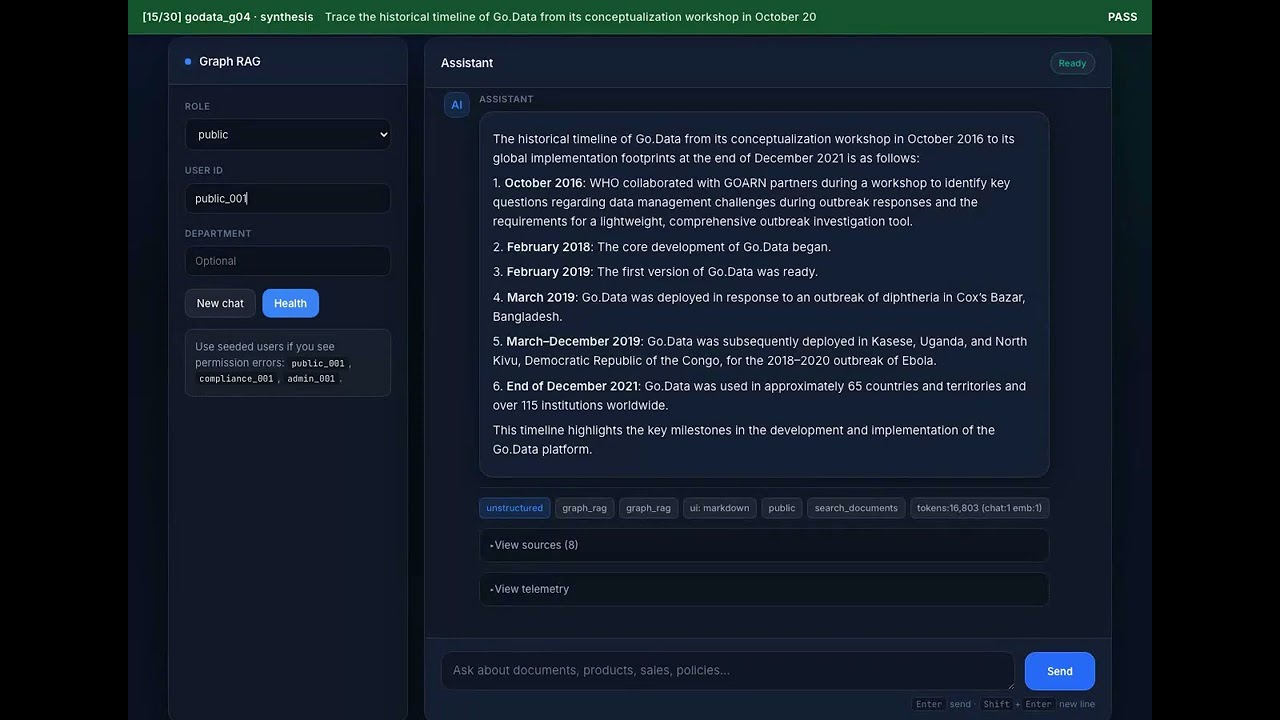
▶️ Watch: https://youtu.be/7011-xkI1RI
Agentic GraphRAG is a production-oriented Graph RAG stack that keeps structured business data and unstructured documents in the same graph database, then routes each question to the right retrieval strategy—or combines both. You get SQL-grade analytics on Northwind-style entities and multi-hop reasoning over WHO reports, policies, and manuals—without maintaining separate vector DBs, ETL pipelines, and ad-hoc orchestration glue.
Built with Neo4j · FastAPI · LangGraph · OpenAI.
The core platform is feature-complete for a production-oriented v1:
| Area | Status |
|---|---|
| Dual-graph RAG (structured + documents + hybrid) | ✅ |
| Scalable ingestion (Redis + RQ workers, versioning) | ✅ |
| Google OIDC auth, RBAC, per-user thread isolation | ✅ (release/v1.0) |
Dev sidebar auth (no Google UI on master) |
✅ |
Streaming answers (/query/stream) with charts |
✅ |
Retrieval feedback loop + ops dashboard (/feedback) |
✅ |
| Regression eval suites | ✅ |
| Branch | Auth in UI | Use case |
|---|---|---|
master (default) |
Sidebar User ID + Role — no Google sign-in in /chat or /upload |
Local dev, eval, demos |
release/v1.0 |
Sign in with Google (OIDC JWT) + full production RBAC | Deployments with real identity |
Both branches share the same RAG, ingestion, feedback, and eval features. Only the login UX and default env differ.
| Planned | Description |
|---|---|
| Short memory (per user) | Recent turns and session context across a thread — beyond today's single last-turn snapshot |
| Long memory (per user) | Durable facts and preferences retrieved at query time (graph-backed or dedicated store) |
| Multi-language | Query and answer in multiple languages (detection, prompts, and UI i18n) |
| Typical flat RAG | Agentic GraphRAG |
|---|---|
| One chunk index for everything | Dedicated graphs for tables vs. documents |
| Similarity search only | Cypher for metrics + hybrid retrieval for PDFs |
| Weak on counts, joins, time series | Aggregations, rankings, charts from live Neo4j |
| Loses document structure | Hierarchy: Document → Chapter → Section → Page → Region |
| Single-hop Q&A | Multi-hop paths across entities, networks, and field stories |
| Guesses when context is missing | Eval suite includes anti-hallucination and empty-result cases |
Unique in practice: the same user session can ask “Top 5 products by revenue in 1997” (structured) and “Which field epidemiology network deployed fellows to Greece and Kosovo?” (unstructured, 2–3 hop)—with an LLM MCP router choosing query_data vs. search_documents, RBAC enforcing who sees what, and the chat UI rendering tables, bar/line/doughnut charts, or narrative answers as appropriate.
flowchart TB
  Q[User question] --> R[MCP router]
  R -->|metrics / SQL-like| S[Structured agent]
  R -->|policies / PDFs| U[Unstructured agent]
  R -->|both| H[Hybrid answer]
  S --> C[Text-to-Cypher → Neo4j]
  U --> V[Vector + full-text + graph expand]
  U --> T[TOC / page / fact lookup]
  C --> N[(Neo4j)]
  V --> N
  T --> N
  S --> UI[Charts + tables + narrative]
  U --> UI
  H --> UI
| Mode | Best for | Examples |
|---|---|---|
| Structured | Counts, filters, rankings, time series, BI | “Monthly order count in 1997” · “Revenue share by category” |
| Unstructured | Facts, relationships, timelines, synthesis over PDFs | “ISBN of the annual report” · “Network that deployed fellows to Malta and Moldova” |
| Hybrid | Incidents + policy context in one answer | “Show compliance incidents and summarize related policy guidance” |
Unstructured retrieval is not “vector-only.” It layers semantic search, lexical match, graph expansion from extracted entities, structural TOC/page fetch, and phrase-based fact lookup (URLs, licenses, abbreviations)—so complex questions anchor on the right section before synthesis.
Structured retrieval is not “text-to-SQL on CSV.” It uses your Neo4j schema (Northwind demo or your own Cypher ingest), schema-aware repair, multistep plans for hard questions, and automatic chart selection (bar, horizontal bar, line, pie/doughnut).
Try these in chat, or run the bundled eval suites (python3 scripts/run_rag_eval.py --help):
| Complexity | Structured (Northwind · regular_001 / regular_office) |
Unstructured (Go.Data · public_001) |
|---|---|---|
| Lookup | Which supplier provides Chai? | What is the electronic version ISBN of the Go.Data annual report 2021? |
| Aggregation | How many products exist in each category? | How many countries and territories were supported during 2020–2021? |
| Multi-hop | Which customers purchased products in the Seafood category? | Which network deployed alumni to Greece, Malta, Moldova, and Kosovo? |
| Temporal | Show monthly order count in 1997. | Which deployment came first: Cox's Bazar or Kasese, Uganda? |
| Compare / synthesize | Revenue share by category (doughnut). | Contrast proximity tracing tools vs. Go.Data as categorized by WHO. |
| Anti-hallucination | Which categories have never appeared in an order? | Which Silicon Valley firm wrote the Go.Data iOS app? (should deny—not invent) |
| Layer | Technology |
|---|---|
| Graph database | Neo4j 5.x |
| AI orchestration | LangGraph |
| API | FastAPI + Uvicorn |
| LLM / Embeddings | OpenAI (gpt-4o-mini, text-embedding-3-small) |
| PDF parsing | PyMuPDF + pdfplumber |
| Job queue | Redis + RQ (optional — in-process fallback when unset) |
| Containers | Docker / Docker Compose |
git clone https://github.com/umerjavaidkh/agentic_graph_rag.git
cd agentic_graph_rag
cp .env.example .env          # add OPENAI_API_KEY
docker compose up --build
Open:
| Page | URL |
|---|---|
| Chat | http://localhost:8000/chat |
| Upload | http://localhost:8000/upload |
| Feedback monitor | http://localhost:8000/feedback |
| API docs | http://localhost:8000/docs |
| Health | http://localhost:8000/health |
Do not set
NEO4J_URIin.envwhen using the bundled Docker Neo4j — it is wired automatically.
Add to .env:
REDIS_URL=redis://redis:6379/0Then:
docker compose up --build              # starts Neo4j + Redis + API + 1 worker
docker compose up --scale worker=3    # scale to 3 parallel workers
Without REDIS_URL, jobs run inside FastAPI via BackgroundTasks — fine for local dev.
Go to http://localhost:8000/upload:
- Drop multiple PDFs onto the drop zone — they are submitted concurrently.
- Each file appears as a live job card with status, dispatch mode (
WORKER/IN-PROCESS), version, and expandable logs. - The queue status bar shows Redis connectivity, queue depth, and failed job count.
Or via curl:
# Single PDF
curl -X POST http://localhost:8000/ingest/unstructured \
  -F "file=@sample_data_to_test/unstructured/rag_document.pdf" \
  -F "doc_key=rag-document"

# Cypher data (requires ALLOW_CYPHER_INGEST=true + admin role)
curl -X POST http://localhost:8000/ingest/cypher \
  -F "file=@sample_data_to_test/structured/northwind-data.cypher" \
  -F "user_id=admin_001" \
  -F "role=admin"
doc_key controls versioning: same key + same file → skipped; same key + changed file → new revision.
Ingestion requires role=admin — on master, use the User ID / Role picker on /upload (admin_001 + admin). On release/v1.0, sign in with Google as a mapped admin — see Authentication & roles.
Open /chat, pick User ID and Role in the sidebar. No Google sign-in.
| Track | Prerequisite | User ID | Role |
|---|---|---|---|
| Structured | Northwind loaded | regular_001 |
regular_office |
| Unstructured | PDF ingested | public_001 |
public |
| Hybrid | Both loaded | compliance_001 |
compliance_officer |
| Ingestion | — | admin_001 |
admin (use /upload) |
Structured quick checks:
Which customers ordered the most?
Top 5 products by sales revenue in 1997?
Unstructured quick checks:
List all the table of contents from the Go.Data document.
What is the URL for the Go.Data Community of Practice portal?
Hybrid:
Show compliance incidents and summarize the related policy guidance.
Check out release/v1.0 for Sign in with Google in /chat and /upload.
- Set
GOOGLE_CLIENT_IDin.envand registerhttp://localhost:8000as an Authorized JavaScript origin in Google Cloud Console. - Open
/chat→ Sign in with Google. - Default signed-in users get
compliance_officer(documents + structured). Emails listed inAUTH_EMAIL_ROLE_MAPwith=admincan use/uploadfor ingestion.
| Track | Prerequisite | Signed-in role |
|---|---|---|
| Structured | Northwind loaded via /upload (admin) |
compliance_officer or admin |
| Unstructured | PDF ingested via /upload (admin) |
compliance_officer or admin |
| Hybrid | Both loaded | compliance_officer or admin |
| Ingestion | Admin email in AUTH_EMAIL_ROLE_MAP |
admin only |
Smoke suites under eval/ exercise routing, answers, charts, and anti-hallucination cases against /query. Corpus-specific expectations live in JSON only — not in retriever code.
python3 scripts/run_rag_eval.py --suite all          # document + structured + advanced
python3 scripts/run_rag_eval.py --attach-feedback    # label pass/fail for feedback loop
pytest tests/test_rag_eval_validators.py -q
Set EVAL_BASE_URL (default http://localhost:8000) and EVAL_TIMEOUT (default 180) for slow LLM calls.
A dedicated ops window at http://localhost:8000/feedback shows how the feedback loop is performing — separate from chat, read-only, auto-refreshes every 30 seconds.
Requires RETRIEVAL_FEEDBACK_ENABLED=true in .env (and docker compose up -d --build app after changes).
| Panel | Purpose |
|---|---|
| KPI cards | Recording on/off, routing apply on/off, store type (Redis or JSONL), event and label counts |
| Label coverage chart | Pass / fail / unlabeled breakdown |
| Pass rate by mode | Which retrieval modes (graph_rag_lexical, text2cypher, etc.) perform best |
| Patterns table | Learned question buckets, pass rates, retrieval + route hints, whether routing would apply |
| Recent events | Last queries: request_id, mode, route, outcome, whether feedback.routing ran |
| Question probe | Type any question to inspect pattern stats via /feedback/stats |
When RETRIEVAL_FEEDBACK_ENABLED=true, each assistant reply in /chat shows Helpful? buttons. A click posts to POST /feedback/outcome with that message’s request_id (same path as eval labeling). Votes appear on the dashboard after refresh.
- Enable feedback in
.env:RETRIEVAL_FEEDBACK_ENABLED=true RETRIEVAL_FEEDBACK_ROUTING=false # observe first; set true when labels are ready RETRIEVAL_FEEDBACK_STORE_QUESTION=false REDIS_URL=redis://redis:6379/0
- Use chat or run eval with
--attach-feedbackto label pass/fail. - Open /feedback in a second browser tab while testing.
- When patterns have enough labeled samples (
RETRIEVAL_FEEDBACK_MIN_SAMPLES), enableRETRIEVAL_FEEDBACK_ROUTING=trueand watch Routing applied in recent events.
| Endpoint | Description |
|---|---|
GET /feedback |
Dashboard UI |
GET /feedback/dashboard |
JSON aggregate (powers the UI) |
GET /feedback/stats?question=… |
Stats + hint for one question pattern |
POST /feedback/outcome |
Attach pass/fail to a prior request_id |
Feedback shares the same Redis instance as ingestion (different key namespaces). Fine for current scale; see architecture notes if you outgrow a single Redis.
Query path
User Query → MCP Router (routing.py + feedback_loop resolver)
                 ├─ Structured Agent → Text-to-Cypher / multistep → Neo4j → charts/tables
                 ├─ Unstructured Agent → hybrid retrieval → Neo4j → narrative + sources
                 └─ Hybrid (compliance role) → both paths → merged answer
                      │
                      ▼
              feedback_loop (observe → label → learn → optional apply)
Feedback loop (src/feedback_loop/) — observe pipeline telemetry, label outcomes, optionally improve routing:
| Stage | What happens |
|---|---|
| Observe | After /query and /query/stream, persist compact telemetry (Redis stream or JSONL) |
| Label | POST /feedback/outcome or eval --attach-feedback marks pass/fail per request_id |
| Learn | Aggregate pass rates by question pattern (intent flags) + retrieval mode or route tool |
| Apply | When RETRIEVAL_FEEDBACK_ROUTING=true, FeedbackRoutingService adjusts multistep vs text2cypher, document hybrid mode, or MCP route — only after enough labeled samples |
See Feedback monitor below for the ops UI. Application code imports from src/feedback_loop; src/telemetry/feedback/ is a deprecated shim.
Unstructured retrieval modes (selected per question): vector similarity · full-text · graph expand from NER · TOC structural fetch · page-by-number · phrase/fact lookup (URLs, licenses).
Ingestion write path:
PDF → LightPdfParser
        │
        ├── Axis 1: Document → Chapter → Section → Page → Region
        ├── Page vision (optional, ENABLE_PAGE_VISION=true)
        └── Axis 2: Embeddings · NER · Clustering · LLM relationship pass
                      (parallel thread pools)
              │
              └── Neo4jExporter (UNWIND batched writes) → Neo4j
With Redis workers:
POST /ingest  →  API  →  Redis queue
                              │
                    ┌─────────┴─────────┐
                 Worker 1           Worker N
                    │                   │
             per-doc Redis lock (same doc serialised, different docs parallel)
             parse → Axis 2 → batched Neo4j writes → update job in Redis
                              │
GET /ingest/jobs/{id}  →  reads from Redis  →  200
Copy .env.example → .env. Key variables:
| Variable | Default | Description |
|---|---|---|
OPENAI_API_KEY |
required | LLM, embeddings, routing |
NEO4J_USER |
neo4j |
Neo4j username |
NEO4J_PASSWORD |
password123 |
Neo4j password |
CHAT_MODEL |
gpt-4o-mini |
Document RAG synthesis; default for other stages |
STRUCTURED_MODEL |
(CHAT_MODEL) | Text-to-Cypher + structured answers |
ROUTING_MODEL |
(CHAT_MODEL) | MCP routing (search_documents vs query_data) |
AXIS2_MODEL |
(CHAT_MODEL) | Ingestion NER + relationship LLM pass |
EMBEDDING_MODEL |
text-embedding-3-small |
Retrieval + ingest embeddings |
VISION_MODEL |
gpt-4o-mini |
Page vision (ENABLE_PAGE_VISION=true) |
| APP_PORT | 8000 | API port |
Active model resolution: GET /config/models
master (default): AUTH_ENABLED=false — sidebar user_id + role for /query; /upload and /admin/* require role=admin via form/query params.
release/v1.0: AUTH_ENABLED=true + GOOGLE_CLIENT_ID — Sign in with Google in the UI; JWT overrides body identity.
| Variable | Default (master) |
Description |
|---|---|---|
AUTH_ENABLED |
false |
true → chat/upload require Google (or OIDC); use on release/v1.0 |
GOOGLE_CLIENT_ID |
(empty) | OAuth 2.0 Web client ID — GIS button on release/v1.0 only |
AUTH_DEFAULT_ROLE |
compliance_officer |
Role assigned to new Google users (chat: documents + structured) |
AUTH_EMAIL_ROLE_MAP |
(empty) | Comma-separated email=role overrides, e.g. you@corp.com=admin |
AUTH_JIT_PROVISION |
true |
On each login, sync User + HAS_ROLE in Neo4j from config/maps |
AUTH_ALLOW_BODY_FALLBACK |
true when auth off |
true → unsigned /query may send user_id/role in JSON (eval/dev). Set false in production. |
AUTH_PROVIDER |
google |
google or oidc (corporate IdP via OIDC_ISSUER, OIDC_AUDIENCE) |
AUTH_CLAIM_ROLE_MAP |
(empty) | Optional IdP group → role map (JSON or Group=role pairs) |
Admin configuration (ingestion on release/v1.0): map operator Google emails to admin in .env:
# release/v1.0 production example
AUTH_ENABLED=true
GOOGLE_CLIENT_ID=your-client-id.apps.googleusercontent.com
AUTH_DEFAULT_ROLE=compliance_officer
AUTH_EMAIL_ROLE_MAP=you@company.com=admin
AUTH_ALLOW_BODY_FALLBACK=false   # production: Google only for /query
Dev defaults on master:
AUTH_ENABLED=false
AUTH_ALLOW_BODY_FALLBACK=trueadmin— ingestion (/upload,/ingest/*),/admin/reset-neo4j, full RBAC.compliance_officer— chat only (/query,/query/stream): documents + structured data.regular_office— structured data only (demo userregular_001).public— document graph only (demo userpublic_001).
When a Bearer JWT is present, the server ignores sidebar/body user_id and role — identity comes from Google claims + maps above.
Public config for the UI: GET /auth/config · current principal: GET /auth/me (with Authorization: Bearer …).
| Variable | Default | Description |
|---|---|---|
REDIS_URL |
(unset = in-process) | Set to redis://redis:6379/0 for workers |
INGEST_QUEUE_NAME |
ingest |
RQ queue name |
AXIS2_NER_CONCURRENCY |
8 |
Parallel NER calls per doc |
AXIS2_LLM_PAIR_CONCURRENCY |
6 |
Parallel LLM relationship calls per doc |
AXIS2_MAX_LLM_PAIRS |
300 |
Cap on candidate pairs sent to LLM |
NEO4J_WRITE_BATCH |
2000 |
UNWIND chunk size for bulk writes |
DOC_SKIP_DUPLICATE_HASH |
true |
Skip ingest when same file already active |
DOC_VERSION_RETAIN_METADATA |
true |
Keep expired DocRevision nodes for audit |
ENABLE_PAGE_VISION |
false |
Vision model descriptions for PDF pages |
ALLOW_CYPHER_INGEST |
false |
Enable .cypher file upload endpoint |
ALLOW_DB_RESET |
false |
Enable /admin/reset-neo4j |
| Variable | Default | Description |
|---|---|---|
RETRIEVAL_FEEDBACK_ENABLED |
false |
Record pipeline telemetry after queries (no behavior change) |
RETRIEVAL_FEEDBACK_ROUTING |
false |
Apply labeled hints to routing/retrieval (true = self-improvement) |
RETRIEVAL_FEEDBACK_STORE_QUESTION |
false |
Store first 120 chars of question in feedback events (privacy: keep false in prod) |
RETRIEVAL_FEEDBACK_MIN_SAMPLES |
30 |
Minimum labeled outcomes before a hint can apply |
RETRIEVAL_FEEDBACK_MIN_MARGIN |
0.15 |
Required pass-rate gap between best and second-best mode |
REDIS_URL |
(unset) | Recommended for production feedback aggregates (same Redis as ingestion) |
# Label a prior query (e.g. from eval or thumbs)
curl -X POST http://localhost:8000/feedback/outcome \
  -H "Content-Type: application/json" \
  -d '{"request_id": "abc123", "passed": true}'

# Inspect pattern stats + suggested hint (read-only)
curl "http://localhost:8000/feedback/stats?question=Top%205%20products%20by%20revenue&agent=structured"

# Full ops dashboard JSON (powers /feedback UI)
curl http://localhost:8000/feedback/dashboard| Setup | Value |
|---|---|
| Docker + bundled Neo4j | Leave unset |
| Docker + Neo4j on your Mac | bolt://host.docker.internal:7687 |
| API on Mac + Neo4j in Docker | bolt://localhost:17687 |
| API on Mac + local Neo4j | bolt://localhost:7687 |
# Query (dev — body user_id/role when AUTH_ALLOW_BODY_FALLBACK=true)
curl -X POST http://localhost:8000/query \
  -H "Content-Type: application/json" \
  -d '{"question": "Which customers ordered the most?", "user_id": "regular_001", "role": "regular_office"}'

# Query (production — Google ID token)
curl -X POST http://localhost:8000/query \
  -H "Content-Type: application/json" \
  -H "Authorization: Bearer $GOOGLE_ID_TOKEN" \
  -d '{"question": "List all table of contents for the Go.Data document."}'

# Upload PDF (admin JWT required)
curl -X POST http://localhost:8000/ingest/unstructured \
  -H "Authorization: Bearer $GOOGLE_ID_TOKEN" \
  -F "file=@doc.pdf" -F "doc_key=my-doc"

# Job status (admin JWT required)
curl -H "Authorization: Bearer $GOOGLE_ID_TOKEN" \
  http://localhost:8000/ingest/jobs/{job_id}
curl -H "Authorization: Bearer $GOOGLE_ID_TOKEN" \
  "http://localhost:8000/ingest/jobs?limit=20"
curl -H "Authorization: Bearer $GOOGLE_ID_TOKEN" \
  http://localhost:8000/ingest/queue/status

# Auth helpers
curl http://localhost:8000/auth/config
curl -H "Authorization: Bearer $GOOGLE_ID_TOKEN" http://localhost:8000/auth/me

# Health / active models
curl http://localhost:8000/health
curl http://localhost:8000/config/models

# Feedback loop (requires RETRIEVAL_FEEDBACK_ENABLED=true)
curl -X POST http://localhost:8000/feedback/outcome \
  -H "Content-Type: application/json" \
  -d '{"request_id": "YOUR_REQUEST_ID", "passed": true}'
curl "http://localhost:8000/feedback/stats?question=monthly%20order%20count%20in%201997"
Response fields from /ingest/jobs/{id}: status, dispatch (worker / background_task), logical_doc_id, revision_id, version_number, skipped_duplicate, logs[], error.
flowchart LR
  subgraph chat [Chat /query]
    G[Google JWT] --> C[claims + AUTH_EMAIL_ROLE_MAP]
    C --> JIT[Neo4j User HAS_ROLE]
    JIT --> RBAC[can_query_knowledge_area]
    B[Body user_id/role] -.->|only if no JWT and AUTH_ALLOW_BODY_FALLBACK| RBAC
  end
  subgraph ingest [Ingest /upload]
    G2[Google JWT] --> A{role = admin?}
    A -->|yes| UP[/ingest/* /admin/*]
    A -->|no| DENY[403]
  end
| Surface | Auth | Role required |
|---|---|---|
/chat, POST /query, POST /query/stream |
JWT recommended; body fallback optional | Any role with data access (compliance_officer+ for both graphs) |
/upload, POST /ingest/*, GET /ingest/* |
JWT required (no body fallback) | admin only |
POST /admin/reset-neo4j |
JWT required | admin (+ ALLOW_DB_RESET=true) |
| Role | Documents (esg) |
Structured (structured) |
Ingestion |
|---|---|---|---|
public |
✅ | ❌ | ❌ |
regular_office |
❌ | ✅ | ❌ |
compliance_officer |
✅ | ✅ | ❌ |
admin |
✅ | ✅ | ✅ |
| User ID | Role | Documents | Structured |
|---|---|---|---|
public_001 |
public |
✅ | ❌ |
regular_001 |
regular_office |
❌ | ✅ |
compliance_001 |
compliance_officer |
✅ | ✅ |
admin_001 |
admin |
✅ | ✅ |
Google sign-in creates JIT users in Neo4j (AUTH_JIT_PROVISION=true). Role is taken from AUTH_EMAIL_ROLE_MAP first, else AUTH_DEFAULT_ROLE, and re-synced on each login.
Follow-up memory (thread_id): scoped per user as {user_id}:{session_uuid} on the server. Two different Google users never share follow-up context; New chat only clears the current user's thread. Today this is a single last-turn snapshot (conversation/thread_memory.py). Per-user short and long memory are on the roadmap.
Google OAuth origin_mismatch: the browser origin must exactly match an Authorized JavaScript origin (e.g. http://localhost:8000, not 127.0.0.1 unless both are registered).
| Purpose | Value |
|---|---|
| Browser | http://localhost:17474 |
| Bolt URL (in Browser login) | neo4j://localhost:17687 |
| Username / Password | neo4j / password123 |
Ports 17474 / 17687 avoid clashing with a local Neo4j on 7474 / 7687.
# Shell access
docker exec -it graphrag-neo4j cypher-shell -u neo4j -p password123agentic_graph_rag/
├── sample_data_to_test/
│ ├── unstructured/ # rag_document.pdf, rag_document_2.pdf
│ └── structured/ # northwind-data.cypher
├── src/
│ ├── api.py # FastAPI routes, dispatch, job list, queue status
│ ├── config/settings.py # All env-var settings
│ ├── ingestion/
│ │ ├── service.py # IngestionManager (store-backed, per-doc lock)
│ │ ├── job_store.py # RedisJobStore / InMemoryJobStore
│ │ ├── queue.py # RQ queue helpers
│ │ ├── tasks.py # run_ingest_job() — RQ worker callable
│ │ └── models.py # IngestionStatus enum
│ ├── document/
│ │ ├── parser.py # LightPdfParser (PyMuPDF + pdfplumber)
│ │ ├── page_vision.py # Optional vision enrichment
│ │ └── versioning.py # Logical doc ID, revision plans, hashing
│ ├── exporter/exporter.py # Neo4jExporter — UNWIND batched writes
│ ├── semantic/axis2.py # Axis 2 (parallel NER + LLM relationship pass)
│ ├── retrieval/
│ │ ├── unstructured/ # DocumentRAGRetriever (facade + mixins)
│ │ │ ├── retriever.py # Public API + backward-compat exports
│ │ │ ├── mixins/ # hybrid, graph_seeds, ranking, lexical, TOC/page/box strategies
│ │ │ ├── query_intent.py # Question-shape routing (TOC, page, synthesis, …)
│ │ │ ├── toc_retrieval.py, visual_retrieval.py, executor.py
│ │ └── structured/ # StructuredRetriever (facade)
│ │ ├── retriever.py
│ │ ├── cypher/ # generate, validate, repair, pipeline
│ │ ├── multistep/ # planner, executor, context
│ │ ├── schema/ · policies/ · formatting/
│ ├── graph/ # Neo4j constants, lifecycle helpers
│ ├── presentation/ # UI blocks (markdown, tables, charts)
│ ├── conversation/ # Thread memory + clarification
│ ├── feedback_loop/ # Observe → label → learn → optional routing apply
│ │ ├── pattern.py · profile.py · store.py · record.py · hints.py · dashboard.py
│ │ ├── resolver.py # Shared MCP tool resolution (router + stream)
│ │ └── routing/ # Policy-based FeedbackRoutingService
│ ├── static/
│ │ ├── chat.html · upload.html · feedback.html # Feedback ops monitor
│ ├── auth/ # RBAC + OIDC (Google JWT, JIT provision, deps)
│ ├── streaming/ # NDJSON /query/stream orchestrator
│ └── prompts/ # LLM prompts
├── eval/ # JSON smoke suites + validators
├── scripts/run_rag_eval.py # Regression eval against /query
├── tests/
│ ├── test_retrieval_feedback_unit.py
│ ├── test_scalable_pipeline_unit.py
│ ├── test_document_versioning_unit.py
│ ├── test_toc_retrieval_unit.py
│ └── test_rag_eval_validators.py
├── docker-compose.yml # Neo4j + Redis + API + worker
├── Dockerfile
└── .env.example
App not loading (port 8000 refused)
docker ps --filter name=graphrag
docker logs graphrag-app --tail 50
# Common cause: missing OPENAI_API_KEY, or NEO4J_URI set to localhost in .env
docker compose up -d app
Neo4j Browser: "Connection failed" — use neo4j://localhost:17687, not localhost:7687.
Worker not picking up jobs
docker ps --filter name=worker
docker logs $(docker ps --filter name=worker -q | head -1) --tail 30
docker exec graphrag-redis redis-cli ping        # should return PONG
curl http://localhost:8000/ingest/queue/status   # check failed_jobs[]
Job status lost after restart — set REDIS_URL for durable storage; without it state lives only in the API process.
Access denied on structured queries — with Google sign-in, use compliance_officer or admin (default: AUTH_DEFAULT_ROLE=compliance_officer). In dev sidebar mode: structured needs regular_001 / regular_office; documents need public_001 / public; both graphs need compliance_001 or admin_001.
Ingestion returns 401/403 — sign in on /upload with an email listed in AUTH_EMAIL_ROLE_MAP=…=admin. Body role/user_id fields are not accepted on ingest routes.
Google sign-in: Error 400 origin_mismatch — add http://localhost:8000 to Authorized JavaScript origins in Google Cloud Console (match the exact URL you open in the browser).
Rebuild slow — only rebuild the changed service:
docker compose up -d --build apppython -m venv venv && source venv/bin/activate
pip install -r requirements.txt
# .env: set OPENAI_API_KEY, NEO4J_URI=bolt://localhost:7687, NEO4J_PASSWORD
uvicorn src.api:app --reload --host 0.0.0.0 --port 8000Medium article: Agentic Graph RAG — architecture and walkthrough
- Never commit
.env— it is gitignored - Production checklist:
AUTH_ENABLED=true,AUTH_ALLOW_BODY_FALLBACK=false(no impersonation via JSON body)AUTH_EMAIL_ROLE_MAP=your-admin@company.com=admin— only listed emails can ingestAUTH_DEFAULT_ROLE=compliance_officer(or tighter) for everyone elseALLOW_CYPHER_INGEST=false,ALLOW_DB_RESET=false- Do not publish Neo4j (17474/17687) or Redis (6379) to the public internet
- Ingest and admin routes require a verified Google JWT +
adminrole — never trust formrole/user_id - Rotate your OpenAI key if it was ever exposed