


Learn Large Language Model development through hands-on projects and real-world implementations.
A practical workshop for building LLM applications from scratch. Learn by doing - each project guides you through essential concepts while building production-ready systems, from conversational AI to multimodal applications.
LLM-Workshop provides hands-on learning experiences through practical projects, featuring:
- 🧠 Conversational AI - Advanced dialog systems with reasoning capabilities
- 🔍 Retrieval-Augmented Generation - Knowledge-grounded QA systems and vector databases
- 🕸️ Knowledge Graph Engineering - Automated entity extraction and graph visualization
- 🤖 Multi-Agent Systems - Distributed AI coordination and task orchestration
- 🎨 Multimodal Models - Image, text and document processing with advanced vision-language models
- ⚡ Production Infrastructure - Scalable deployment patterns and monitoring
Core dialog systems and reasoning frameworks
- Foundation models with long-context processing capabilities
- Instruction following with chain-of-thought reasoning
- Tool-augmented agents for mathematical and logical tasks
- In-context learning and multi-turn conversation modeling
📚 Paper Collection
- Attention Is All You Need - Vaswani et al., 2017
- BERT: Pre-training of Deep Bidirectional Transformers for Language Understanding - Devlin et al., 2018
- Language Models are Unsupervised Multitask Learners - Radford et al., 2019
- Retrieval-Augmented Generation for Knowledge-Intensive NLP Tasks - Lewis et al., 2020
Reasoning strategies and cognitive frameworks
- Chain-of-thought and step-by-step reasoning patterns
- Zero-shot reasoning and emergent problem-solving capabilities
- Self-consistency and consensus-based inference
- Tree-based exploration and deliberate thinking models
📚 Paper Collection
- Chain-of-Thought Prompting Elicits Reasoning in Large Language Models - Wei et al., 2022
- Large Language Models are Zero-Shot Reasoners - Kojima et al., 2022
- Self-Consistency Improves Chain of Thought Reasoning in Language Models - Wang et al., 2022
- Tree of Thoughts: Deliberate Problem Solving with Large Language Models - Yao et al., 2023
Advanced RAG architectures and knowledge graphs
- Production-grade RAG systems with BGE-m3 and BGE-reranker
- Automated entity extraction and knowledge graph construction
- Chain-of-Thought reasoning for knowledge extraction
- Enterprise NL2SQL with intelligent rejection mechanisms
- Interactive graph visualization with Pyvis and NetworkX
📚 Paper Collection
- From Local to Global: A Graph RAG Approach to Query-Focused Summarization - Edge et al., 2024 (Microsoft GraphRAG)
- Retrieval-Augmented Generation for Large Language Models: A Survey - Gao et al., 2023
- BGE M3-Embedding: Multi-Lingual, Multi-Functionality, Multi-Granularity Text Embeddings Through Self-Knowledge Distillation - Chen et al., 2024
- RAG vs Fine-tuning: Pipelines, Tradeoffs, and a Case Study on Agriculture - Ovadia et al., 2024
Advanced context management and optimization strategies
- KV-Cache optimization and prompt engineering techniques
- Tool masking strategies and dynamic behavior control
- Filesystem-based externalized memory systems
- Attention recitation and goal focus management
- Error preservation and failure learning mechanisms
📚 Paper Collection
- Attention Is All You Need - Vaswani et al., 2017
- Efficient Memory Management for Large Language Model Serving with PagedAttention - Kwon et al., 2023
- FlashAttention-2: Faster Attention with Better Parallelism and Work Partitioning - Dao, 2023
Advanced image and document processing
- Image text recognition and content analysis with Qwen-VL-Max
- Document layout analysis and information extraction
- Multimodal knowledge graph construction
- Cross-modal information fusion and processing
📚 Paper Collection
- Qwen-VL: A Versatile Vision-Language Model for Understanding, Localization, Text Reading, and Beyond - Bai et al., 2023
- LayoutParser: A Unified Toolkit for Deep Learning Based Document Image Analysis - Shen et al., 2021
- Knowledge Graphs Meet Multi-Modal Learning: A Comprehensive Survey - Chen et al., 2024
Advanced distributed AI coordination and collaboration patterns
- Manual function call implementations with Self-Ask pattern
- AutoGen-based function call implementations with ReAct pattern
- Code interpreter capabilities for dynamic problem solving
- Reflexion-based reflection systems with semantic memory
- Advanced inter-agent communication protocols and message passing
- Complex task decomposition and hierarchical planning strategies
- Advanced consensus mechanisms and conflict resolution algorithms
- Distributed reasoning and collaborative problem solving
📚 Paper Collection
- Self-Consistency Improves Chain of Thought Reasoning in Language Models - Wang et al., 2022 (Self-Ask)
- ReAct: Synergizing Reasoning and Acting in Language Models - Yao et al., 2022
- Reflexion: Language Agents with Verbal Reinforcement Learning - Shinn et al., 2023
- Communicative Agents for Software Development - Qian et al., 2023
- MetaGPT: Meta Programming for A Multi-Agent Collaborative Framework - Hong et al., 2023
Comprehensive data pipeline for instruction tuning and preference learning
- Few-shot format instruction data construction from structured datasets
- Self-Instruct automated data generation and expansion
- Alpaca-style supervised fine-tuning data preparation
- RLHF preference data construction for reward modeling
📚 Paper Collection
- Self-Instruct: Aligning Language Models with Self Generated Instructions - Wang et al., 2022
- Stanford Alpaca: An Instruction-following LLaMA Model
- Training language models to follow instructions with human feedback - Ouyang et al., 2022
- Constitutional AI: Harmlessness from AI Feedback - Bai et al., 2022
Historical foundations and modern fine-tuning principles
- GPT-1 style fine-tuning with frozen embeddings and linear classifiers
- Feature-based transfer learning vs end-to-end fine-tuning
- DashScope embedding integration for sentiment classification
- Educational progression from basic to advanced fine-tuning techniques
- Practical implementation of early fine-tuning methodologies
📚 Paper Collection
- Improving Language Understanding by Generative Pre-Training - Radford et al., 2018 (GPT-1)
- Universal Language Model Fine-tuning for Text Classification - Howard & Ruder, 2018 (ULMFiT)
- Language Models are Unsupervised Multitask Learners - Radford et al., 2019 (GPT-2)
- Parameter-Efficient Transfer Learning for NLP - Houlsby et al., 2019
- Python 3.8+ with pip
- API Keys: OpenAI or Alibaba DashScope
git clone https://github.com/tylerelyt/LLM-Workshop.git
cd LLM-Workshop

# Each lesson has its own dependencies - install what you need:
# Chapter 1: Foundation
pip install -r chapter1/lesson1/requirements.txt  # Agent Architectures
pip install -r chapter1/lesson2/requirements.txt  # Mathematical Reasoning
pip install -r chapter1/lesson3/requirements.txt  # Multi-modal Dialogs

# Chapter 2: Advanced Reasoning
pip install -r chapter2/lesson1/requirements.txt  # Chain-of-Thought
pip install -r chapter2/lesson2/requirements.txt  # Zero-shot Reasoning
pip install -r chapter2/lesson3/requirements.txt  # Tree of Thoughts

# Chapter 3: Advanced Knowledge Engineering
pip install -r chapter3/lesson1/requirements.txt  # RAG System
pip install -r chapter3/lesson2/requirements.txt  # Knowledge Graph
pip install -r chapter3/lesson3/requirements.txt  # NL2SQL

# Chapter 4: Context Engineering
pip install -r chapter4/lesson1/requirements.txt  # KV-Cache Optimization
pip install -r chapter4/lesson2/requirements.txt  # Tool Masking Strategy
pip install -r chapter4/lesson3/requirements.txt  # Filesystem Memory
pip install -r chapter4/lesson4/requirements.txt  # Attention Recitation
pip install -r chapter4/lesson5/requirements.txt  # Error Preservation

# Chapter 5: Multimodal Models
pip install -r chapter5/lesson1/requirements.txt  # Image Content Analysis
pip install -r chapter5/lesson2/requirements.txt  # Document Processing

# Chapter 6: Expert Multi-Agent Orchestration
pip install -r chapter6/lesson1/requirements.txt  # Manual Function Call with Self-Ask
pip install -r chapter6/lesson2/requirements.txt  # AutoGen Function Call Demo
pip install -r chapter6/lesson3/requirements.txt  # Code Interpreter Workshop
pip install -r chapter6/lesson4/requirements.txt  # Reflection System Demo

# Chapter 7: Model Fine-Tuning Data Construction
pip install -r chapter7/lesson1/requirements.txt  # Few-shot Data Construction
pip install -r chapter7/lesson2/requirements.txt  # Self-Instruct Generation
pip install -r chapter7/lesson3/requirements.txt  # Alpaca Data Processing
pip install -r chapter7/lesson4/requirements.txt  # RLHF Preference Data

# Chapter 8: Fine-Tuning Fundamentals
pip install -r chapter8/lesson1/requirements.txt # GPT-1 Style Fine-tuning# Required: Set your LLM API key (DashScope is default and recommended)
export DASHSCOPE_API_KEY="your-dashscope-key"
# Optional: OpenAI as backup (some exercises support both)
export OPENAI_API_KEY="your-openai-key"
# Recommended: Use virtual environment
python -m venv venv
source venv/bin/activate # Windows: venv\Scripts\activate# Build an interactive knowledge graph from scratch
cd chapter3/lesson2
python knowledge_pipeline.py
# Create production-grade RAG systems
cd chapter3/lesson1
python rag_pipeline.py
# Develop enterprise NL2SQL systems
cd chapter3/lesson3
python nl2sql_engine.py
# Build context engineering systems
cd chapter4/lesson1
python example.py
# Build manual function call systems with Self-Ask pattern
cd chapter6/lesson1
python function_call_workshop.py
# Create AutoGen-based function call systems
cd chapter6/lesson2
python autogen_function_call_demo.py
# Develop code interpreter capabilities
cd chapter6/lesson3
python code_interpreter_workshop.py
# Build reflection systems with semantic memory
cd chapter6/lesson4
python reflection_system_demo.py
# Analyze images and documents
cd chapter5/lesson1
python image_analyzer.py
# Build Few-shot instruction data from structured datasets
cd chapter7/lesson1
python construct_fewshot.py --input-file data/sentiment_demo.json --task-type sentiment --output-path data/fewshot_sentiment.jsonl
# Generate Self-Instruct data expansion (single-file workshop)
cd chapter7/lesson2
python self_instruct_workshop.py
# Convert to Alpaca format for fine-tuning
cd chapter7/lesson3
python alpaca_constructor.py --input-file ../lesson1/data/fewshot_sentiment.jsonl --conversion-type fewshot_to_alpaca --output-path data/alpaca_data.jsonl
# Construct RLHF preference pairs
cd chapter7/lesson4
python rlhf_constructor.py --input-file ../lesson3/data/alpaca_data.jsonl --method model_comparison --high-model qwen-plus --low-model qwen-turbo --output-path data/rlhf_pairs.jsonl
# Learn GPT-1 fine-tuning principles with DashScope embeddings
cd chapter8/lesson1
python dashscope_lr_sentiment.py --input-file data/sentiment_demo.json --batch-size 5Getting Updates
git pull origin main # Get latest code and resourcesCommon Issues
- Environment Setup: Ensure all dependencies are installed per documentation
- API Keys: Verify your LLM API keys are properly configured
- Python Version: Requires Python 3.8+ with compatible packages
For persistent issues, check lesson-specific README files or open an issue.
We welcome contributions! Here's how to get started:
- Fork this repository
- Create a feature branch (
git checkout -b feature-amazing) - Commit your changes (
git commit -m 'Add amazing feature') - Push to the branch (
git push origin feature-amazing) - Open a Pull Request
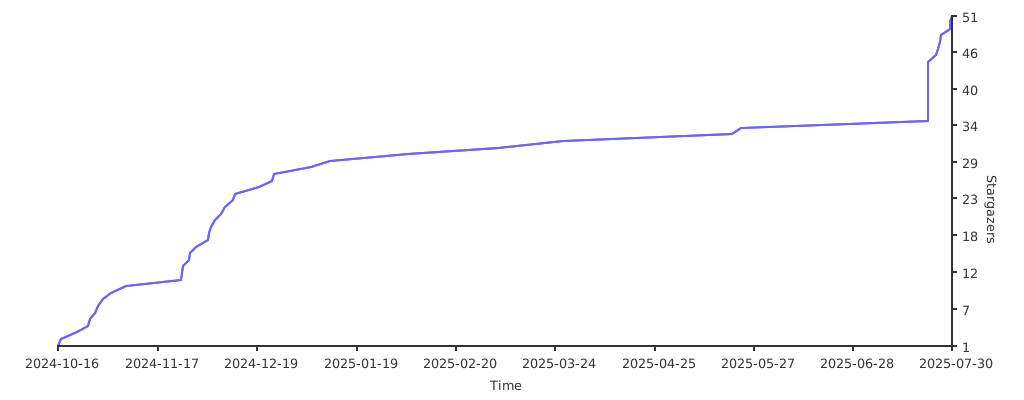
This project is licensed under the MIT License - see the LICENSE file for details. You are free to use, modify, and distribute this code for any purpose, including commercial use.
LLM-Workshop is designed for developers who learn best by building real projects:
- 🚀 Aspiring AI Engineers - Build your first production LLM applications
- 💻 Full-Stack Developers - Add AI capabilities to your existing skills
- 🔬 Research Engineers - Bridge the gap between papers and production code
- 🏗️ System Builders - Learn scalable AI architecture patterns through practice
Learn by doing: Each module takes you from concept to working implementation, building real systems you can deploy and extend.