The deployment agent that ships your code — not a rewrite of it.
Convoy turns "deploy this repo" into a safe, evidence-gated production deployment. It scans your repo, asks five questions once, rehearses the build on an ephemeral twin, authors only the deployment files you need, promotes through canary gates while real signals stay healthy, and auto-rolls back the moment they don't.
Every capability is exposed as an MCP tool so Claude Code — or any MCP client — can plan, apply, approve, and diagnose deployments as part of a larger workflow, while approval gates keep a human in the loop by default.
Built for the Built with Opus 4.7 Claude Code hackathon (April 21–26, 2026).
Meet the problem Convoy was built to solve.
Meridian is a three-service fintech startup: an orders API (Express + Postgres), a PDF report renderer, and a payments worker. Their principal engineer Karan is leaving next week. Production is throwing intermittent 503s on the orders service — a mystery bug that only Karan fully understands. The CTO wants to ship a payment-processing refactor and bring up the new reports service before Karan walks out the door.
Without Convoy, the team is blocked. Every deployment went through Karan: he knew which environment variables were missing on Fly, which services depended on which, what the rollback story was. None of that is written down. The new engineer is afraid to touch prod.
With Convoy, they run one command:
convoy onboard ./meridian-orders   # five questions, three minutes
convoy plan ./meridian-orders --save
convoy apply <plan-id>
Here's what happens in the next 8 minutes:
-
Onboard — Before the first plan, Convoy asks five questions: platform mandate (Fly), approvers (CTO's GitHub handle), canary strategy, compliance requirements, secrets manager. Answers go to
.convoy/preferences.json. Every subsequent plan for this repo inherits them. The CTO's handle means Convoy will pause at every gate until he approves. -
Scan — Convoy reads the repo. It finds the Express app, the Prisma schema, the BullMQ worker, the
.env.examplewithDATABASE_URLandSTRIPE_SECRET_KEY. It detects the health endpoint at/health. No config, no annotation — it reads the evidence. -
Pick — Fly.io scores highest (+25 for the worker topology, +15 for the Dockerfile). The platform decision is inspectable: a score table with the delta for each signal, so the team can disagree and override with
--platform=railwayif they want. Becauseonboarddeclared a Fly mandate, Fly wins outright. -
Rehearse — Before a single line of config is committed, Convoy spawns the orders service locally, hits it with 60 synthetic requests, and scrapes the metrics. This is where it catches the bug: p99 of 8,740ms. Zero errors — all requests succeeded — but every user waited 8 seconds. The medic agent (Claude Opus 4.7) reads the logs and reports: "I found a global
renderLockinsrc/routes/render.tsthat serialises all PDF requests through a single promise chain. Replace it with a semaphore." The pipeline stops. Nobody approved anything. Nobody got paged at 2am. -
Fix and resume — the new engineer fixes the lock. They run
convoy resume. Convoy carries the uncommitted fix onto the convoy branch as afix:commit — the medic's diagnosis is the commit subject — and the fix lands in the same PR as the deploy plumbing. Main only sees it at merge time, after rehearsal proved it works. -
Author gate — Convoy pauses. The approval card shows rehearsal evidence: p99, error rate, smoke tests. The CTO approves from evidence. Convoy opens the PR with the Dockerfile,
fly.toml, CI workflow, and.env.schema. -
Secrets gate — Before the deploy command runs, Convoy diffs the expected vars against what Fly has staged.
STRIPE_SECRET_KEYis missing. It pauses — not fails, pauses — surfaces the key in the web UI, and lets the operator paste the value inline. Convoy pushes it to Fly viafly secrets setand proceeds. -
Canary — Convoy deploys to one machine at 5% traffic, compares the p99 delta (+3ms), declares healthy, and promotes.
-
Observe — 120 seconds of post-deploy monitoring. SLO healthy. Done.
Total time: 8 minutes. Total tribal knowledge required: zero. The plan page is the handoff document: what was scanned, what was scored, what rehearsal found, what secrets were staged.
Karan can leave. The team can ship.
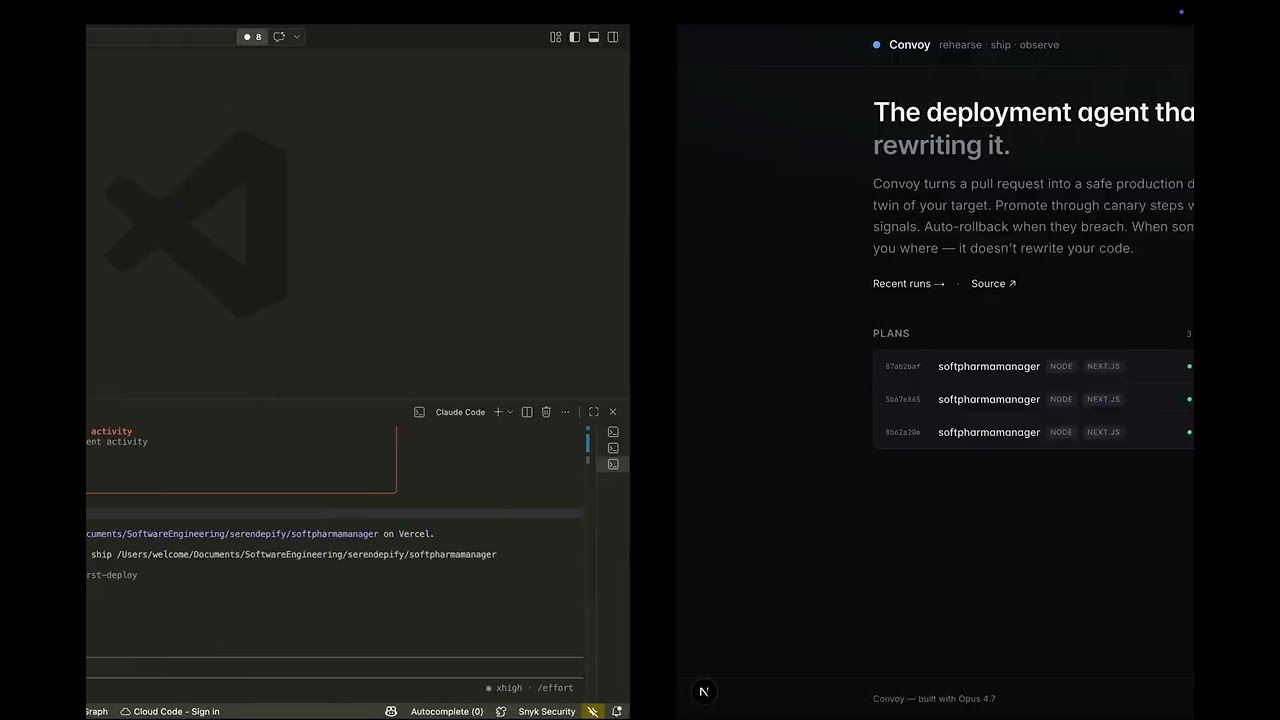
A walkthrough of the real pipeline — plan, rehearse, medic agent, canary, observe — recorded against the actual product. ▶ Watch on YouTube
curl -fsSL https://raw.githubusercontent.com/teckedd-code2save/convoy/main/scripts/get | bashThis puts Convoy in ~/.convoy/app and runs the full setup: npm dependencies (root, web/, demo-app/), .env creation with an interactive Anthropic API key prompt, shell helpers (convoy, convoy-ship-here), and Claude Code plugin + MCP registration. Re-running it updates in place. Idempotent.
git clone https://github.com/teckedd-code2save/convoy.git
cd convoy
./scripts/install
Same setup, your choice of location. Either way, finish with:
source ~/.zshrc      # or ~/.bashrc / config.fish
# restart Claude Code so it picks up the plugin + MCP serverConvoy's MCP server speaks Streamable HTTP. If a teammate or CI box is already running Convoy, point your Claude Code at it:
# on the host
npm run mcp-http                      # serves http://localhost:3738/mcp

# on your machine
claude mcp add convoy --transport http http://that-host:3738/mcp
State is SQLite on the host, so multiple clients can interleave tool calls safely.
onboard → orient → scan → pick → rehearse → author → canary → promote → observe
                                                 │                           │
                                                 └─ medic (any breach)       └─ learn (every run)
                                                                                      │
                                                          memory ←───────────────────┘
                                                             │
                                                         enricher (next plan)
| Stage | What it does |
|---|---|
| onboard | Five-question first-contact interview. Captures platform mandate, approvers, canary strategy, compliance, and secrets manager. Stored to .convoy/preferences.json. Runs once per repo; every subsequent plan inherits it. |
| orient | Per-run drift detector. Reads fly.toml, vercel.json, CI workflows, secrets-manager packages, and observability deps — then compares them against saved preferences. Surfaces any mismatch explicitly before planning; never re-scores silently. |
| scan | Live repo scan. Builds a coordinated service graph with infra, backend, worker, and frontend lanes — each with its own ecosystem, topology, data layer, health path, and secrets hints. 12 ecosystems, monorepo-aware. |
| pick | Scores all five platforms (Fly.io, Railway, Vercel, Cloud Run, VPS) per lane against real evidence. Respects --platform=X, existing platform config, and any mandate declared in onboard. |
| rehearse | Spawns the target in an env-scrubbed shell — real install, real build, real boot, synthetic load against real probe paths, metrics scraped, logs captured. Runs before author: no PR opens until the service has proven it boots healthy. |
| author | Pauses for open_pr approval with rehearsal evidence on-screen, then drafts only the files Convoy owns (Dockerfile, platform manifest, .env.schema, CI workflow, provenance record) and opens a real GitHub PR. |
| canary | Health-gated incremental rollout (one machine → rest on Fly). Halts on error-rate or p99 breach. |
| promote | Configurable bake window between deploy and full promote. |
| observe | Post-deploy watch window. SLO-healthy = release stays. Breach = auto-rollback. |
| medic | Sidecar to any breach. An Opus 4.7 tool-use loop — up to six turns, four scoped tools (read_log_tail, read_file, grep_repo, finalize_diagnosis). Produces a structured root-cause card; never patches your code. |
| learn | Post-run Opus pass (fire-and-forget). Reads the last 40 run events, extracts a lesson, writes confidence-weighted facts and reusable skill docs to the memory store. Never blocks the pipeline — a failed learn call is silently discarded. |
Plan supersede lineage. Re-planning the same target marks the old plan superseded. convoy plans shows active / superseded → <id>. The web UI dims old plans so the operator always works from the current one.
Fix-and-resume. When the medic classifies a failure as owned=developer, the run pauses with awaiting_fix. Fix the code (or let Claude Code fix it), then convoy resume. The fix lands on the convoy branch as a fix: commit whose subject is the medic's diagnosis, and rides into the same PR as the deploy plumbing.
Run this once before the first plan for any repo. Convoy walks you through five sections — deployment style, platform, release process, secrets and compliance, observability — and writes .convoy/preferences.json. Subsequent plans inherit everything without asking again.
convoy onboard ./my-app
# or, non-interactively:
convoy onboard ./my-app --answers='{"platformMandate":"fly","approvers":["alice"]}'
The interview captures:
- Platform mandate — lock to
fly,vercel,railway,cloudrun, orvps; or leave open for Convoy to score - Approvers — GitHub usernames; gates pause until they approve (empty = auto-approve when rehearsal is clean)
- Canary strategy —
skip,canary, orbluegreen; bake window in seconds - Compliance —
soc2,hipaa,pci,gdpr; triggers forced manual approval and audit logging - Secrets manager —
platform-native,doppler,infisical,vault,aws-sm, orenv-file
Re-run convoy onboard ./my-app any time to update a single setting.
Run this before planning a repo that's been active for a while, or when you want to understand what signals Convoy will read.
convoy orient ./my-appOrient reads fly.toml, vercel.json, railway.json, CI workflows (deploy steps + secrets references), secrets-manager packages in package.json, and observability deps. It then diffs what it found against .convoy/preferences.json:
✓  Existing platform: fly  (fly.toml)
✓  CI deploy target: fly   (.github/workflows/deploy.yml — fly deploy)
⚠  Drift: vercel.json found but preferences declare mandate=fly
   → Run `convoy onboard --platform=fly` to update, or remove vercel.json
Drift is surfaced explicitly before any plan is created. Convoy never re-scores around a mismatch and calls it "fine."
| Platform | Deploy | Rollback | Key signal |
|---|---|---|---|
| Fly.io | Real, via flyctl |
Real, proven end-to-end | Health-gated canary; auto-creates the app on first run |
| Vercel | Real, via vercel CLI |
Best-effort alias to prior preview | Preview deploy + promote |
| VPS | Real — GHCR image + Docker + Caddy over SSH | Re-point to prior image tag | convoy vps bootstrap <host> turns a fresh box into a target |
| Railway | Connection probe + secret staging real; deploy runner v2 | — | Scales-to-zero workers |
| Cloud Run | Connection probe + secret staging real; deploy runner v2 | — | Serverless containers |
When --vps-manage-caddy is set, Convoy resolves your domain against the VPS IP before pushing any image. If the A record is wrong or missing, it tells you exactly what to add:
⚠  DNS preflight failed for api.example.com
   Resolved: 203.0.113.50  →  expected: 198.51.100.12 (your-vps.host)
   Add an A record:  api.example.com.  A  198.51.100.12
   Re-run after DNS propagates (~5 min for most registrars).
convoy vps bootstrap user@host SSHes into a fresh Debian or RHEL box, probes for Docker and Caddy, and installs anything missing — idempotently. It presents the exact commands before running them and requires --yes before touching the box. Also exposed as the convoy_vps_bootstrap MCP tool.
convoy vps bootstrap deploy@198.51.100.12 --yes
# → installs Docker CE, Caddy v2, creates /srv deploy root
Every platform adapter implements the same interface — deploy, rollback, readLogs, healthCheck — plus read-only connection probes that surface missing CLIs, auth problems, and secrets gaps before any state change, each with the exact remedy command.
Convoy integrates with Infisical, Doppler, and Vault as first-class secrets managers. When a manager is detected (from onboard preferences or package deps), stage-secrets leads with a pull offer before asking you to paste values manually.
convoy secrets pull --manager=infisical          # fetch all expected keys
convoy secrets pull --manager=doppler --key=STRIPE_SECRET_KEY   # single key
convoy secrets push --key=DATABASE_URL --value=... # push a staged value back
Pull authenticates and fetches in one shot — Infisical uses universal auth (client-id + client-secret → ephemeral token, nothing persisted), Doppler calls the CLI, Vault calls vault kv get. Secret values are never printed to stdout; Convoy logs key names and counts only.
The stage-secrets gate in the apply pipeline can use convoy secrets pull automatically when credentials are on hand, then diff the fetched set against the .env.schema expected vars and surface only the gaps.
convoy onboard <path>                  # first-contact interview (do this first)
convoy orient <path>                   # drift check before re-planning
convoy plan <path> --save --open       # plan + open in the web viewer
convoy plans                           # list plans (active / superseded → <id>)
convoy apply <plan-id> --open          # run the pipeline, watch live
convoy resume                          # continue after a fix
convoy ship <path>                     # plan + save + apply in one shot
convoy status [run-id]                 # auto-spawns the viewer, prints the live URL
convoy vps bootstrap <host> --yes      # provision a fresh VPS
convoy secrets pull --manager=doppler # fetch secrets before stagingcd web && npm run dev # http://localhost:3737The viewer shares one SQLite state file with the CLI and MCP server. Every plan and run gets a URL, approvals you click in the UI unpause the pipeline within ~400ms, old (superseded) plans are visually dimmed, and the projects dashboard tracks every repo you've shipped.
| Tool | What it does |
|---|---|
convoy_plan |
Scan a repo (path or GitHub URL), produce a saved deployment plan |
convoy_list_plans |
List saved plans, including active / superseded status |
convoy_apply |
Run the pipeline against a plan |
convoy_status |
Follow a run; see stage progress and pending approval gates |
convoy_approve |
Approve or reject a gate without leaving the session |
convoy_diagnose |
Read the medic's structured root-cause card for a failed run |
convoy_list_runs |
Run history |
convoy_vps_bootstrap |
Turn a fresh VPS into a deploy target (Docker + Caddy) |
The bundled Claude Code plugin registers these commands:
| Command | What it does |
|---|---|
/convoy:onboard [path] |
Run the onboard interview for a repo — do this before the first ship |
/convoy:orient [path] |
Drift check: compare repo artifacts against saved preferences |
/convoy:ship <target> |
Plan + apply end-to-end, approvals at each gate |
/convoy:ship-status |
Status of the most recent (or a specific) run |
/convoy:ship-resume |
Re-apply after you've fixed the code |
/convoy:ship-rollback |
Roll a service back to its previous healthy release |
/convoy:help |
List all commands |
When rehearsal, canary, or observe breaches tolerance, Convoy hands the failure to an Opus 4.7 tool-use loop with four scoped tools: read_log_tail, read_file, grep_repo, finalize_diagnosis. Up to six turns. The agent decides what to read, forms hypotheses, verifies them, and finalizes on its own. Path traversal is refused at the tool boundary — it literally cannot read outside the repo root.
▸ rehearse
  · phase=synthetic_load.breach p99_ms=494 error_rate_pct=6.67
  · phase=medic.invoked
  ◇ medic read_log_tail n=50
  ◇ medic grep_repo /orders_query_timeout|deadline/
  ◇ medic read_file src/routes/orders.ts
  ◇ medic finalize_diagnosis
  ! rootCause=orders.ts has a DEMO_MODE=buggy branch that
    sleeps 800ms before every query  classification=code
    confidence=high  owned=developer
That's real output from convoy apply --inject-failure=rehearse. The verdict is a structured card — rootCause, classification (code / config / infra), confidence, owned (developer / convoy) — and every tool call streams live to the CLI and the web viewer's medic spotlight.
What the medic never does is patch your code. owned=developer pauses the run for a human (or your Claude Code session) to push the fix. The whole loop is ~450 lines in src/core/medic.ts, no framework.
convoy/
├── src/
│   ├── core/               Orchestrator, stages, medic agent, rehearsal +
│   │                       GitHub runners, SQLite state, key resolver (BYOK)
│   ├── planner/            Scanner (service graph), per-lane picker, enricher
│   ├── onboard/            Interview runner, preferences schema, drift engine
│   ├── orient/             Artifact reader, signal collector, drift detector
│   ├── adapters/           fly/ vercel/ railway/ cloudrun/ vps/ — one interface
│   ├── mcp/                MCP server: stdio (index.ts) + HTTP (http.ts) transports
│   └── cli.ts              commander entrypoint
├── plugin/                 Claude Code plugin — slash commands, agents, .mcp.json
├── scripts/                get (curl installer) · install (full setup) · mcp-server
├── web/                    Next.js 15 + Tailwind 4 viewer, port 3737 — projects
│                           dashboard, run timelines, approvals, medic spotlight
├── demo-app/               Breakable Express service (DEMO_MODE=buggy flips a bug)
└── docs/                   architecture.md · principles.md · rollback-proof.md
Four layers, each with a clear responsibility:
- TypeScript core (
src/) — deterministic. Scanner, picker, author, orchestrator, medic scaffolding, and all platform adapters run without AI. The enricher, medic, and learn pass are opt-in AI passes layered on top. - Agent memory (
src/core/memory.ts,src/core/learn.ts) — three-tier store in the same SQLite DB: semantic facts (persistent key/value about a repo), episodic outcomes (one compressed record per run), and procedural skills (reusable deployment patterns). After every run the learn pass extracts a lesson and writes to memory. Before every plan the enricher loads a context summary so Opus drafts with prior history. No weight mutation — learning is prompt augmentation. - Opus 4.7 enricher + medic + learn — non-deterministic, upgrades quality. The enricher tailors Dockerfiles and writes first-person plan narratives (loaded with prior context on repeat deploys). The medic runs a scoped tool-use loop on any breach. The learn pass closes the feedback loop. All three degrade gracefully when
ANTHROPIC_API_KEYis absent. - Next.js 15 viewer (
web/) — reads the same SQLite DB the CLI and MCP server write. Approval clicks write back via server actions. Nothing in the viewer has a separate state store.
Memory data flow:
convoy plan ./app
  └─ ConvoyMemory.buildContextSummary('./app')
       ├─ facts:    "preferred_platform: fly [95%]"
       ├─ outcomes: "[succeeded] fly @ observe · p99=142ms → migration ran cleanly"
       └─ skills:   "Express + Prisma on Fly: run migrate deploy as release command"
           │
           └─► injected into enricher system prompt → Opus plans with history
                                                            │
convoy apply <plan>
  └─ run completes → orchestrator.#triggerLearn()
       └─ Opus reads 40 events → extracts lesson + facts + skills
            └─► memory.recordOutcome() + memory.setFact() + memory.saveSkill()
                   └─► available to next convoy plan
Three ways to supply an Anthropic API key, in priority order:
.convoy/byok.jsonin the target project (gitignored, auto-loaded):ANTHROPIC_API_KEY/CONVOY_ANTHROPIC_API_KEYenv vars (whatscripts/installsets up).- Nothing — every AI pass degrades gracefully to deterministic output. Useful for CI.
Plan enrichment runs on Sonnet 4.6 with prompt caching; the medic agent runs on Opus 4.7.
# First contact
convoy onboard <path> # five-question interview, writes preferences.json
convoy orient <path> # drift check: artifacts vs preferences
# Planning
convoy plan <path-or-url> # local path, GitHub URL, or owner/repo
convoy plan <path> --save --open # persist + open in the web viewer
convoy plan <path> --platform=vps # fly | railway | vercel | cloudrun | vps
convoy plan <path> --workspace=apps/web # monorepo subpath
convoy plan <path> --no-ai # skip enrichment
# Applying
convoy plans # list saved plans (active / superseded → <id>)
convoy apply <plan-id> --open # run + watch live
convoy apply <plan-id> -y # unattended (--auto-approve)
convoy apply <plan-id> --demo # fully scripted, zero credentials
convoy apply <plan-id> --inject-failure=rehearse # watch the medic work
# Secrets
convoy secrets pull --manager=infisical
convoy secrets pull --manager=doppler --key=STRIPE_SECRET_KEY
convoy secrets push --key=KEY --value=VALUE
# VPS
convoy vps bootstrap <host> --yes
convoy apply <plan-id> --vps-host=<host> --vps-ghcr-image=ghcr.io/you/app
# Real GitHub PR + rehearsal + Fly deploy
convoy apply <plan-id> \
--real-author --auto-merge \
--real-rehearsal --probe-path=/orders \
--real-fly --fly-app=my-app --fly-create-app --fly-bake-window=120
# Resume after a fix
convoy resume # continue the most recent paused/failed run
convoy resume <run-id> --fresh # replay from scratch instead
# End-to-end
convoy ship <path-or-url> # plan + save + apply in one shot
convoy status [run-id] # auto-spawns the viewer, prints the live URLEnvironment variables: ANTHROPIC_API_KEY, CONVOY_WEB_URL (default http://localhost:3737), CONVOY_STATE_PATH (default .convoy/state.db), CONVOY_PLANS_DIR (default .convoy/plans), CONVOY_MCP_PORT (default 3738), CONVOY_VPS_HOST.
All optional. Convoy preflights each one and fails loud with the exact remedy.
gh auth login # GitHub — real PRs (repo + workflow scopes)
fly auth login # Fly.io (brew install flyctl)
vercel login # Vercel (npm i -g vercel)
# VPS — SSH access only; convoy vps bootstrap installs the restPer target repo: a github.com remote you can push to (for real PRs), and service secrets in <target>/.env.convoy-secrets (gitignored, staged via the platform CLI, never committed).
npm test
npm run typecheck
(cd web && npm run typecheck)
(cd demo-app && npx tsc --noEmit)1. We ship your code. We do not rewrite your code.
Convoy authors only deployment-surface files: Dockerfile, platform manifest, CI workflow, .env.schema. Everything in src/, app/, lib/, tests/ is off-limits, enforced by the provenance manifest, the filesystem containment check, and the medic's system prompt.
2. Every forward action has a pre-staged reverse. No step runs without a named, measured rollback path. Canary → rollback on breach. Promote → re-point. Observe → auto-rollback. The plan page lists the rollback story for every stage before the pipeline starts.
3. Evidence over assertion. Health is proven with independent signals — real probes, real metrics — not the platform API's return code. The score table is inspectable. The medic's diagnosis cites the exact file and line. Every gate decision is logged with the evidence that triggered it.
See docs/principles.md for the rationale and docs/architecture.md for the full design.
MIT.
{ "provider": "infisical" }         // universal-auth → fetches the key from your vault
{ "provider": "direct", "apiKey": "sk-ant-..." }   // local dev