


Conversational voice agents with non-blocking background execution. (No other framework does this out of the box.)
Most voice agent frameworks block conversation while tools execute. User says "generate me a video" and the agent goes silent for two minutes. Bodhi splits the work: main agents handle the live conversation (Gemini Live API by default, OpenAI Realtime also supported), while background subagents (Vercel AI SDK) run long tasks in parallel. When a task finishes, the agent naturally announces it.
User: "Make me a video of a sunset AND search for weather in Tokyo"

Main Agent (Gemini/OpenAI Live — realtime voice):
  "I'm generating your video and looking up the weather..."
  │
  ├─ Subagent 1: Video generation (2 min, Veo API)
  ├─ Subagent 2: Web search (3 sec, Gemini)
  │
  "What else can I help with?"      ← keeps talking
  │
  [3s]  "The weather in Tokyo is..."  ← search result arrives
  [2m]  "Your video is ready!"        ← video arrives
Click to watch the demo
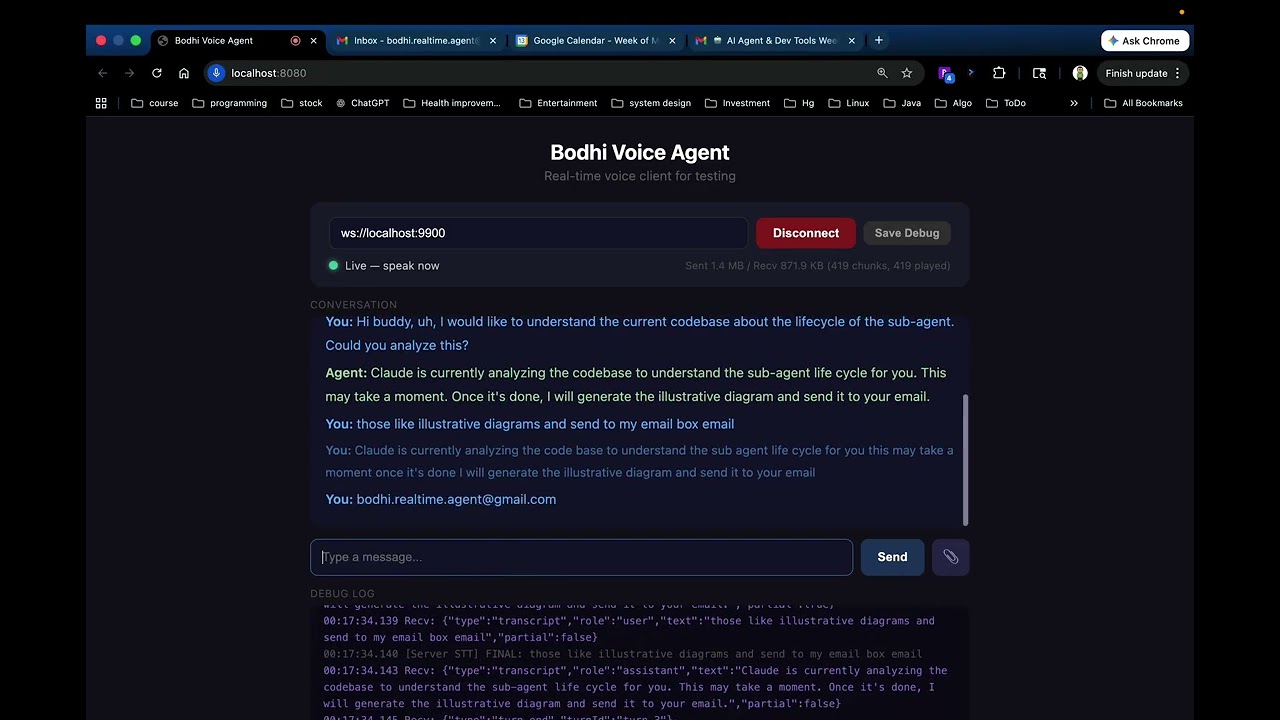
Speak coding requests naturally — Claude Code reads, edits, creates files, runs commands, and searches your codebase in the background while you keep talking. See examples/claude_code for setup.
Click to watch the demo
The OpenClaw demo shows a voice assistant backed by an interactive background subagent. Say "write a Python prime checker" or "summarize today's tech news by email" — the request is delegated to OpenClaw which can code, browse the web, send emails, and more. If it needs clarification, it asks the user via voice mid-task. See examples/openclaw for setup.
- Background subagents: Mark any tool as
execution: 'background'— it hands off to a Vercel AI SDK subagent with its own tool-use loop (maxSteps), running in parallel while the voice agent continues the conversation. Subagents can be interactive — asking the user follow-up questions via voice mid-task - Real-time voice: Bidirectional audio streaming via Gemini Live API (default) or OpenAI Realtime API, with server-side VAD and turn detection
- Multi-agent transfers: Define specialist agents with distinct personas and tools; transfer mid-conversation with context replay and audio buffering
- Inline + background tools:
inlinetools block the turn (fast lookups);backgroundtools run async (image/video generation, data analysis) - Behaviors: Declarative presets for speech speed, verbosity, language — auto-generates tools, manages state, syncs with client
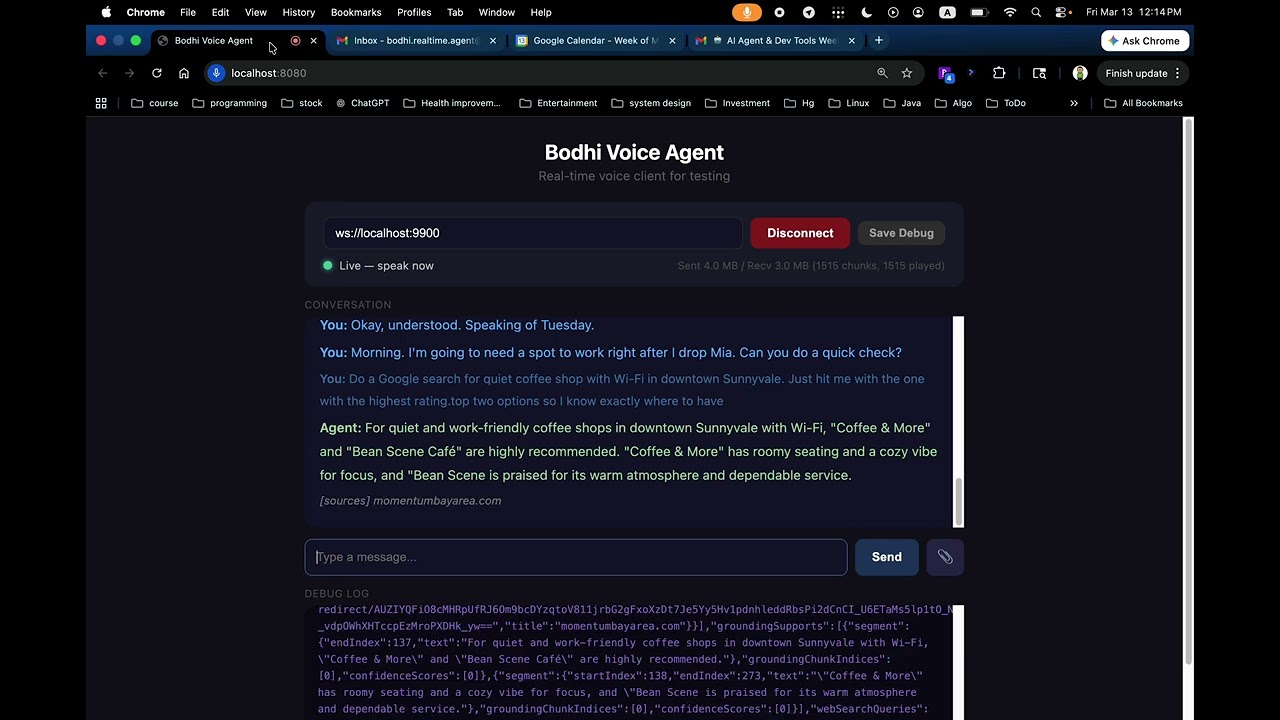
- Google Search: Built-in grounded web search via Gemini with source citations
- Image & video generation: Generate media with Gemini/Veo and push to the client in real time
- Memory: LLM-powered fact extraction and persistence across sessions with pluggable storage
- Session resumption: Transparent reconnection via Gemini resumption handles and audio buffering
- Observability: Type-safe EventBus and lifecycle hooks for logging, metrics, and debugging
- Zero infrastructure. No LiveKit server, no media SFU, no platform subscription. Just your Node.js server talking directly to Gemini (or OpenAI) over WebSocket.
| Bodhi | LiveKit Agents | Pipecat | OpenAI Realtime Agents | ElevenLabs | |
|---|---|---|---|---|---|
| Parallel background subagents | Yes — built-in, each with own tool loop | No — manual async | No — manual frame injection | No — tools block | No |
| Voice keeps talking during tools | Yes — execution: 'background' |
No | No | No | No |
| Zero infrastructure | Yes — direct to Gemini/OpenAI | No — requires LiveKit SFU | No — requires transport | Yes — but browser-only | No — hosted platform |
| Server-side tool execution | Yes | Yes | Yes | No — browser sandbox | Yes — via webhooks |
| Multi-agent transfers | Yes — with context replay | Yes — updateAgent() |
Manual | Yes — declarative handoffs | Yes — visual editor |
| Provider support | Gemini Live, OpenAI Realtime | OpenAI, Gemini, XAI | 60+ services | OpenAI only | Multiple LLMs |
| Memory / fact extraction | Built-in | No | No | No | Platform-managed |
| Language | TypeScript | TypeScript / Python | Python | TypeScript | REST API |
- You're building a single-user voice assistant that needs to do real work in the background (coding, research, data analysis, media generation) while staying conversational
- You want zero infrastructure — no media servers, no platform subscriptions, just a Node.js process and an API key
- You need interactive background tasks — subagents that can ask the user follow-up questions mid-task via voice
- You're comfortable with TypeScript and want full control over your agent logic
- Multi-participant rooms (meetings, group calls) — use LiveKit Agents
- Provider flexibility (swap between 60+ STT/TTS/LLM services) — use Pipecat
- Browser-only agents (no server) — use OpenAI Realtime Agents
- No-code / visual builder — use ElevenLabs
- Node.js >= 22
- A Google API key for Gemini Live API (default), or an OpenAI API key for Realtime API
- pnpm (recommended)
pnpm add bodhi-realtime-agentimport { createGoogleGenerativeAI } from '@ai-sdk/google';
import { z } from 'zod';
import { VoiceSession } from 'bodhi-realtime-agent';
import type { MainAgent, ToolDefinition } from 'bodhi-realtime-agent';
// 1. Define tools
const getCurrentTime: ToolDefinition = {
name: 'get_current_time',
description: 'Get the current date and time.',
parameters: z.object({
timezone: z.string().optional().describe('Timezone name'),
}),
execution: 'inline',
execute: async (args) => {
const { timezone } = args as { timezone?: string };
const now = new Date();
return {
time: now.toLocaleString('en-US', {
timeZone: timezone ?? undefined,
dateStyle: 'full',
timeStyle: 'long',
}),
};
},
};
// 2. Define agents
const mainAgent: MainAgent = {
name: 'main',
instructions: 'You are a helpful voice assistant.',
tools: [getCurrentTime],
};
// 3. Create and start a session
const session = new VoiceSession({
sessionId: `session_${Date.now()}`,
userId: 'user_1',
apiKey: process.env.GOOGLE_API_KEY!,
agents: [mainAgent],
initialAgent: 'main',
port: 9900,
model: createGoogleGenerativeAI({ apiKey: process.env.GOOGLE_API_KEY! })('gemini-2.5-flash'),
});
await session.start();
// Connect a WebSocket audio client to ws://localhost:9900The top-level integration hub. It wires together all framework components and manages the full session lifecycle:
Client App  <--WebSocket-->  ClientTransport  <--audio-->  GeminiLiveTransport  <--WebSocket-->  Gemini Live API
                                    |                              |
                                    +--------- VoiceSession -------+
                                    |    (audio fast-path relay)    |
                                    |                              |
                              AgentRouter    ToolExecutor    ConversationContext
Audio flows on a fast-path directly between the client and Gemini transports, bypassing the EventBus for minimal latency.
Agents are the top-level personas that Gemini assumes. Each agent has its own system instructions and tool set.
const mainAgent: MainAgent = {
  name: 'main',
  instructions: 'You are a helpful assistant.',
  tools: [myTool],
  onEnter: async (ctx) => { /* agent activated */ },
  onExit: async (ctx) => { /* agent deactivated */ },
  onTurnCompleted: async (ctx, transcript) => { /* turn finished */ },
};
Agent transfers are triggered by a special transfer_to_agent tool. The framework intercepts this tool call automatically, disconnects from Gemini, reconnects with the new agent's config, and replays conversation context:
const transferToExpert: ToolDefinition = {
  name: 'transfer_to_agent',
  description: 'Transfer to the expert agent.',
  parameters: z.object({
    agent_name: z.literal('expert'),
  }),
  execution: 'inline',
  execute: async () => ({ status: 'transferred' }),
};
Tools are declared with a Zod schema (for both Gemini declaration and runtime validation) and an execution mode:
| Mode | Behavior |
|---|---|
inline |
Gemini waits for the result before continuing to speak |
background |
Handed off to a subagent; Gemini continues speaking while it runs |
const myTool: ToolDefinition = {
  name: 'lookup',
  description: 'Look up information.',
  parameters: z.object({ query: z.string() }),
  execution: 'inline', // or 'background'
  timeout: 10_000,      // optional, default 30s
  execute: async (args, ctx) => {
    // ctx.abortSignal is triggered on cancellation/timeout
    return { answer: '42' };
  },
};Sessions follow a strict state machine:
CREATED --> CONNECTING --> ACTIVE --> RECONNECTING --> ACTIVE
                            |                           |
                        TRANSFERRING --> ACTIVE       CLOSED
                            |
                          CLOSED
- RECONNECTING: Triggered by GoAway signals or unexpected disconnects. Audio is buffered and replayed.
- TRANSFERRING: Active during agent transfers. Client audio is buffered until the new agent is connected.
A type-safe, synchronous event bus for loose coupling between components:
session.eventBus.subscribe('agent.transfer', (payload) => {
  console.log(`Transfer: ${payload.fromAgent} -> ${payload.toAgent}`);
});

session.eventBus.subscribe('tool.result', (payload) => {
  console.log(`Tool ${payload.toolName}: ${payload.result}`);
});
Available events: session.start, session.close, session.stateChange, session.goaway, turn.start, turn.end, turn.interrupted, agent.enter, agent.exit, agent.transfer, agent.handoff, tool.call, tool.result, tool.cancel, gui.update, gui.notification.
The client WebSocket carries both audio and GUI events on the same connection using the native binary/text frame distinction:
- Binary frames: Raw PCM audio (16-bit, 16 kHz, mono)
- Text frames: JSON messages for GUI events
Server → Client (text frames):
{ "type": "gui.update",       "payload": { "sessionId": "...", "data": { ... } } }
{ "type": "gui.notification",  "payload": { "sessionId": "...", "message": "..." } }
{ "type": "ui.payload",       "payload": { "type": "choice", "requestId": "...", "data": { ... } } }
Client → Server (text frames):
{ "type": "ui.response", "payload": { "requestId": "...", "selectedOptionId": "..." } }GUI events published on the EventBus (gui.update, gui.notification, subagent.ui.send) are automatically forwarded to the connected client. Client ui.response messages are published back to the EventBus as subagent.ui.response events, closing the loop for interactive subagent UIs.
Lifecycle hooks for observability (logging, metrics, alerting):
const session = new VoiceSession({
  // ...
  hooks: {
    onSessionStart: (e) => console.log(`Session started: ${e.sessionId}`),
    onSessionEnd: (e) => console.log(`Session ended after ${e.durationMs}ms`),
    onToolCall: (e) => console.log(`Tool: ${e.toolName} (${e.execution})`),
    onToolResult: (e) => console.log(`Result: ${e.status} in ${e.durationMs}ms`),
    onAgentTransfer: (e) => console.log(`${e.fromAgent} -> ${e.toAgent}`),
    onError: (e) => console.error(`[${e.component}] ${e.error.message}`),
  },
});The memory system automatically extracts durable facts about the user from conversation:
import { MarkdownMemoryStore, MemoryDistiller } from 'bodhi-realtime-agent';

const memoryStore = new MarkdownMemoryStore('./memory');
const distiller = new MemoryDistiller(
  conversationContext,
  memoryStore,
  hooksManager,
  model,
  { userId: 'user_1', sessionId: 'session_1' },
);

// Triggers extraction every 5 turns
distiller.onTurnEnd();

// Force extraction at checkpoints (agent transfer, session close)
distiller.onCheckpoint();

// Merge duplicate/contradictory facts
await distiller.consolidate();
Facts are persisted as Markdown files (memory/{userId}.md) organized by category:
## Preferences
- Prefers dark mode
- Likes concise answers

## Entities
- Works at Acme Corpsrc/
core/ # Central orchestration
voice-session.ts # Top-level integration hub
session-manager.ts # Session state machine
event-bus.ts # Type-safe event system
conversation-context.ts # Conversation timeline + context
conversation-history-writer.ts # EventBus-driven persistence
hooks.ts # Lifecycle hook manager
session-store.ts # Session checkpoint persistence
errors.ts # Error class hierarchy
agent/ # Agent management
agent-router.ts # Agent transfers and subagent handoffs
agent-context.ts # Runtime context for agent hooks
subagent-runner.ts # Background subagent execution (AI SDK)
tools/ # Tool execution
tool-executor.ts # Zod validation, timeout, cancellation
transport/ # Network layer
gemini-live-transport.ts # Gemini Live API WebSocket
client-transport.ts # Client-facing WebSocket server
audio-buffer.ts # Bounded ring buffer for audio
zod-to-schema.ts # Zod → Gemini JSON Schema converter
memory/ # User memory
markdown-memory-store.ts # File-based memory persistence
memory-distiller.ts # LLM-powered fact extraction
prompts.ts # Extraction/consolidation prompt templates
types/ # TypeScript interfaces and type definitions
test/ # Unit and integration tests (mirrors src/ structure)
examples/ # Usage examples
pnpm install        # Install dependencies
pnpm build          # Build with tsup (ESM + CJS + declarations)
pnpm test           # Run tests with vitest
pnpm test:watch     # Run tests in watch mode
pnpm lint           # Check with Biome
pnpm lint:fix       # Auto-fix lint issues
pnpm typecheck # TypeScript type checking# Hello World — voice pacing, agent transfer, Google Search, image/video generation
GEMINI_API_KEY=your_key pnpm tsx examples/hello_world/agent.ts
# OpenClaw — voice-driven AI agent (coding, research, email, web browsing)
# Requires an OpenClaw gateway running at ws://127.0.0.1:18789
pnpm tsx examples/openclaw/openclaw-demo.tsThen start the web client (pnpm tsx examples/openclaw/web-client.ts) and open http://localhost:8080 in Chrome. See hello_world and openclaw for details.
E2E tests require a Google API key and are skipped by default:
GOOGLE_API_KEY=your_key pnpm test