


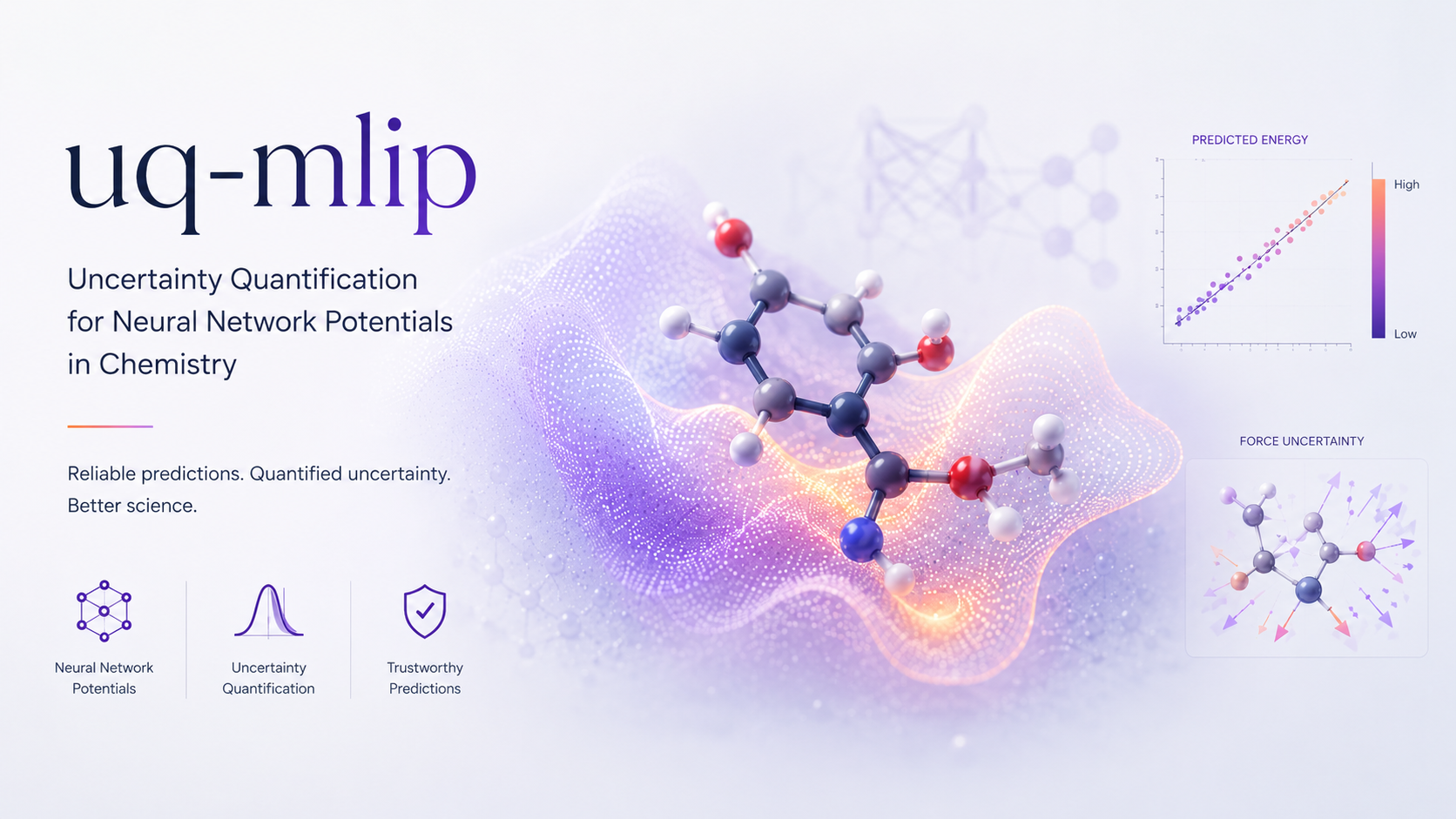
This repository contains code for training and evaluating per-atom uncertainty
quantification for machine learning interatomic potentials (MLIPs). The
recommended interface is the installable uq-mlip package, which provides a
unified command-line and Python API for the same extract, train, and predict
workflow available in the standalone scripts.
New to uncertainty quantification for neural network potentials? Start with the UQ for NNPs primer.
The primer gives a beginner-friendly overview of what uncertainty quantification means for neural network potentials, why per-atom uncertainty is useful, and how the workflow in this repository fits into simulation practice.
uq-mlip implements uncertainty quantification workflows developed through two
peer-reviewed studies in

- Uncertainty quantification for neural network potential foundation models introduces the UQ approach for neural network potential foundation models.
- Assessing universal MLIP robustness with per-atom uncertainty for simulations of solid-liquid interfaces demonstrates per-atom uncertainty as a practical diagnostic for MLIP robustness in challenging interfacial simulations.
MLIP predictions can look stable even when local atomic environments are
outside the model's reliable domain. uq-mlip adds per-atom uncertainty
estimates so simulations can be inspected, filtered, or monitored at the level
where failures often begin.
uq-mlip makes per-atom uncertainty quantification easy to add to MLIP
workflows. The UQ model is specific to the MLIP and dataset, so users should
train a UQ model on validation or representative configurations before using it
in simulations.
MACE and UMA are supported out of the box as default model backends:
git clone https://github.com/pnnl/UQ-MLIP.git
cd UQ-MLIP
git checkout master
pip install -e .
To include a backend in the same environment:
pip install -e ".[mace]"  # for MACE extraction
pip install -e ".[uma]"   # for UMA extraction
MACE and UMA currently depend on incompatible e3nn versions, so use separate
environments if you need to exercise both dependency stacks. After the first
PyPI release, this section will be updated to use pip install uq-mlip.
To automate backend-specific setup:
scripts/create_backend_env.sh mace
scripts/create_backend_env.sh uma
On macOS, XGBoost may also require the OpenMP runtime:
brew install libomp
For UMA on systems where ~/.cache is not writable:
export FAIRCHEM_CACHE_DIR=/path/to/writable/fairchem-cache
Train a UQ model:
uq-mlip extract \
  --backend mace \
  --sample validation.xyz \
  --savedir embeddings/

uq-mlip train \
  --embeddings embeddings/embedding_info_validation.npz \
  --savedir uq-model/
Run the local hello world example to train a small UQ model, predict a synthetic trajectory, and generate a UQ profile visualization:
python examples/hello_world/train_run_visualize.py
To make a tiny complete-frame fixture from a large XYZ/extXYZ trajectory:
python scripts/slice_xyz.py /path/to/large.xyz examples/test_data/my_slice.xyz --frames 8
To smoke-test a real backend in its own environment:
scripts/run_hello_world.sh mace
scripts/run_hello_world.sh uma
You can pass custom train/run slices to the backend smoke test without copying a large trajectory into the repository:
scripts/run_hello_world.sh mace .venv-mace outputs/mace-small \
  examples/test_data/aimd_pbe_train.xyz examples/test_data/aimd_pbe_run.xyz
Use it in existing code with the decorator-style calculator:
from uq_mlip import UQCalculator

atoms.calc = UQCalculator(
    base_calculator=mace_calc,
    uq_model="uq-model/",
    backend="mace",
    model="medium-0b",
)
Or use the convenience helper:
from uq_mlip import with_uq

atoms.calc = with_uq(
    mace_calc,
    uq_model="uq-model/",
    backend="mace",
    model="medium-0b",
)
Energy and force calls continue to behave like the original calculator. After a
calculation, per-atom uncertainty is available as atoms.arrays["uq"],
atoms.arrays["uq_lower"], and atoms.arrays["uq_upper"].
To verify a local checkout:
pip install -e ".[dev]"
python -m pytest
uq-mlip --help
python examples/hello_world/train_run_visualize.py
The commands below expose the same workflow through the original script-level entry points. They remain useful for direct inspection, debugging, and reproducing the paper-era workflow.
To train the GBM model, first extract per-atom embeddings and per-atom energies
from a trained MLIP. The following commands provide methods to extract this
information for MACE and UMA. If using a finetuned checkpoint, the
--checkpoint flag can be used to specify the path to the checkpoint file. The
sample should be in a format readable by ASE and contain configurations from
the validation set used to train or finetune the MLIP.
python run_embeddings_mace.py \
  --sample data/example.xyz \
  --savedir data/embeddings_mace \
  --model-size medium-0b \
  --index ":"
python run_embeddings_uma.py \
  --sample data/example.xyz \
  --savedir data/embeddings_uma \
  --model-size uma-s-1p1 \
  --head 'omat' \
  --index ":"
Once the embeddings and energies have been extracted, the GBM model can be trained using the following command.
python train-gbm.py --embeddings data/embeddings_mace/embedding_info_example.npz \
  --savedir data/gbm_mace \
  --upper-alpha 0.95 \
  --lower-alpha 0.05 \
  --estimators 1000
To compute per-atom uncertainties for a trajectory produced using the MLIP, the per-atom embeddings must be extracted in the same way as described above.
python run_embeddings_mace.py \
  --sample data/md_run.xyz \
  --savedir data/embeddings_mace \
  --model-size medium-0b \
  --index ":"
Then, the following command can be used to compute per-atom uncertainties using the trained GBM model.
python run-gbm.py --embeddings 'data/embeddings/embedding_info_md_run.npz' --savedir 'results/gbm_mace'
If you use this model or code in your research, please cite the following papers:
@article{Bilbrey2025,
  author = {Bilbrey, Jenna A. and Firoz, Jesun S. and Lee, Mal-Soon and Choudhury, Sutanay},
  title = {Uncertainty quantification for neural network potential foundation models},
  journal = {npj Computational Materials},
  year = {2025},
  volume = {11},
  number = {1},
  pages = {109},
  doi = {10.1038/s41524-025-01572-y},
  url = {https://doi.org/10.1038/s41524-025-01572-y}
}

@article{Bilbrey2026,
  author = {Bilbrey, Jenna A. and Firoz, Jesun S. and Allec, Sarah I. and Sprueill, Henry W. and von Rueden, Alexander D. and Jackson, Benjamin A. and Raugei, Simone and Lee, Mal-Soon and Choudhury, Sutanay},
  title = {Assessing universal MLIP robustness with per-atom uncertainty for simulations of solid-liquid interfaces},
  journal = {npj Computational Materials},
  year = {2026},
  doi = {10.1038/s41524-026-02051-8},
  url = {https://doi.org/10.1038/s41524-026-02051-8}
}The README banner image was generated with ChatGPT.