
The data foundation for modern automation




Infrahub Community | Infrahub Enterprise | Sandbox
Infrahub is the data foundation for modern infrastructure automation, for teams managing networks, data centers, and cloud infrastructure. It moves them from fragmented data and one-off scripts to repeatable, validated workflows — delivering infrastructure as a reliable service to the rest of the business and the AI agents that consume it.
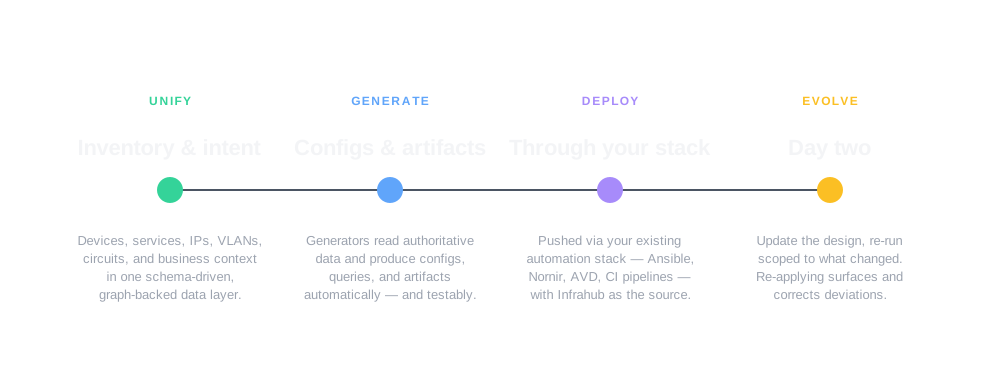
- Schema-first, graph-backed data model. Define your own data models for devices, services, topologies, and business context — enforced with validation and queried with first-class relationships on a Neo4j graph database.
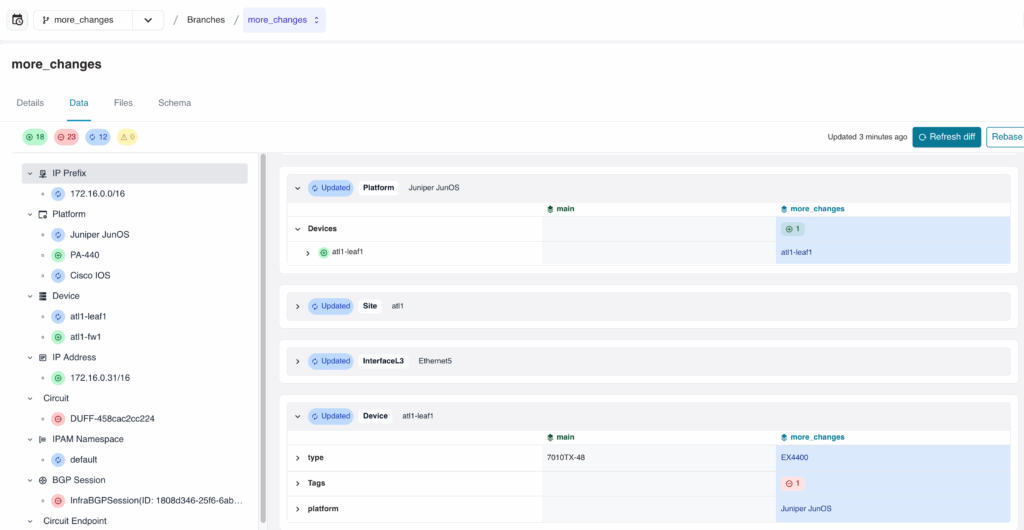
- Version control for data, not just configs. Branches, peer review, and a complete queryable history of who changed what, when, and why — applied to schema, data, and generated artifacts.
- Generators and transforms. Render configurations and other artifacts from Infrahub data using Jinja2 or Python — composable, reusable, and version-controlled alongside the data.
- Built for production. Templates and generators are unit-and-integration testable. Every change moves through branch → CI → review → merge — and idempotent re-runs surface and correct deviations without a full rebuild.
- Integrations and self-service. Connectors for Git, Ansible, and Nornir. Infrahub Sync federates data from Netbox, Nautobot, and IP Fabric. GraphQL, REST, and a web UI back service catalogs so internal teams and customers can self-serve.
- AI-ready by design. An MCP server and Infrahub Skills make Infrahub's validated, relationship-rich data directly usable to Claude, Cursor, and other AI agents.
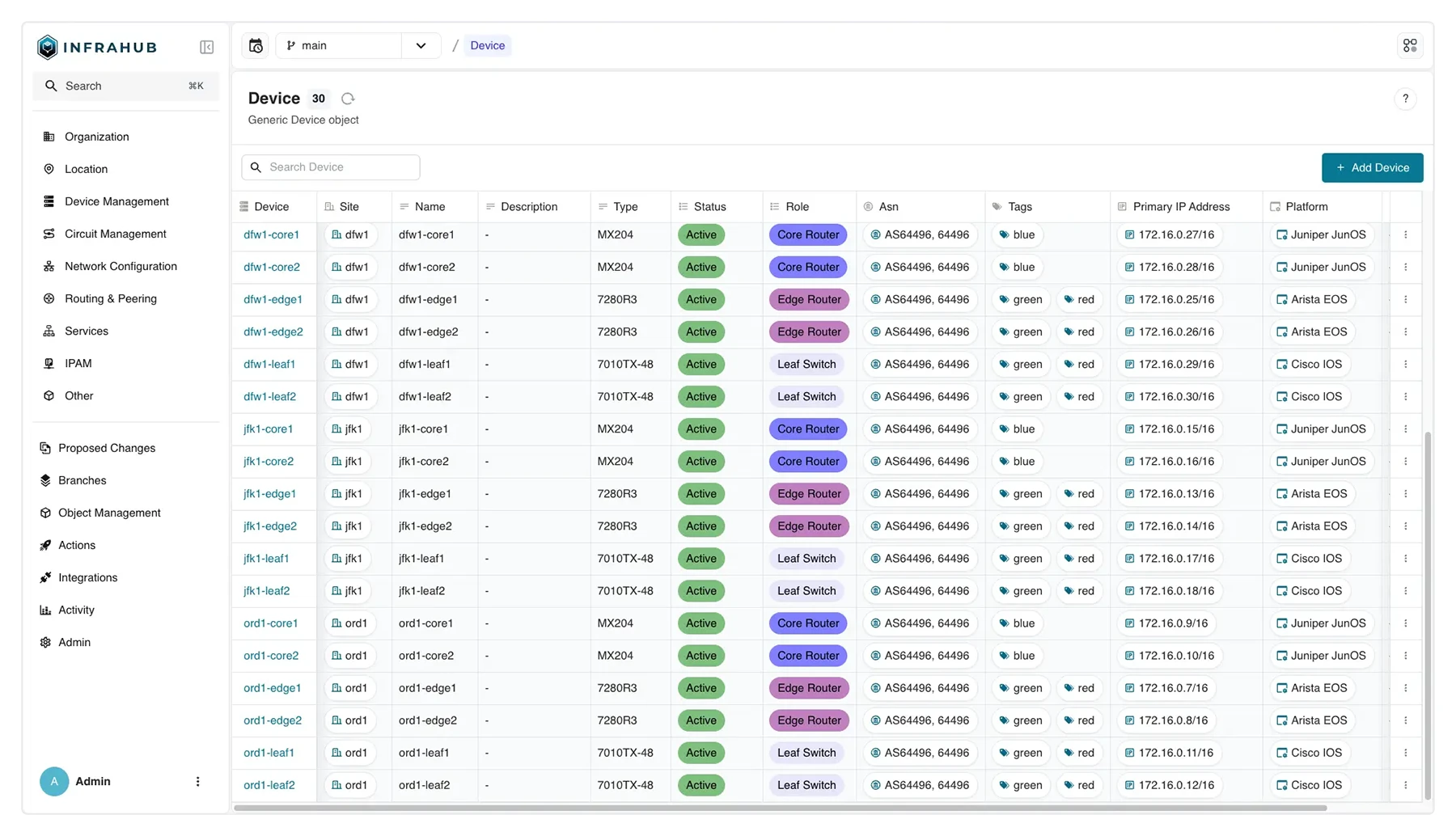
- Unify infrastructure data — one source of truth across devices, services, IPs, VLANs, circuits, and the business context tied to them.
- Automate at scale — generate, validate, and deploy configurations across vendors and sites; support full lifecycle workflows for provisioning, upgrade, and decommission.
- Enable self-service — let app, platform, and ops teams request infrastructure resources through APIs and a UI backed by authoritative data.
- Build an AIOps knowledge graph — model dependencies and relationships across infrastructure to provide the data foundation for AI-driven reasoning, troubleshooting, and predictive operations.
Infrahub is purpose-built for network and infrastructure automation. It combines an extensible schema language, native version control of the data, a graph data store, and open-source foundations — Neo4j, Git, Prefect, GraphQL, and Python — in a single platform. For a side-by-side comparison with common alternatives, see How Infrahub compares.
Three ways to try Infrahub:
- Sandbox — a hosted demo of the Infrahub UI with sample data — explore the interface without installing anything.
- Getting Started Lab — a guided browser tutorial covering branches, schemas, and unified storage.
- Quick Start guide — set up a local Infrahub instance and walk through the basics in your own environment.
For production deployments on Kubernetes, see opsmill/infrahub-helm and the installation guide.
OpsMill maintains a set of officially supported projects that help teams develop with Infrahub, run it in production, and integrate it with the rest of their automation stack.
Develop with Infrahub
| Project | Purpose |
|---|---|
infrahub-sdk-python |
Python SDK and the infrahubctl CLI — build integrations and manage Infrahub from code |
infrahub-vscode |
VS Code extension with schema validation, GraphQL query support, and schema visualization |
schema-library |
Reusable schemas for common infrastructure patterns — a starting point for modeling |
infrahub-mcp |
MCP server exposing Infrahub data to Claude, Cursor, and other AI agents |
infrahub-skills |
AI skills that give coding assistants knowledge of Infrahub conventions and data models |
Run Infrahub in production
| Project | Purpose |
|---|---|
infrahub-helm |
Helm charts for deploying Infrahub on Kubernetes |
infrahub-backup |
Backup and restore CLI for Infrahub instances |
Integrate with your automation stack
| Project | Purpose |
|---|---|
infrahub-ansible |
Ansible Collection — use Infrahub as the source of truth for Ansible playbooks |
nornir-infrahub |
Nornir inventory plugin for Python network automation |
infrahub-sync |
Federate data from Netbox, Nautobot, IP Fabric, and other systems into Infrahub |
The full set of OpsMill projects is at github.com/opsmill.
Infrahub UI
Branching and diff view — every change tracked, comparable, and queryable
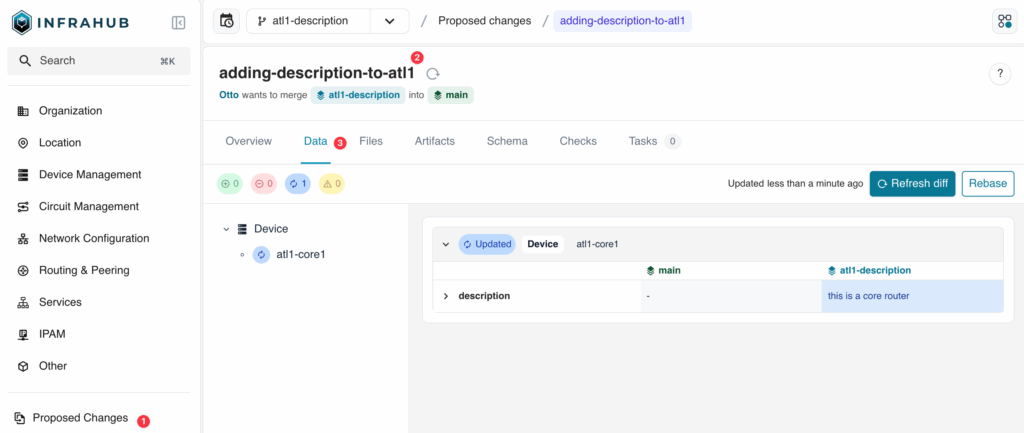
Proposed change — peer review and approve before merge
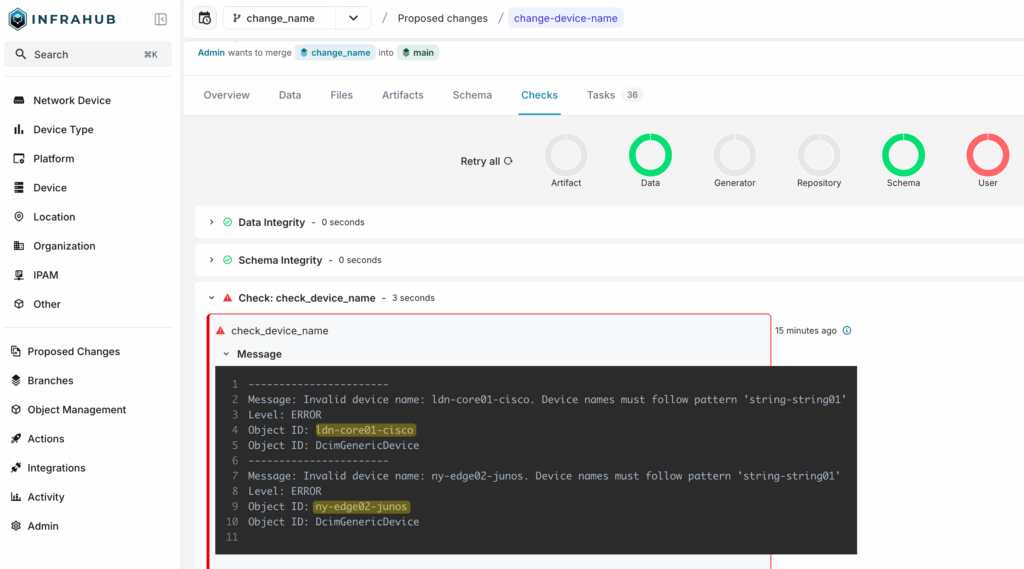
CI checks — validation runs on every proposed change; merge blocked when checks fail
The Infrahub Community edition is open source and free. For deployments that need high availability, advanced RBAC, performance enhancements, and SLA-backed support, Infrahub Enterprise is available.
- Discord — discord.gg/opsmill
- GitHub Issues — github.com/opsmill/infrahub/issues
- Newsletter — Ottermatic
- Blog — opsmill.com/blog
Contributions of all sizes are welcome — bug fixes, schema accelerators, integrations, documentation, and core features. See CONTRIBUTING.md to get started.
See our security policy for supported versions and disclosure procedures.
Infrahub is released under the Apache 2.0 License.