In a staircase problem, you try to calculate the different ways to reach the n'th stair where you can take up to m steps at a time.
This staircase problem is often used as an interview question. Most of these questions are memorization problems, so they are well suited for new hires. For people who have been working for some time, these questions are not that good because they do not show a person's skills during an interview, but we can revisit these problems and use them for thinking and developing our analytical skills.
In practical terms, we use this to generate a collection of all possible ways to achieve an outcome given some fixed unit of measure. If we had 4 as a staircase (n) and this represented the outcome and we had three steps of 1,2, or 3, we would have these seven ways to get there {1,1,1,1},{1,1,2},{1,2,1},{2,1,1},{2,2},{1,3},{3,1}. This idea of sets is where the concept of permutations comes in because this is looking at combinations where the order is distinct in each set. The text I have read refers to this also as ordered arrangements of n elements, such as 19 elements, of a set S such as {1,2,3}, where repetition is allowed and are called n-tuples. In this case, a rule states that 19 is the limit of elements and the maximum sum of the elements. Generally speaking, this may be more applicable to combinatorics
1-2-3 steps at a time given a number of steps in a staircase.
I designed two iterative functions I came up with by looking at a spreadsheet.
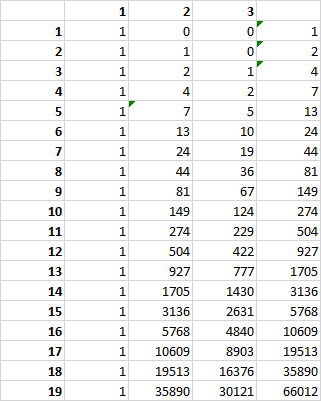
I made the spreadhseet to help me look for patterns.
My spreadsheet analysis showed me two iterative methods I could use.
I coded them up in JavaScript. This is a screenshot from the browser.
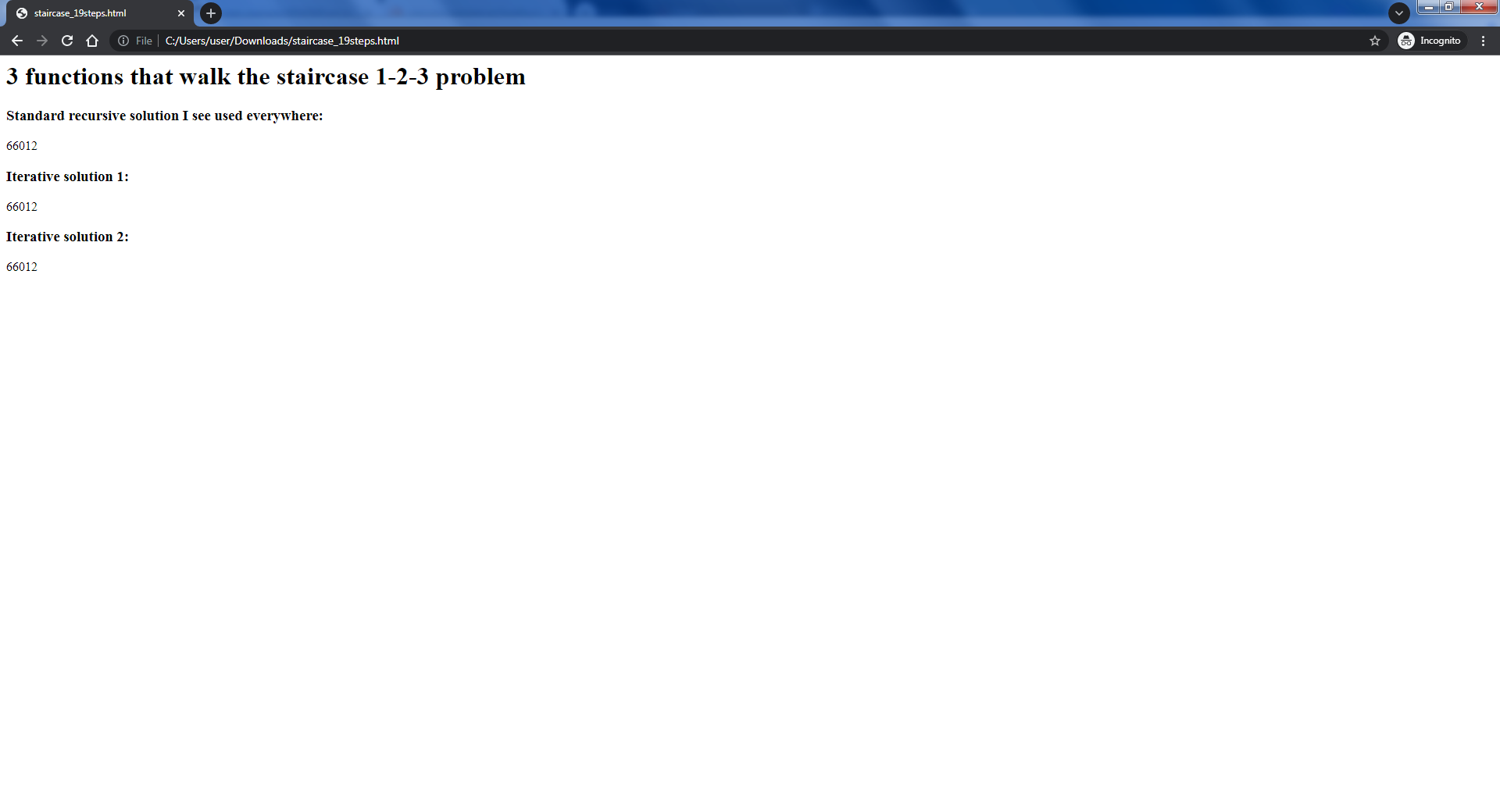
Both functions require you to start it out with some initial data.
The b variables are what is different between them. In one case, mr_stairs1, I added the prior three indexes of b. In the second case, I sum the prior value in the index of a,b, and c array. From what I have found as of today, mr_stairs2 is the more common iterative version. They usually only do a 1-2 step, though. These both do a 1-2-3 mix, but mr_stairs1 is quite different for summing the prior three indexes of the b array. In the c array, I used two methods; one method sums the previous indexes and adds two to the value. I think this is the more common. The other method uses the prior two indexes of the b-array and subtracts one. I think this is different than other approaches I have seen because I have not seen anyone do this.
function mr_stairs1(n)
{
   let a = [];
   let b = [];
   let c = [];

   a[0]=1;
   a[1]=1;
   a[2]=1;
   a[3]=1;


   b[0]=0;
   b[1]=1;
   b[2]=2;
   b[3]=4;

   c[0]=0;
   c[1]=0;
   c[2]=1;
   c[3]=2;

   let i = 0;

   for(i = 4; i <= n; i++){
      a[i] = 1;
      b[i] = (b[i-3] + b[i-2] + b[i-1]);
      c[i] = (b[i-2] + b[i-1])-1;
   }
   return (a[n-1]+ b[n-1] + c[n-1]);
}

function mr_stairs2(n)
{
   let a = [];
   let b = [];
   let c = [];

   a[0] = 1;
   a[1] = 1;
   a[2] = 1;


   b[0] = 0;
   b[1] = 1;
   b[2] = 2;

   c[0] = 0;
   c[1] = 0;
   c[2] = 1;

   let i=0;

   for(i = 3; i <= n; i++){
      a[i] = 1;
      b[i] = (a[i-1] + b[i-1] + c[i-1]);
      c[i] = (b[i-2] + b[i-1])-1;
   }

   return (a[n-1]+ b[n-1] + c[n-1]);
}