Project Lead: Julian Benson
Dataset:
This project investigates the non-linear probability curves of Riichi Mahjong through the lens of Michaelis-Menten enzyme kinetics. By treating a "Tenpai" (ready) hand as a catalytic enzyme and the depleting tile wall as a substrate pool, we derived a Michaelis Constant (
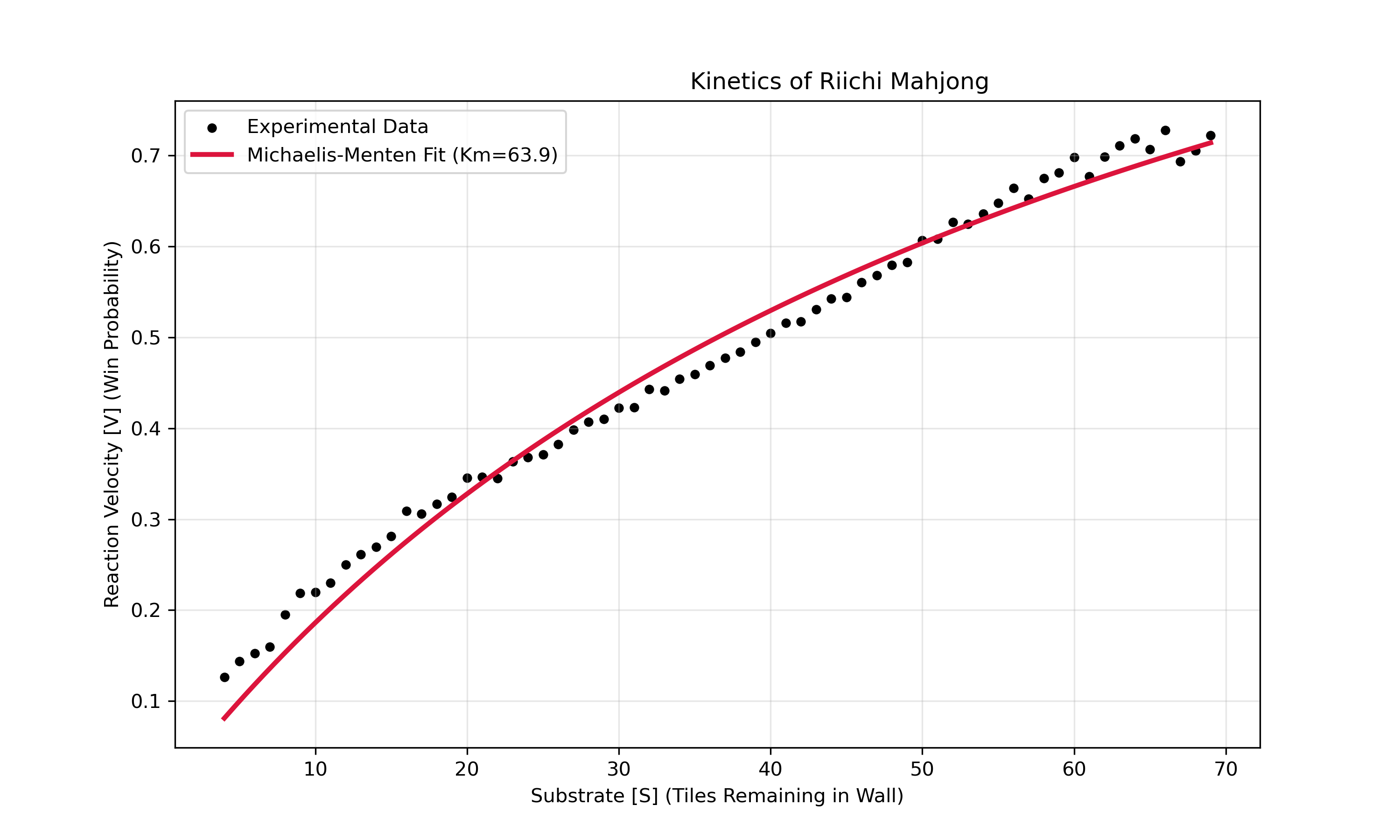

The results mathematically demonstrate that Mahjong is a substrate-limited system, providing a rigorous kinetic explanation for strategic "failure points" in the late game.
- Conformational Locking: We model the Riichi declaration as a conformational lock, where a player sacrifices structural flexibility for an exponential increase in potential energy (payout).
-
The Starvation Threshold: Because a standard game starts with only 70 substrate units (tiles) and has a
$K_m$ of 64, the "reaction" operates in a state of starvation from Turn 1. - Kinetic Failure: Win rates collapse non-linearly. We identify Turn 8 as the critical kinetic threshold after which the board state can no longer support high-efficiency product formation.
-
Mahjong_Kinetics_Paper.md: The full documentary-style deep dive, covering the evolutionary history of the game, the protein dynamics of the hand, and the thermodynamic implications of the "Rule of 64." -
harvest_data.py: High-performance parser for Tenhou JSON logs. -
analyze_kinetics.py: Regression script usingscipy.optimizeto calculate$V_{max}$ and$K_m$ from experimental data. -
kinetics_data.csv: The processed dataset ($>1M$ records).
pip install -r requirements.txt
python analyze_kinetics.py