This package provides two command-line tools for testing and inspecting Unicode support in terminal emulators.
To install or upgrade:
$ pip install -U ucs-detect
Unicode contains East Asian languages which use Wide (W) or Fullwidth (F) characters that occupy 2 cells. Many languages use zero-width or "combining" characters that modify adjacent characters with complex advancing rules. Emoji sequences also use Zero Width Joiners to join multiple emojis, or with adjusting Fitzpatrick variations, and emoji flags are represented by regional indicators of a country code. They may be also displayed without combined emoji and have a "standalone" representation.
Terminal applications must determine the display width of these characters, the Unicode Standard is without specific definitions for terminals, many stand behind without any grapheme support at all, conforming to pre-emoji era POSIX standard definitions and sans-grapheme wcwidth(3) system libraries.
Further, even well-meaning terminals who report to support "Graphemes" DEC Private Mode 2027 have varying interpretations of Unicode Standards.
ucs-detect measures terminal compliance with the Specification of the python wcwidth library,
for the latest Unicode versions across WIDE, ZERO, ZWJ, VS-16, and VS-15 unicode sequences and
grapheme width of over 500 languages.
ucs-browser allows interactive browsing of each kind of category with an interactive terminal
browsing program. This may also output to a non-tty, and is used to publish the example test files
at https://github.com/jquast/ucs-detect/tree/master/docs/ucs_example_files
ucs-detect uses the Query Cursor Position terminal sequence to ask
"where is the cursor?" after printing test characters. By comparing the
reported cursor position against the wcwidth expected width, compliance is
measured.
This technique is inspired by resize(1), which determines terminal dimensions over transports like serial lines by moving to (999, 999) and querying cursor position.
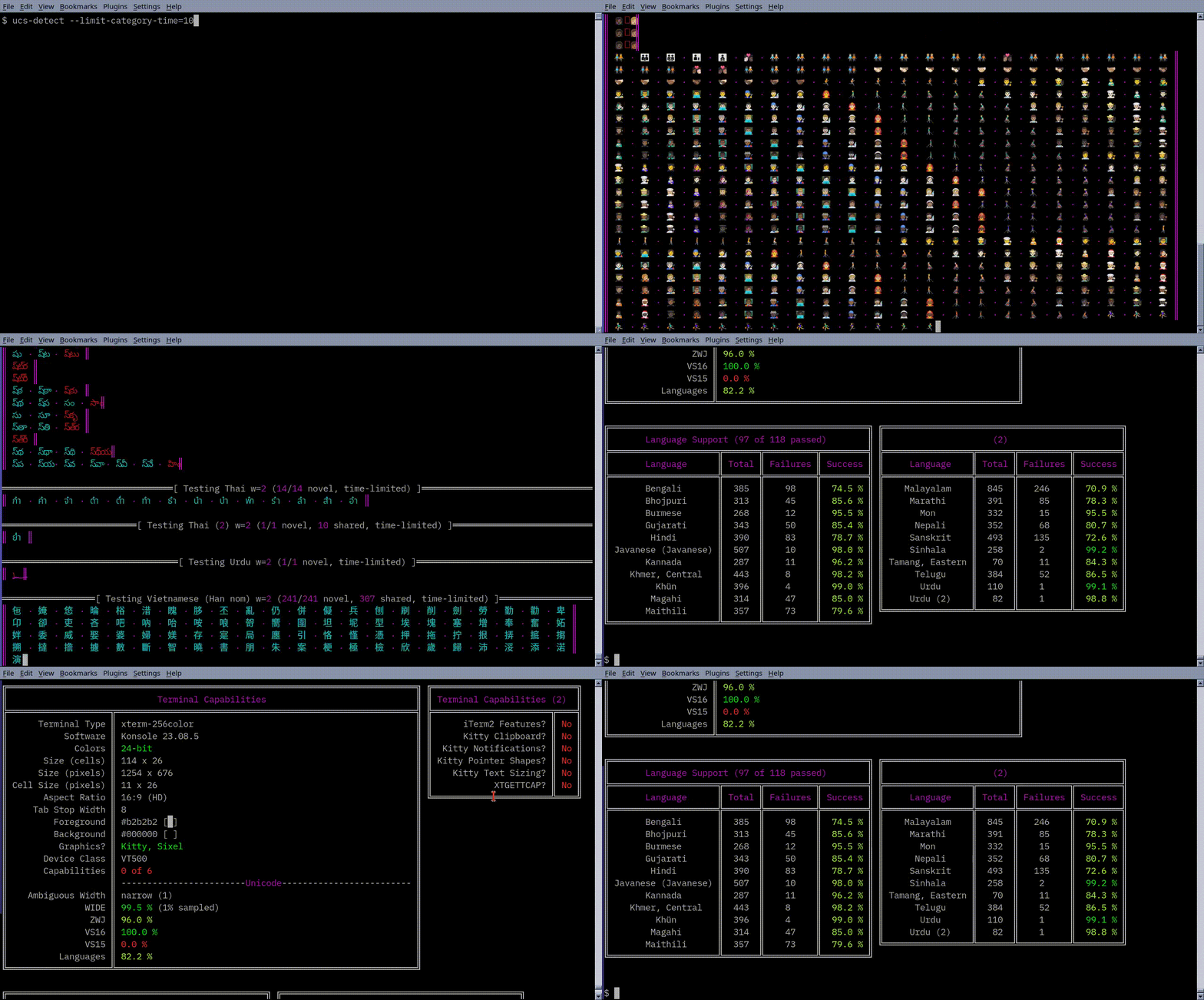
ucs-detect is the primary testing tool. It tests a terminal emulator's
Unicode support for Wide characters, Emoji Zero Width Joiner (ZWJ) sequences,
Regional Indicators and flags, Variation Selector-16 (VS-16) and VS-15 sequences,
and zero-width combining characters across hundreds of languages.
Terminal features that may be automatically detected are also reported: Bracketed Paste, Synchronized Output, Mouse SGR, Grapheme Clustering, Kitty Keyboard protocol, Sixel, ReGIS, Kitty or iTerm2 image protocol, and XTGETTCAP support.
Run a default test:
$ ucs-detect
Run a detailed test and save a YAML report:
$ ucs-detect --save-yaml=data/my-terminal.yaml
Notable CLI options:
--rerun <yaml-file>- Re-test a terminal using parameters from a previous YAML report.
--test-only <category>- Test a single category:
wide,zwj,vs16,vs15,lang,unicode,terminal,sri,sfz,ri, orall(default). --limit-category-time <seconds>- Time budget per test category, auto-adjusts sampling (0=unlimited).
--stop-at-error <pattern>- Pause on errors matching pattern for interactive investigation. Values:
all,zwj,wide,sri,sfz,ri,vs16,vs16n,vs15,lang, or a specific language name (e.g.,Hindi). --probe-silently- Minimal output, modifying only a single line.
--save-json <path>- Save results as a JSON report.
--no-terminal-test- Skip terminal feature detection.
--no-languages-test- Skip language support testing.
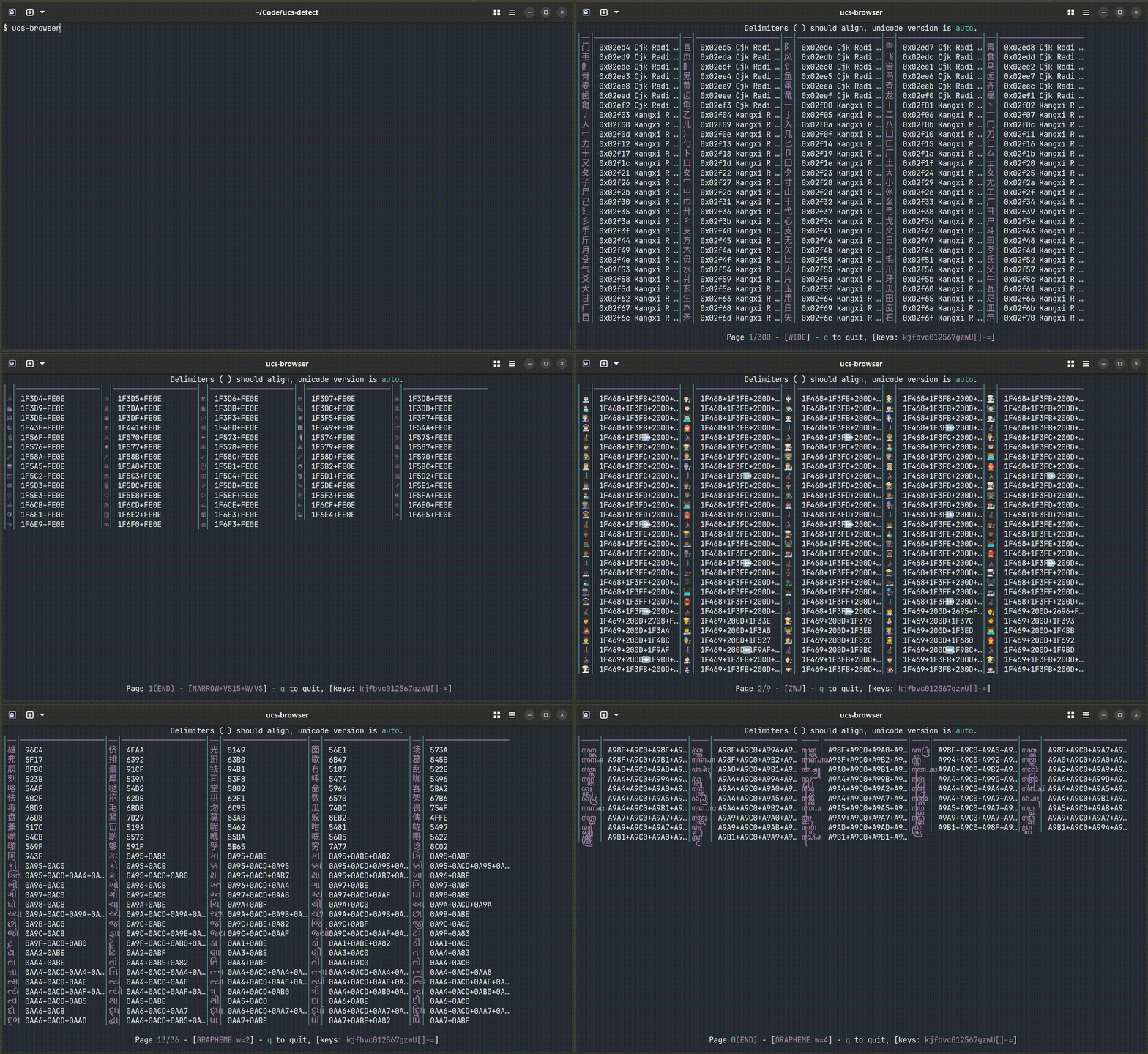
ucs-browser is an interactive terminal browser for visually inspecting
unicode character width rendering. It displays characters with pipe (|)
alignment markers that should align correctly in any terminal with proper
Unicode support.
$ ucs-browser
Modes are toggled with keyboard shortcuts:
0: Reset to default (wide characters)1/2: Narrow (1-cell) or Wide (2-cell) charactersc: Combining charactersg: Grapheme clusters ([/]to adjust width)z: Emoji ZWJ sequences5: VS-15 (text style)6: VS-16 space kludge7: VS-16 (emoji style)w: Toggle with/without variation selectorU: Toggle uncommon CJK extensionsv: Select Unicode version-/+: Adjust name column width
Modes may also be directly entered by CLI options (see ucs-browser --help)
Navigation follows less(1) conventions: j/k for lines, f/b for
pages, q to quit.
Example files are created using ucs-browser, and are published in the source repository at url https://github.com/jquast/ucs-detect/tree/master/docs/ucs_example_files
Results for over 30 terminals on Linux, Mac, and Windows are published at https://ucs-detect.readthedocs.io/results.html
Individual YAML reports are in the data folder:
https://github.com/jquast/ucs-detect/tree/master/data
Related articles:
- ucs-detect test results (November 2023, release 1.0.4)
- State of Terminal Emulation 2025 (November 2025, release 1.0.8)
Results are shared with terminal emulator projects and may become outdated as they improve Unicode support. Submit a pull request to update YAML data files.
Re-test an existing terminal:
$ ucs-detect --rerun data/contour.yaml
This re-executes with the same parameters, overwriting the existing YAML file.
Submit results for a new terminal:
$ ucs-detect --save-yaml=data/jeffs-own-terminal.yaml --limit-category-time=900
The --limit-category-time argument is used to automatically reduce test size to attempt to
complete each category under a reasonable time. This automatically adjusts the
--limit-codepoints-wide-pct parameter as low as 1%.
To preview documentation changes, create a draft pull request. A readthedocs.org build status will appear -- click "Details" for an HTML preview.
The general workflow to gather results and create documentation is, in combined serial and parallel order:
tox -e docker_build,docker_verify,docker_run_series,docker_screenshots &
tox -e system_verify,system_run_series,system_screenshots
wait
tox -e docs
For reproducible isolated runs, the project provides a Docker image with Xvfb and all linux terminal
emulators pre-installed. All Docker operations are managed through tox targets:
# one-time buildx builder setup
tox -e docker_buildx_setup

# build the image (with cache)
tox -e docker_build

# verify all terminals installed (group --version check)
tox -e docker_verify

# run ucs-detect on all terminals
tox -e docker_run_series

# this accepts extra 'run-series.py' arguments,
tox -e docker_run_series -- --timeout 600 --run-only "foot,kitty"

# generate screenshots
tox -e docker_screenshots
Unfortunately, many terminals have to be excluded from docker:
- Not Linux or not X11 compatible
- GPU-accelerated and not compatible with Xvfb,
- massive number of build dependencies
- JS/Electron stuff (chromium?) for some reason.
- Cannot reliably set geometry
- Tests with ucs-detect fine, but cannot screenshot for any reason
This requires installing those terminals on the developer's host system.
Use the 'system' targets to run these:
# verify all terminals installed (group --version check)
tox -e system_verify

# run ucs-detect on all terminals
tox -e system_run_series

# generate screenshots
tox -e system_screenshots
The script run-series.py is an X11 automation for testing all linux terminals. When -e program
[arguments] or similar is not supported, keystrokes are injected into the target application to
launch ucs-detect by configuration.
Use --stop-at-error to investigate discrepancies interactively:
$ ucs-detect --stop-at-error 'Hindi'
Example output:
Failure in language 'Hindi' (Hindi-2-01):
+---+-----------+--------+----------+---------+-------------------------+
| # | Codepoint | Python | Category | wcwidth |           Name          |
+---+-----------+--------+----------+---------+-------------------------+
| 1 |   U+0915  | \u0915 |    Lo    |    1    |   DEVANAGARI LETTER KA  |
| 2 |   U+094D  | \u094d |    Mn    |    0    |  DEVANAGARI SIGN VIRAMA |
| 3 |   U+0928  | \u0928 |    Lo    |    1    |   DEVANAGARI LETTER NA  |
| 4 |   U+093F  | \u093f |    Mc    |    0    | DEVANAGARI VOWEL SIGN I |
+---+-----------+--------+----------+---------+-------------------------+
+----+
| क्नि |
+----+

measured by terminal: 3
measured by wcwidth:  2

Shell
-----
printf '\xe0\xa4\x95\xe0\xa5\x8d\xe0\xa4\xa8\xe0\xa4\xbf\n'

Python
------
python -c "print('\u0915\u094d\u0928\u093f')"

press return for next error, or n for non-stop:
Language testing uses the Universal Declaration of Human Rights (UDHR) dataset, translated into 500+ languages, as a test corpus for zero-width characters (Mn — Nonspacing Mark), combining characters (Mc — Spacing Mark), and language-specific scripts.
Source data: https://github.com/eric-muller/udhr/
The UDHR provides practical coverage of common complex grapheme clusters across the world's languages, serving as an indicator of a terminal's support for combining marks across diverse scripts.
- 2.2.0 (2026-05-29): Enrich source repository with more tools, like
make-screenshots.py, expanded XTGETTCAP detection and results table, record XTVERSION, TERM_PROGRAM directly. Record cpu and memory resource usage, and introducerun-series.py, used with or without docker for batch testing with parallel execution (Linux only). - 2.1.0 (2026-04-17): Add more testing for standalone and flags (RI), kitty text sizing
protocol, make ucs-browser compatible with older python versions, and some changes
to allow ucs-detect to integrate as a network service (see
telnet modem.xyz) - 2.0.2 (2026-02-28): Some timing bugfixes caused features to sometimes report "No" support, and provide major speed enhancement to terminal test with integration of latest blessed release.
- 2.0.1 (2026-02-05): Add
--probe-silentlymode,--save-json, time measurements with RTT and ping-like statistics, and telnetlib3 shell support for testing over telnet. Bugfix iTerm2 image feature detection. - 2.0.0 (2026-02-01): More correct results with up-to-date wcwidth, loads of new CLI options like
--rerun,--limit-category-timeand remove CLI arguments--unicode-version,--shell,--quick, and--no-emit-osc1337. Thewcwidth-browserprogram has been migrated from wcwidth, and setup.py was migrated to pyproject.toml. Requires Python 3.8. - 1.0.8 (2025-11-02): Added detection of DEC Private Modes, testing of Variation Selector 15, Sixel graphics and pixel size, and automatic software version (XTVERSION and ^E answerback).
- 1.0.7 (2024-01-06): Add python 3.10 compatibility for yaml file save and update wcwidth requirement to 0.2.13.
- 1.0.6 (2023-12-15): Distribution fix for UDHR data and bugfix for python 3.8 through 3.11. ucs-detect Welcomes @GalaxySnail as a new project contributor.
- 1.0.5 (2023-11-13): Set minimum wcwidth release version requirement.
- 1.0.4 (2023-11-13): Add support for Emoji with VS-16 and more complete testing. Published test results.
- 1.0.3 (2023-10-28): Drop python 2 support. Add more advanced testing. Changes
default behavior when called without arguments, use
ucs-detect --quick
--shell
to use the new release with matching previous release behavior. - 0.0.4 (2020-06-20): Initial releases and bugfixes