User-defined preconditioning of local solver in HybridisationPC #2240
Conversation
This file contains hidden or bidirectional Unicode text that may be interpreted or compiled differently than what appears below. To review, open the file in an editor that reveals hidden Unicode characters.
Learn more about bidirectional Unicode characters


 sv2518
force-pushed
the
sv/approx-schur-in-hyb
branch
from
sv2518
force-pushed
the
sv/approx-schur-in-hyb
branch
from
5dbeb69 to
85a02cf
Compare

dham
previously approved these changes
Oct 7, 2021
Member
 dham
left a comment
dham
left a comment
dham
left a comment
There was a problem hiding this comment.
Subject to upstream changes landing.
sv2518
force-pushed
the
sv/approx-schur-in-hyb
branch
3 times, most recently
from
c4f17c4 to
b040ca1
Compare

Contributor
Author
|
OK, I cleaned this up and rebased on top of master. When the other PR is merged I will still need to drop the first commit. |
sv2518
changed the title
sv2518
force-pushed
the
sv/approx-schur-in-hyb
branch
from
b040ca1 to
c20d899
Compare

…ement in the reconstruction calls and precondition the local solve in the reconstruction calls with its inverse.
sv2518
force-pushed
the
sv/approx-schur-in-hyb
branch
from
c20d899 to
ab15f13
Compare
Contributor
Author
|
Hey, I converted this to draft now actually. I am currently working on preparing another PR that is similar to this one, but introduces diagonal local preconditioners. Since this started to be quite invasive in the hybridisation PR I refactored recent changes of the hybridisation PR into a separate class (including the changes in this PR), so maybe we want to hold of on this one until I finished the diagonal PR. |
Contributor
Author
|
This will be swallowed by #2259, so I close. |
Sign up for free
to join this conversation on GitHub.
Already have an account?
Sign in to comment


Add this suggestion to a batch that can be applied as a single commit.
This suggestion is invalid because no changes were made to the code.
Suggestions cannot be applied while the pull request is closed.
Suggestions cannot be applied while viewing a subset of changes.
Only one suggestion per line can be applied in a batch.
Add this suggestion to a batch that can be applied as a single commit.
Applying suggestions on deleted lines is not supported.
You must change the existing code in this line in order to create a valid suggestion.
Outdated suggestions cannot be applied.
This suggestion has been applied or marked resolved.
Suggestions cannot be applied from pending reviews.
Suggestions cannot be applied on multi-line comments.
Suggestions cannot be applied while the pull request is queued to merge.
Suggestion cannot be applied right now. Please check back later.
This PR is based on my other two PRs. The only commit of relevance is the last one, 85a02cf.
In this PR I introduce a PETSc option which allows users to provide an approximation to the Schur complement in the reconstruction calls which is then used as a preconditioner to the local system solve.
If we are doing hybridised mixed Poisson e.g., we know that this is a good idea (and already advise our users to try in this demo https://www.firedrakeproject.org/demos/saddle_point_systems.py.html). The argument to provide an approximation to the Schur complement is that the Schur complement's condition number is increasing with increasing amount of cells. By providing an approximation to the Schur complement and using it as a preconditioner we essentially lower the condition number.
The difference to the demo is that we are doing the solve on a local level (on a unit cell, h=1), but the condition number does not only depend on the mesh size parameter
h, but also on the approximation degreep.I have provided a test for a mixed Poisson problem and looked at the condition numbers of the local operators. Without preconditioning the Schur complement
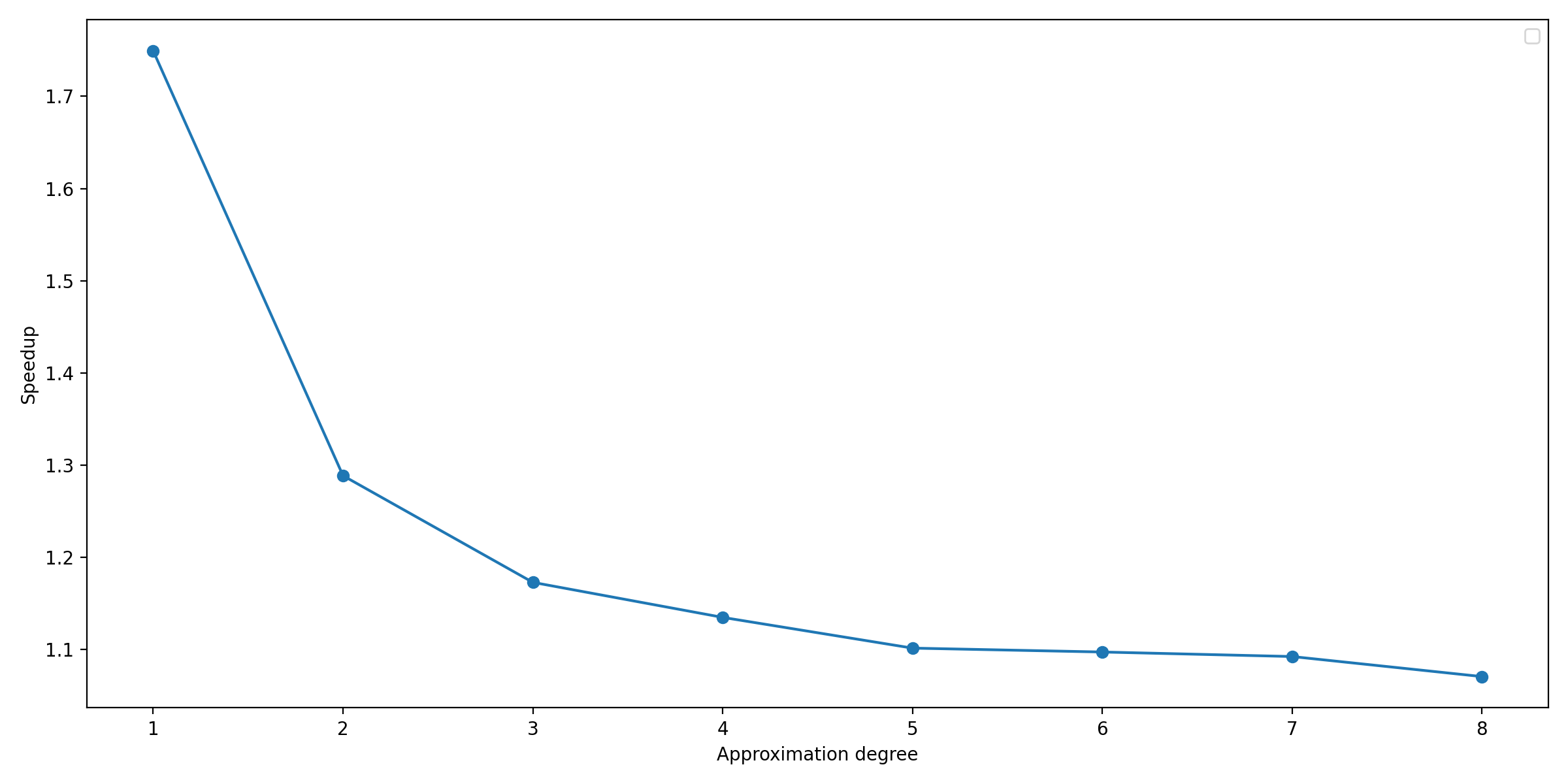
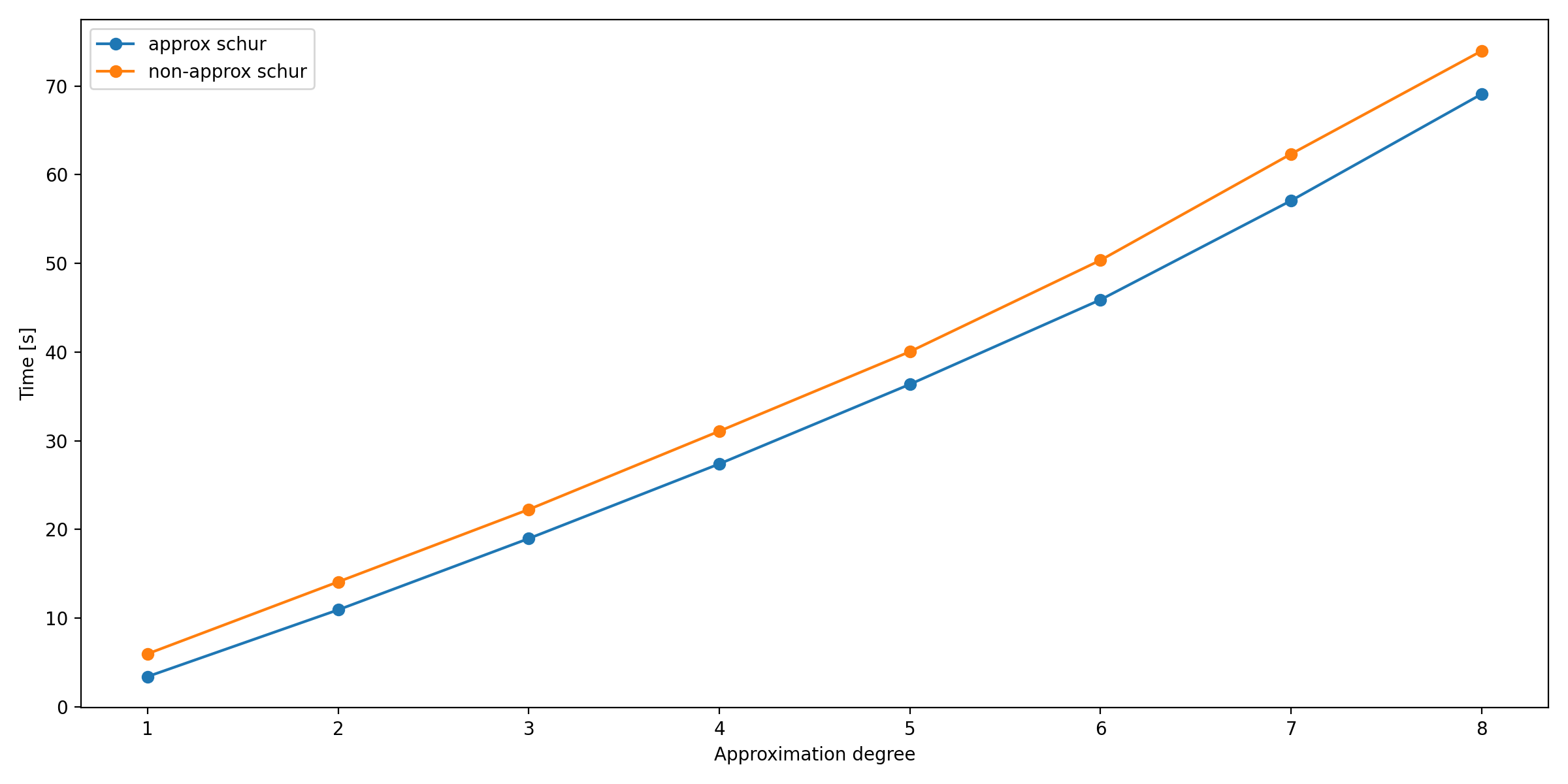
Shas condition number 16.77 for the given discretisation, and 5.95 for the preconditioned Schur complementP*S. The condition numbers would be higher if I had chosen a high approximation degree.So from looking at the condition numbers I would say yes, this a good idea but I am not sure if we already profit from this with the code infrastructure that we have on master at the moment. The way I build the system is by simply solving
P^{-1} * S x = P^{-1} blocally and we can't do local actions yet, so all the operators here are all dealt with in a matrix-explicit manner. With the preconditioner we need to build more matrices, and the trade-off might not pay off.So I did some timings and as expected I think I have the same issue as in my other PR. It does pay off to do this but the speedup is limited at higher order due a dominating cost of data transfer.