A Rust-native deep learning framework built on libtorch.
Same GPU kernels as PyTorch. No Python. No GIL. No GC. Just Rust.





PyTorch Users • Getting Started • Graph Builder • Graph Tree • Training • Multi-GPU • Parity • Benchmarks • Migration Guide • Data Loading
| PyTorch | floDl |
|---|---|
model = nn.Sequential(
    nn.Linear(2, 16),
    nn.GELU(),
    nn.LayerNorm(16),
    nn.Linear(16, 2),
)

pred = model(x)
loss = F.mse_loss(pred, target)
loss.backward()
optimizer.step() |
let model = FlowBuilder::from(Linear::new(2, 16)?)
    .through(GELU)
    .through(LayerNorm::new(16)?)
    .through(Linear::new(16, 2)?)
    .build()?;

let pred = model.forward(&x)?;
let loss = mse_loss(&pred, &target)?;
loss.backward()?;
optimizer.step()?; |
Same concepts, same names, same GPU kernels underneath. The ? operator
replaces silent failures with compile-time error handling. Drop replaces the
garbage collector. The full migration guide covers
every op, module, and pattern.
New to Rust? Read Rust for PyTorch Users — 10 patterns in 15 minutes.
With the CLI (recommended, no Rust needed):
curl -sL https://flodl.dev/fdl -o fdl && chmod +x fdl
./fdl setup          # detect hardware, download libtorch, configure build environment
./fdl init my-proj   # scaffold a new project with training template
The fdl script auto-downloads a pre-compiled CLI binary (~750KB, pure Rust,
no libtorch dependency). It detects your GPUs, downloads the right libtorch
variant, and configures Docker or native builds. See the full CLI
reference for all commands.
One-liner with Docker (no Rust, no setup):
curl -sL https://flodl.dev/init.sh | sh -s my-project
cd my-project
make build    # first build (~5 min, downloads libtorch)
make run      # train the model
Native -- Rust 1.85+ and libtorch:
./fdl libtorch download    # auto-detects CPU or CUDA
cargo add flodl && cargo build
For CUDA: cargo add flodl --features cuda + CUDA toolkit.
Both paths generate an annotated training template. Edit src/main.rs to
build your model:
use flodl::*;
let model = FlowBuilder::from(Linear::new(2, 16)?)
.through(GELU)
.through(LayerNorm::new(16)?)
.also(Linear::new(16, 16)?) // residual connection
.through(Linear::new(16, 2)?)
.build()?;
let params = model.parameters();
let mut optimizer = Adam::new(¶ms, 0.01);
model.train();
for (input_t, target_t) in &batches {
let input = Variable::new(input_t.clone(), true);
let target = Variable::new(target_t.clone(), false);
let pred = model.forward(&input)?;
let loss = mse_loss(&pred, &target)?;
optimizer.zero_grad();
loss.backward()?;
clip_grad_norm(¶ms, 1.0)?;
optimizer.step()?;
}floDl's fluent graph builder lets you describe complex architectures as
readable data flow — no boilerplate, no nn.Module subclassing.
let model = FlowBuilder::from(Linear::new(2, 16)?)
    .through(GELU)                        // activation
    .through(LayerNorm::new(16)?)         // normalization
    .also(Linear::new(16, 16)?)           // residual connection
    .through(Linear::new(16, 2)?)         // output projection
    .build()?;
build() returns a Graph that implements Module — you can nest it
inside other graphs. Things get interesting when architectures get complex:
let g = FlowBuilder::from(encoder).tag("encoded")
    .split(modules![head_a, head_b, head_c]).merge(MergeOp::Mean)
    .loop_body(refinement_block).for_n(3).tag("refined")
    .gate(router, modules![expert_a, expert_b]).using(&["encoded"])
    .switch(selector, modules![light_path, heavy_path]).using(&["refined"])
    .through(StateAdd).using(&["memory"]).tag("memory")
    .loop_body(decoder).while_cond(halt_condition, 10)
    .through(output_head)
    .build()?;
Every construct — split/merge, also, loop_body, gate, switch, map,
tag/using — composes cleanly. Forward references (using before tag) carry
state across calls, enabling recurrent architectures without special-casing.
| Method | What it does |
|---|---|
from(m).through(m) |
Linear chain |
also(m) |
Residual: input + m(input) |
fork(m) |
Side branch: capture output as tag, stream continues |
split(modules![...]).merge(op) |
Parallel branches, merged by Add or Mean |
tag(name) / using(refs) |
Named references — backward or forward (across calls) |
loop_body(body).for_n(n) |
Fixed iteration with BPTT |
loop_body(body).while_cond / until_cond |
Conditional loops |
gate(router, modules![...]) |
Soft routing — weighted combination |
switch(selector, modules![...]) |
Hard routing — only selected branch |
map(body).each() / .over(tag) / .slices(n) |
Element-wise, tagged, or sliced iteration |
input(names) |
Auxiliary graph inputs for multi-input architectures |
See the Graph Builder Tutorial and the full showcase.
This is where floDl goes beyond PyTorch. Graphs nest inside graphs with label-path addressing — dot-separated paths that let you reach into any subgraph from the root. Train components independently, compose them into larger architectures, and control training phases declaratively.
// Build components independently
let scan = FlowBuilder::from(scan_net).tag("hidden")
    .label("scan").build()?;

let read = FlowBuilder::from(read_net).tag("confidence")
    .label("read").build()?;

let encoder = FlowBuilder::from(scan)
    .through(read)
    .label("encoder").build()?;

// Compose into full model
let model = FlowBuilder::from(encoder)
    .through(classifier)
.build()?;Every tag and subgraph is addressable through dotted paths from the root:
model.validate_path("encoder")?;                 // -> Subgraph
model.validate_path("encoder.scan.hidden")?;      // -> Tag (three levels deep)
model.validate_path("encoder.read.confidence")?; // -> TagFreeze and thaw entire subtrees by path — no manual parameter iteration:
// Phase 1: train only the classifier, encoder is frozen
model.freeze("encoder")?;
let fresh_params = model.parameters();  // only unfrozen params
let mut opt = Adam::new(&fresh_params, 1e-3);
// ... train ...

// Phase 2: thaw scan, keep read frozen (it's proven)
model.thaw("encoder.scan")?;
let mut opt = Adam::with_groups()
    .group(&model.parameters_at("encoder.scan")?, 1e-4)  // low LR
    .group(&model.parameters_at("classifier")?, 1e-3)
.build();Train a component standalone, save it, load it into a larger model:
// Pre-trained encoder saved earlier
encoder.save_checkpoint("encoder_v1.fdl.gz")?;

// Load into the composed model — namespace + hash validated
model.load_subgraph_checkpoint("encoder", "encoder_v1.fdl.gz")?;
model.freeze("encoder.read")?; // lock what's provenMetrics flow up through the tree automatically:
model.record_at("encoder.scan.loss", scan_loss)?;
model.record_at("encoder.read.accuracy", read_acc)?;
model.record_scalar("total_loss", total)?;

model.flush(&[]);  // single call flushes the entire tree

// Trends across boundaries — drive training decisions
if model.trend_at("encoder.scan.loss")?.stalled(10, 1e-4) {
    model.thaw("encoder.read")?;  // scan stalled, unfreeze read
}

// Monitor sees all metrics with dotted names automatically
monitor.log(epoch, elapsed, &model);
// -> total_loss, encoder.scan.loss, encoder.read.accuracy
This is progressive model composition: each component is trained and validated independently before becoming a building block in a larger architecture. Checkpoints, metrics, and training phases compose just like the graphs themselves.
See the full Graph Tree Tutorial.
Drop-in monitor with adaptive ETA, resource tracking, and a live web dashboard — no external dependencies, no separate process.
use flodl::monitor::Monitor;

let mut monitor = Monitor::new(num_epochs);
monitor.serve(3000)?;  // optional: live dashboard at http://localhost:3000

for epoch in 0..num_epochs {
    let t = std::time::Instant::now();
    // ... training ...
    monitor.log(epoch, t.elapsed(), &model);  // sees entire graph tree
}
monitor.finish();
epoch 1/100 loss=1.5264 [49ms ETA 4.8s]
epoch 10/100 loss=0.3817 [25ms ETA 2.2s] VRAM: 2.1/6.0 GB (82%)
epoch 50/100 loss=0.0023 [24ms ETA 1.2s] VRAM: 2.1/6.0 GB (82%)
epoch 100/100 loss=0.0012 [23ms] VRAM: 2.1/6.0 GB (82%)
training complete in 2.8s | loss: 0.0012
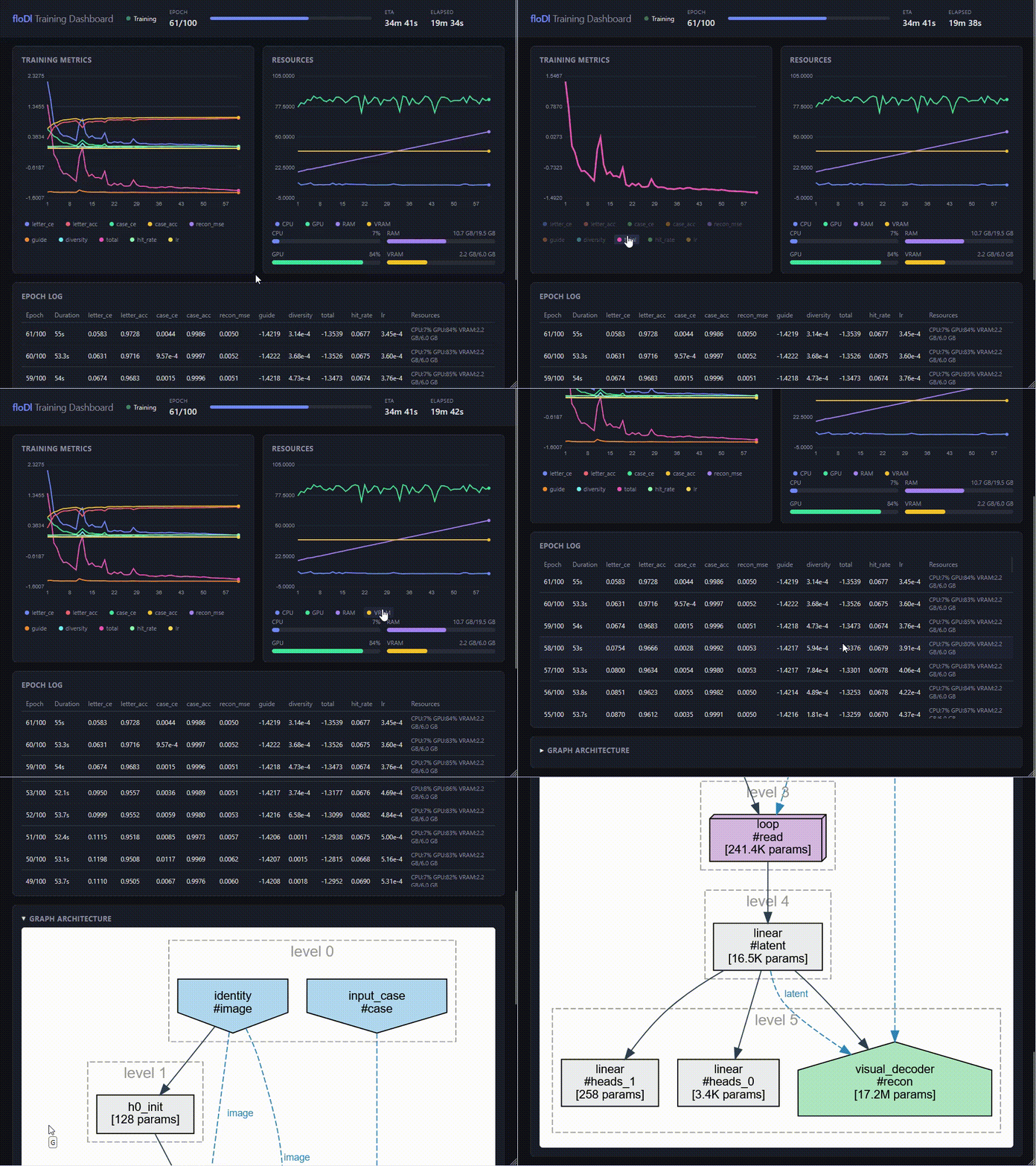
Interactive benchmark dashboard — real data from a 100-epoch training run
The live dashboard updates via Server-Sent Events (no WebSocket, no npm), tracks CPU/GPU/RAM/VRAM, and supports late join — open it mid-training and all past epochs backfill instantly.
monitor.save_html("training_report.html");  // self-contained archive
monitor.export_csv("training.csv")?; // for external analysisTags double as observation points. Collect metrics during training and use trend queries to make programmatic training decisions:
for epoch in 0..num_epochs {
    for (input, target) in &batches {
        let pred = graph.forward(&input)?;
        graph.collect(&["hidden"])?;                 // from graph tag
        graph.record_scalar("loss", loss.item()?);   // external metric
    }
    graph.flush(&["hidden", "loss"]);

    // Programmatic training control
    if graph.trend("loss").stalled(5, 1e-4) {
        optimizer.set_lr(optimizer.lr() * 0.5);      // decay LR
    }
    if graph.trend("loss").converged(5, 1e-5) {
        break;                                        // early stopping
    }
}| Method | What it does |
|---|---|
g.collect(tags) / g.flush(tags) |
Batch -> epoch metric aggregation |
g.record_scalar(tag, value) |
Inject external metrics (loss, accuracy) |
g.trend(tag).slope(n) |
OLS slope over last n epochs |
g.trend(tag).stalled(n, tol) |
Is |slope| below tolerance? |
g.trend(tag).improving(n) |
Is loss decreasing? |
g.trend(tag).converged(n, tol) |
Is variance below tolerance? |
g.trends(tags).all_improving(n) |
Group queries across branches |
let svg = g.svg(Some("model.svg"))?;              // architecture diagram
g.svg_with_profile(Some("profile.svg"))?;          // timing heatmap
g.plot_html("training.html", &["loss", "head"])?;  // interactive curves
See the Training Monitor Tutorial and the Observation example.
Ddp::setup() gives you transparent heterogeneous multi-GPU training with
zero changes to your training loop. floDl detects your GPUs, picks the best
strategy, and balances work automatically: the slowest GPU anchors the pace
while faster ones run ahead intelligently.
Graph DDP -- one line to go from single-GPU to multi-GPU:
// Detect GPUs, replicate model, set optimizer, enable training
Ddp::setup(&model, &builder, |p| Adam::new(p, 0.001))?;

// Training loop is IDENTICAL for 1 or N GPUs
for batch in model.epoch(0) {
    let loss = model.forward_batch(&batch?)?;
    model.step()?;  // AllReduce + sync + optimizer + zero_grad
}
DDP Builder -- thread-per-GPU, works with any Module:
let state = Ddp::builder(model_factory, optim_factory, train_fn)
    .dataset(dataset)
    .batch_size(32)
    .num_epochs(10)
    .policy(ApplyPolicy::Cadence)       // ElChe for mixed GPUs
    .backend(AverageBackend::Nccl)      // or Cpu for A/B testing
    .run()?
.join()?;| Graph DDP | DDP Builder | |
|---|---|---|
| Works with | Graph builder |
Any Module |
| GPU model | Scatter per batch | Thread per GPU (Local SGD) |
| Mixed GPUs | El Che auto-enabled | ApplyPolicy x AverageBackend |
| Setup | One line (Ddp::setup) |
Builder pattern |
| Dashboard | Integrated | Stderr logging |
A/B testing: swap AverageBackend::Nccl for AverageBackend::Cpu
with one line. If loss curves match, you have validated the cheaper
backend for your workload.
See the Multi-GPU Tutorial, DDP Builder Tutorial, Data Loading Tutorial, and DDP Reference.
floDl covers the modules, losses, and optimizers you actually use:
| Category | Count | Highlights |
|---|---|---|
| NN Modules | 30+ | Linear, Conv1d/2d/3d + transpose, GRU/LSTM, MultiheadAttention, Bilinear, all norms (Layer/RMS/Group/Batch/Instance), all pooling, Embedding/EmbeddingBag, PixelShuffle, Upsample, Unfold/Fold |
| Activations | 17 | ReLU, LeakyReLU, ELU, GELU, SiLU, Mish, SELU, Softplus, Hardswish, PReLU, Softmax, ... |
| Losses | 15 | MSE, CrossEntropy, BCE, NLL, CTC, Focal, Triplet, KLDiv, SmoothL1, Cosine, Hinge, Margin, Poisson, ... |
| Optimizers | 7 | SGD, Adam, AdamW, RMSprop, Adagrad, RAdam, NAdam — all with parameter groups |
| Schedulers | 8 | Step, Cosine, Exponential, MultiStep, OneCycle, Cyclic, Warmup (composable), Plateau |
| Init | 9 | Xavier, Kaiming, orthogonal, truncated normal, uniform, normal |
| Tensor Ops | 100+ | Full arithmetic, trig, reductions, shape, indexing, comparisons, fused ops |
| Autograd | 90+ | Differentiable backward for every op above |
Fused Adam/AdamW on CUDA (single kernel for all parameters). Fused gradient
clipping via foreach ops. Mixed precision with AutocastGuard + GradScaler.
CUDA Graphs for replay-based training.
The full migration guide has side-by-side code for every op, module, and pattern.
Same CUDA kernels as PyTorch — the difference comes from what happens between kernel launches. Ten models, ten interleaved rounds, locked GPU clocks (RTX 5060 Ti, v0.3.0 vs PyTorch 2.10.0):
| Model | PyTorch | flodl | Delta |
|---|---|---|---|
| transformer | 3183.0 ms | 2199.8 ms | -31% |
| mlp | 291.1 ms | 207.0 ms | -29% |
| residual_tower | 406.9 ms | 309.7 ms | -24% |
| feedback_fixed | 275.3 ms | 231.3 ms | -16% |
| gated_routing | 248.0 ms | 217.3 ms | -12% |
| iterative_refine | 230.7 ms | 206.0 ms | -11% |
| gru_seq | 1105.1 ms | 1057.5 ms | -4% |
| conv_autoenc | 398.2 ms | 395.3 ms | -1% |
| lstm_seq | 692.3 ms | 692.3 ms | 0% |
| convnet | 1298.0 ms | 1298.2 ms | 0% |
Wins 8 of 10, ties 2, zero regressions. The ties (convnet, lstm_seq) are compute-bound -- both frameworks saturate the GPU, confirming identical CUDA kernels. The gap appears where framework overhead matters: dispatch-bound architectures (transformer -31%, mlp -29%), graph routing (residual_tower -24%), and recurrent loops (feedback_fixed -16%).
Benchmark Report | Interactive dashboard
Deterministic memory. Python adds ~3-5 us of framework overhead per GPU
op. Go's GC can't manage VRAM — an earlier Go implementation
required 5 phases of lifecycle management (refcounting, GC callbacks, VRAM
budgets, pending-free queues). Rust replaces all of that with
impl Drop for Tensor. Memory is freed the instant a tensor leaves scope.
Zero-cost safety. Every op returns Result<T> — no silent failures.
Ownership ensures tensors are freed exactly once. The borrow checker
prevents data races at compile time.
Same GPU kernels. floDl binds libtorch — the C++ library under PyTorch. CUDA, cuBLAS, cuDNN are identical. floDl replaces the dispatch path, autograd tracking, and graph execution.
Training Tools
| Tool | What it does |
|---|---|
clip_grad_norm / clip_grad_value |
Fused gradient clipping (2 kernels total via foreach ops) |
save_checkpoint / load_checkpoint |
Named .fdl checkpoints, structural hash, partial loading, LoadReport |
migrate_checkpoint |
Remap parameter names across versions |
Parameter::freeze / unfreeze |
Per-parameter gradient control |
GradScaler |
Dynamic loss scaling for fp16 training |
cast_parameters |
Cast model parameters to any dtype |
CpuWorker / ModelSnapshot |
Background checkpoint saving |
CudaGraph |
Capture/replay training steps for fixed-shape models |
Module Traits
Beyond forward/parameters, Module provides optional methods the graph
recognizes automatically:
| Method | What happens |
|---|---|
as_named_input() |
using() refs arrive as a named map |
reset() |
Loops auto-call before iterating — clears per-forward state |
detach_state() |
Break gradient chains on retained state |
sub_modules() |
Recursive device placement, training mode, parameter collection |
Build Profiles
# Optimize floDl in dev builds — your code stays fast to compile.
[profile.dev.package.flodl]
opt-level = 3

[profile.dev.package.flodl-sys]
opt-level = 3

# Release: cross-crate optimization for maximum throughput.
[profile.release]
lto = "thin"
codegen-units = 1| Profile | flodl | Your code | Typical rebuild |
|---|---|---|---|
cargo build |
-O3 (cached) |
-O0 (fast) |
< 2s |
cargo build --release |
-O3 + LTO |
-O3 + LTO |
full link |
Multi-GPU (DDP)
| Component | What it does |
|---|---|
Ddp::setup |
One-liner: detect GPUs, distribute, set optimizer, train |
Ddp::builder |
Thread-per-GPU with Local SGD, any Module |
ApplyPolicy |
Sync / Cadence / Async (when to average) |
AverageBackend |
Nccl / Cpu (how to average, A/B testable) |
ElChe |
Heterogeneous GPU cadence strategy |
NcclComms / NcclRankComm |
NCCL AllReduce, Broadcast, abort handles |
CudaEvent / CudaStream |
Async GPU-CPU pipeline, timing |
DataLoader |
Resident/streaming/distributed, VRAM-aware prefetch, auto OOM fallback |
Every differentiable path is verified against finite-difference gradients:
- 117 autograd op-level checks (every op + compositions)
- Module-level checks (every NN module, input + parameter gradients)
- Exact optimizer step verifications (SGD, Adam, AdamW, RMSprop, Adagrad, RAdam, NAdam)
- 1027 library tests, zero clippy warnings — all tests run on both CPU and CUDA
Developed and tested from NVIDIA Pascal (GTX 1060 6GB) to Blackwell
(RTX 5060 Ti 16GB). PyTorch dropped Pascal support after 2.5.1 — floDl
links libtorch's stable C API, which supports every architecture the driver
supports. If nvidia-smi works, floDl trains on it.
| Background | Start here |
|---|---|
| New to Rust | Rust for PyTorch Users — 10 patterns in 15 minutes |
| Know Rust, new to DL | Tensors then Training |
| Know PyTorch | Porting Guide (or /port with AI) then Graph Builder |
| Scaling to multi-GPU | Multi-GPU Training then DDP Builder |
| Just show me code | quickstart or showcase |
- Rust for PyTorch Users — 10 Rust patterns in 15 minutes
- Tensors — creation, ops, memory, CUDA
- Autograd — variables, gradients, backward
- Modules — all layers, convolutions, RNNs, attention, normalization
- Training — losses, optimizers, mixed precision, full loop
- Graph Builder — fluent API from simple to complex
- Advanced Graphs — forward refs, loops, gates, switches
- Visualization — DOT/SVG, profiling heatmaps
- Utilities — checkpoints, clipping, freezing, initialization, scheduling
- Training Monitor — ETA, resource tracking, live dashboard
- Graph Tree — hierarchical composition, freeze/thaw, subgraph checkpoints
- Multi-GPU Training — Ddp::setup, El Che, auto-balancing, DataLoader integration
- DDP Builder — thread-per-GPU, Local SGD, A/B testable backends
- Data Loading — DataLoader, resident/streaming modes, VRAM-aware prefetch, DDP integration
quickstart— build, train, and monitor a model with residual connectionssine_wave— sine regression with monitor, checkpoint round-tripmixed_precision— float16 training withGradScalertransfer_learning— checkpoint, partial load, freeze, fine-tuneschedulers— warmup + cosine + plateau compositionobservation— collect, flush, trend queries, early stoppingshowcase— every graph builder method in one graph
- Porting Guide — module mapping, FlowBuilder patterns, training loop translation
- AI-assisted porting — point any AI coding assistant at the skill guide for automated translation. With Claude Code:
/port my_model.py fdl api-ref— generate a structured API reference for your flodl version. Used by AI tools and useful on its own.
+-----------------------------------------------------------+
|  User Code / Model Definitions                            |
+-----------------------------------------------------------+
|  monitor/  ETA, resource tracking, live web dashboard     |
+-----------------------------------------------------------+
|  graph/    Fluent builder, graph tree, execution, DOT/SVG |
+-----------------------------------------------------------+
|  data/     DataLoader, resident/streaming, prefetch       |
+-----------------------------------------------------------+
|  nn/       Modules, losses, optimizers, DDP, NCCL         |
+-----------------------------------------------------------+
|  autograd/ Reverse-mode AD, gradient tracking             |
+-----------------------------------------------------------+
|  tensor/   Owned tensors with Drop, CPU + CUDA            |
+-----------------------------------------------------------+
|  flodl-sys   FFI bindings to libtorch C++ shim            |
+-----------------------------------------------------------+
|  libtorch / CUDA / NCCL                                   |
+-----------------------------------------------------------+
floDl started as a question: what would a deep learning framework look like if you designed it around Rust's ownership model instead of fighting a garbage collector?
An earlier attempt in Go proved the architecture — the graph builder, the module system, the observation engine — but hit a wall: Go's GC cannot manage GPU memory deterministically. That required building five layers of memory management infrastructure on top of the language, not with it.
Rust solved this at the language level. impl Drop for Tensor replaced
hundreds of lines of lifecycle management. The graph builder, module
composition, and design philosophy carried forward; the memory fights didn't.
floDl is open-sourced software licensed under the MIT license.
