


Mockaton is an HTTP mock server for simulating APIs, designed for testing difficult to reproduce backend states with minimal setup.
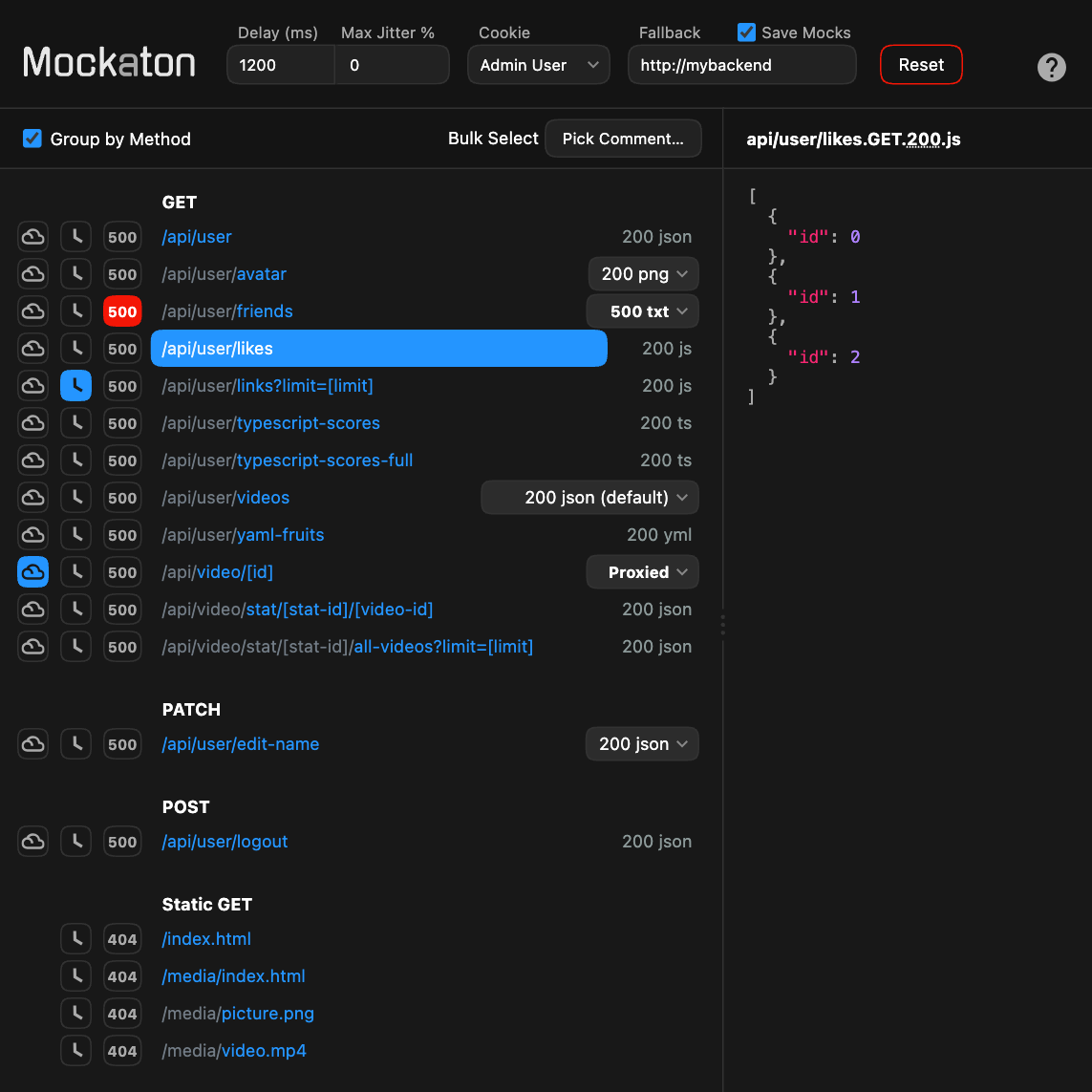
This will spin up Mockaton with the sample directory included in this repo mounted on the container.
git clone https://github.com/ericfortis/mockaton.git --depth 1
cd mockaton
make docker
Test it:
curl localhost:2020/api/userDashboard: localhost:2020/mockaton
npx mockaton my-mocks-dir/Mockaton will serve the files on the given directory. It's a file-system based router, so filenames can have dynamic parameters and comments. Also, each route can have different mock file variants.
| Route | Filename | Description |
|---|---|---|
| /api/company/123 | api/company/[id].GET.200.json | [id] is a dynamic parameter |
| /media/avatar.png | media/avatar.png | Statics assets don't need the above extension |
| /api/login | api/login(invalid attempt).POST.401.json | Anything within parenthesis is a comment, they are ignored when routing |
| /api/login | api/login(default).GET.200.json | (default) is a special comment; otherwise, the first mock variant in alphabetical order wins |
| /api/login | api/login(locked out user).POST.423.ts | TypeScript or JavaScript mocks are sent as JSON by default |
- How to configure Mockaton? See CLI and mockaton.config.js docs.
- How to control Mockaton? Besides the dashboard, there's a Programmatic API.
- How to add plugins? You can write Plugins for customizing responses.
Mockaton has a Browser Extension that lets you download in bulk all your API responses following Mockaton's filename convention.
Write to your mocks directory. Alternatively, there's an API PATCH /mockaton/write-mock.
mkdir -p my-mocks-dir/api
echo '{ "name": "John" }' > my-mocks-dir/api/user.GET.200.json
sleep 0.1 # Wait for the watcher to register it- Route: /api/company/123
- Filename: api/company/[id].GET.200.json
{
  "name": "Acme, Inc."
}Exporting an Object, Array, or String is sent as JSON.
- Route: /api/company/abc
- Filename: api/company/[id].GET.200.ts
export default {
  name: 'Acme, Inc.'
}
Example C: Function Mocks
With a function mock you can do pretty much anything you could do with a normal backend handler.
For example, you can handle complex logic, URL parsing, saving toa database, etc.- Route: /api/company/abc/user/999
- Filename: api/company/[companyId]/user/[userId].GET.200.ts
import { IncomingMessage, OutgoingMessage } from 'node:http'
import { parseSegments } from 'mockaton'

export default async function (req: IncomingMessage, response: OutgoingMessage) {
  const { companyId, userId } = parseSegments(req.url, import.meta.filename)
  const foo = await getFoo()
  return JSON.stringify({
    foo,
    companyId,
    userId,
    name: 'Acme, Inc.'
  })
}