An ADvanced, automatic unstructured MESH generator for 2D shallow-water models.
Python port of the MATLAB ADMESH library and a Pythonic API.
Dominik Mattioli1†, Ethan Kubatko2
†Corresponding author | 1Unaffiliated | 2Ohio State University (CHIL)





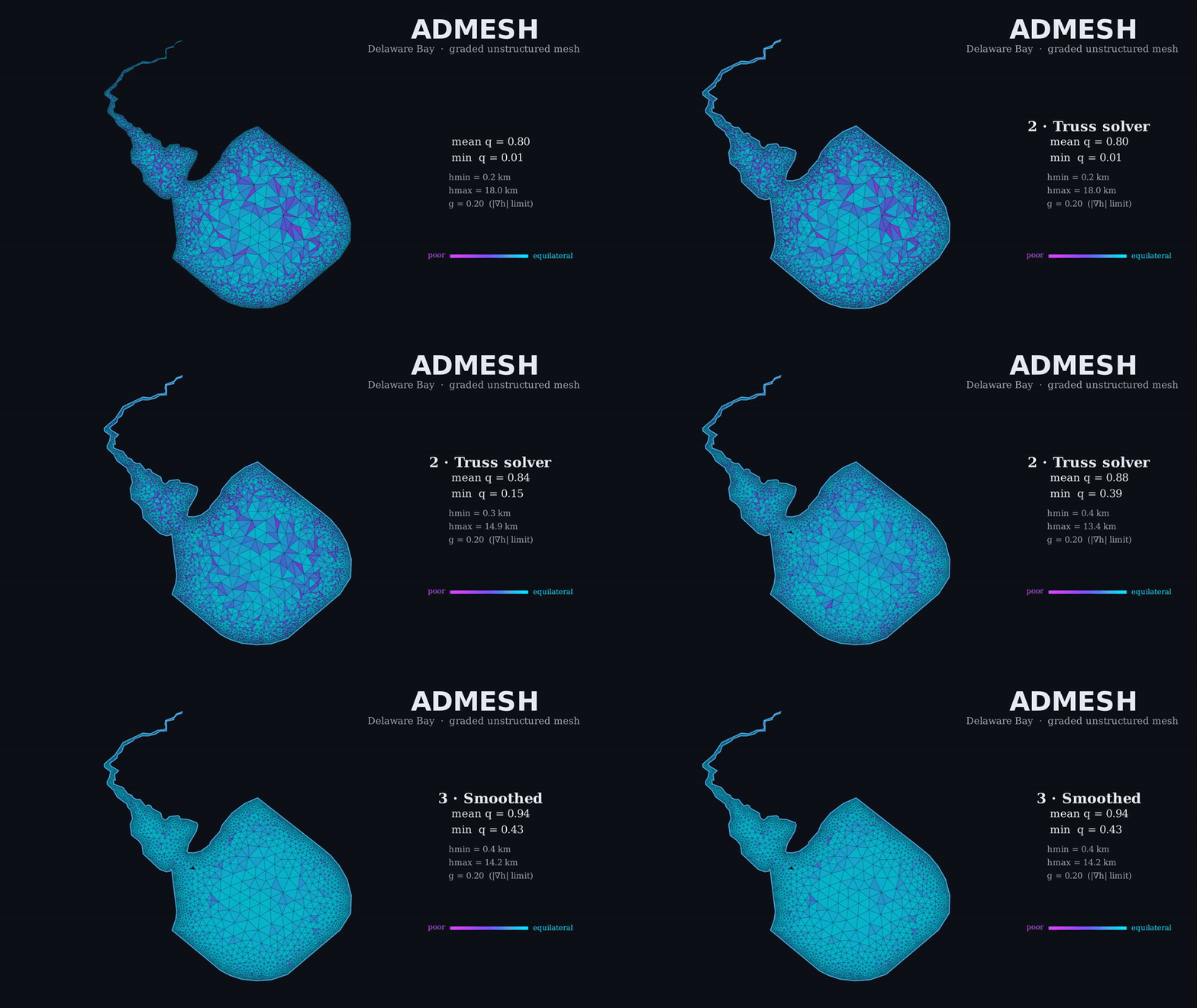
A graded Delaware Bay mesh — fine in the upper river, coarse out in the open bay (hmin/hmax with gradient limit g) — evolving through ADMESH's pipeline: 1. initialization → 2. DistMesh truss solver → 3. FEM smoothing. Element color tracks quality (magenta = poor → cyan = equilateral).
Attention MATLAB users: This Python library is the actively-developed successor to the original MATLAB codebase by Conroy et al. (no longer maintained). An unmaintained copy of that original ADMESH MATLAB library is kept in-repo at
src/matlab/for provenance. Version 1.0.0 will ship with a MATLAB wrapper of the modernized code (Est. Aug 2026).
- Why ADMESH
- Install
- Quickstart
- Pipeline
- Performance
- Status & roadmap
- Documentation
- Citation
- Contributing
- License
For shallow-water modelers who need ADCIRC-ready meshes from Python:
- MATLAB-faithful port. 13 stages reproduced 1:1 from the OSU CHIL Lab
01_ADMESH_Library, with a 250+ test suite tracking numerical agreement — switching from MATLAB does not change your meshes. - Native ADCIRC
fort.14I/O. ADCIRC mesh format only (not gmsh, not generic). Bit-faithful read/mesh/write round-trip, including paired-edge records (IBTYPE 3/4/13/24). - Physics-driven sizing. Element size adapts to boundary curvature, shallow channels, bathymetric gradients, and tidal wavelength via automatic
min-stack composition. No hand-tuned scalar; custom contributions layer on top. - Pythonic surface, faithful internals.
Domain/Mesh/BoundarySegmentare frozen, typed dataclasses; the numerics stay inside the locked faithful-port modules.
Not the right tool if you need 3-D, anisotropic, or non-triangular elements — use gmsh for those.
pip install admesh2D            # core
pip install admesh2D[viz]       # adds chilmesh for mesh.plot() / plot_quality()
From source:
git clone https://github.com/domattioli/ADMESH.git
cd ADMESH
pip install -e ".[dev]"
Requires Python ≥ 3.10. Core deps: NumPy, SciPy, Numba, Shapely. The import name is admesh (the admesh2D on PyPI is the distribution name — the admesh namespace on PyPI is an unrelated STL library).
Install hiccups (Numba on Apple Silicon, SciPy wheels on older Python): see open issues and file a new one if you hit a fresh failure.
import admesh
from admesh import domains

# Simple domain: uniform sizing
mesh = admesh.triangulate(domains.UNIT_DISK, h_max=0.1)
mesh.to_fort14("disk.14")

# Complex domain: graded sizing (notched rectangle)
mesh = admesh.triangulate(domains.NOTCHED_RECTANGLE, h_max=0.2, h_min=0.02)
mesh.to_fort14("notched.14")
mesh is a frozen Mesh dataclass — typed nodes, elements, boundaries (each a BoundarySegment with a BoundaryType code), optional bathymetry, per-element quality.
In triangulate, h_min / h_max set the size bounds; pass a size_field callable to grade. For graded sizing, compose ADMESH's curvature + medial-axis size fields via mesh_size.build_h() (see scripts/render_quickstart_notched.py for example). See docs/ for fort.14 round-trip, re-mesh, custom size-field, and SDF-domain examples.
triangulate(...) runs the 13-stage ADMESH pipeline (faithful port of 01_ADMESH_Library); the Numba-JIT solver replaces the original C MEX, so there is no compile step at install.
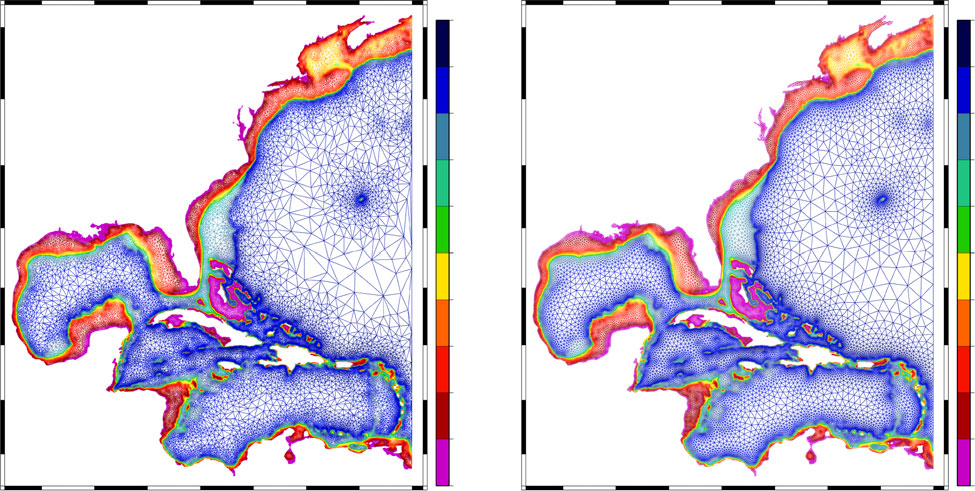
Western North Atlantic (WNAT) benchmark mesh. The size function (red = fine, blue = coarse) drives node placement; force-balance relaxation pushes element quality toward equilateral.
flowchart LR
    A["SDF / fort.14"] --> B["Domain"]
    B --> C["Size field\n(curvature + medial axis\n+ bathy + tide)"]
    C --> D["distmesh2d\n(truss equilibrium)"]
    D --> E["Mesh\n(fort.14 out)"]
Per-stage timings on the WNAT domain (144-ring Western North Atlantic coastline), all columns measured directly at hmin=0.05 / g=0.10, fixed niter=120 to isolate per-call cost. v0.5.0 adds a Numba-JIT SDF kernel + solve_iter smoother; v1.0.0 adds Triangle Delaunay + a C++ force kernel; v1.1.0 (planned) completes the full C++ rewrite of all 13 stages.
| Algorithm step | Module | v0.2.1 | v0.5.0 (Numba) | v1.0.0 (C++ + Triangle) | v1.1.0 (Full C++ — est.) |
|---|---|---|---|---|---|
| domain load + SDF build | distance |
0.018 | 0.017 | 0.021 | 0.020 |
| SDF grid eval | distance |
1.464 | 0.271 | 0.361 | 0.240 |
| curvature | curvature |
0.003 | 0.003 | 0.003 | 0.003 |
| medial axis | medial_axis |
0.462 | 0.416 | 0.451 | 0.300 |
| grading solve | mesh_size |
0.496 | 0.005 | 0.005 | 0.003 |
| size-field build (subtotal) | — | 2.425 | 0.695 | 0.821 | 0.566 |
| distmesh (point gen + relax) | distmesh |
1255.0 | 46.5 | 25.6 | 17.1 |
| quality | quality |
0.009 | 0.009 | 0.008 | 0.005 |
| TOTAL | 1257.5 s | 47.2 s | 26.4 s | 17.6 s | |
| Speedup vs v0.2.1 | 1× | 26.7× | 47.6× | 71.4× |
| v0.2.1 | v0.5.0 | v1.0.0 | v1.1.0 (Full C++) | |
|---|---|---|---|---|
| nodes | 49377 | 49377 | 49192 | 49192 |
| elements | 93655 | 93642 | 93247 | 93247 |
| Min. Elem Quality | 0.038 | 0.010 | 0.050 | 0.050 |
| Mean Elem Quality | 0.963 | 0.962 | 0.963 | 0.963 |
| StDev Elem Quality | 0.055 | 0.057 | 0.054 | 0.054 |
The v1.0.0 speedup is in distmesh (Triangle Delaunay 4× + C++ force kernel): the same point-placement converges 1.8× faster per call with quality holding at mean 0.963.
fort.14 boundary labels round-trip through BoundaryType, an IntEnum over ADCIRC IBTYPE codes (OPEN=0, MAINLAND=1, ISLAND=11, MAINLAND_FLUX=20); paired-edge / weir codes (3 / 4 / 13 / 24) and any unmapped code preserve as plain int on BoundarySegment.bc_type.
Reproduce or extend across new versions:
python benchmarks/compare_versions.py \
    --mesh tests/fixtures/fort14/adcirc_examples/wnat_test.14 \
    --domain benchmarks/data/wnat_onur_boundary.json \
    --ref v0.2.1="v0.2.1 (original Python)" \
    --ref current="v0.5.0 (Numba-optimized Python)" \
    --hmin 0.05 --g 0.10 --niter 120 --hist
Add a --ref <tag>="<label>" per version to compare; the table writes to benchmarks/results/version_comparison.md.
- Shipped (v0.2.1). Pythonic API + fort.14 round-trip + 13-stage faithful port + valence balancing + custom size-field hooks. Published to PyPI and archived on Zenodo.
- In flight. Spec 009 release-readiness (CI workflows, mkdocs site, stage-module reorg into
admesh/_stages/). Spec 008 Gmsh I/O. - Next. Default size-field stack consolidation; paired-edge IBTYPE 3 / 4 / 13 / 24 promoted to named
BoundaryTypemembers.
Open epics live as labeled issues — see planning-required.
API reference lives in the docstrings (triangulate, Domain, Mesh, BoundarySegment, read_fort14/write_fort14, and the 13 stage modules). Design notes, porting log, and domain-format specs are under docs/ and specs/; project invariants in CONSTITUTION.md. A hosted mkdocs site lands with spec 009.
Algorithm / theory (cite the original paper):
Conroy, C.J., Kubatko, E.J., West, D.W. (2012). ADMESH: an advanced, automatic unstructured mesh generator for shallow water models. Ocean Dynamics 62, 1503–1517. https://doi.org/10.1007/s10236-012-0574-0
This software (cite the archived release):
Mattioli, D., Conroy, C.J., Kubatko, E.J., West, D.W. (2026). ADMESH: An advanced, automatic unstructured mesh generator for 2D shallow-water models (Python port). Zenodo. https://doi.org/10.5281/zenodo.20264101
The DOI resolves to the latest release; version-specific DOIs are on the Zenodo record. A CITATION.cff at the repo root feeds GitHub's "Cite this repository" button. Paper copy: papers/Conroy-2012-ADMESH.pdf.
Contributions and bug reports are welcome — open an issue or pull request on GitHub.
Theory (algorithm, size-field formulation, ADCIRC integration): Ethan J. Kubatko — kubatko.3@osu.edu / Python port (this repository): Dominik Mattioli — github.com/domattioli
Apache 2.0 — see LICENSE.