


Reinforcement learning for a Universal Robots UR7e cobot: line following (simulation and real sim-to-real deployment), target reaching, and obstacle avoidance — with kinematic tools, sensor fusion (EKF), and a scientific SAC-vs-PPO comparison.
And
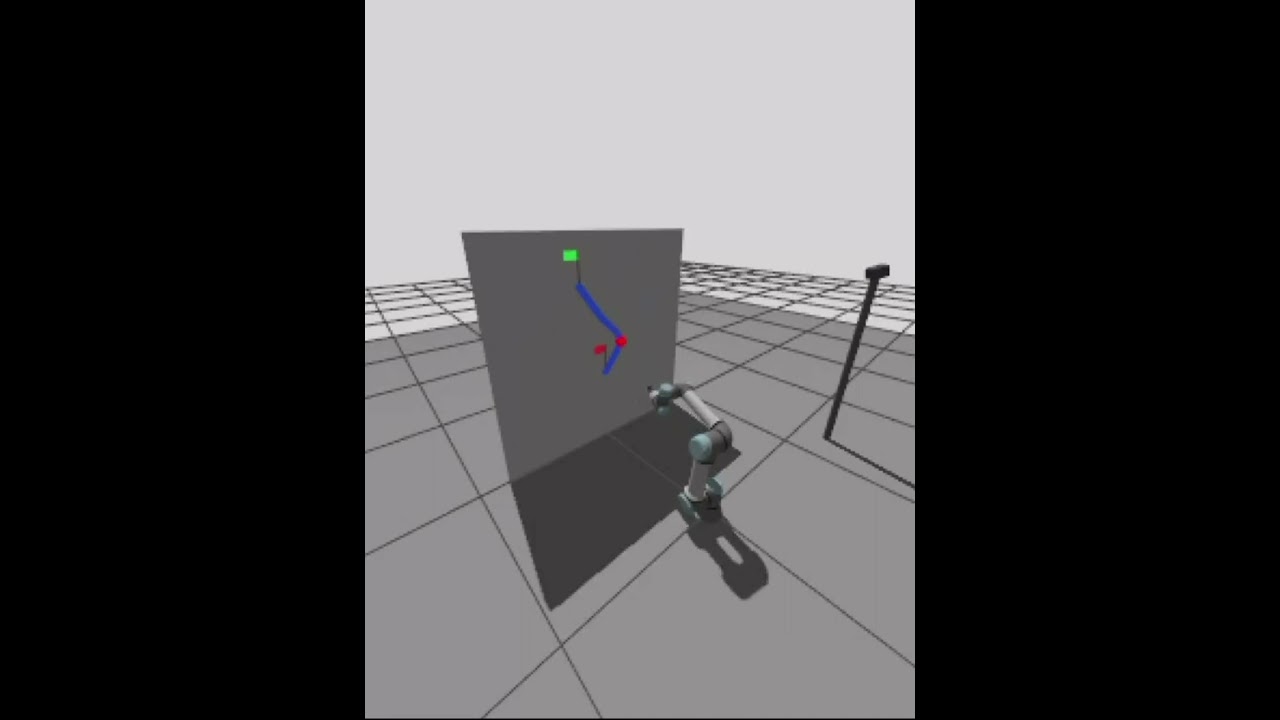
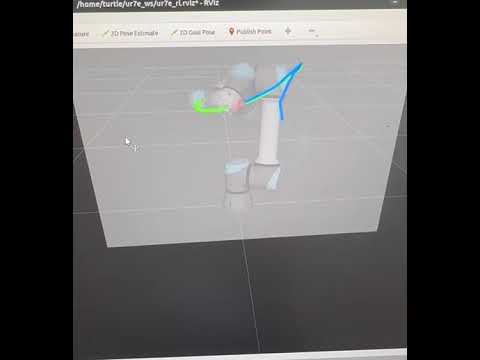
This suite contains four independent projects. Simulations are functional, but the full transfer onto the real robot is not validated end-to-end: the vision/KLT chain loses the laser dot during motion, which currently blocks closed-loop control on hardware — see the real-implementation README for details.
| # | Folder | Role | Status |
|---|---|---|---|
| 1 | line-follower-simulation-simple |
Lightweight SAC trajectory-tracking demo (100% acquisition, 97% completion, 5.8mm RMS) | Validated in simulation |
| 2 | line-follower-simulation-complete |
Full ROS 2/Gazebo pipeline: SAC+HER, Extended Kalman Filter, LQR singularity-adaptive control, Monte Carlo trajectories | Validated in simulation (7/10 success on held-out episodes) |
| 3 | line-follower-real-implementation |
Real UR7e deployment: fixed camera + TCP-mounted laser, ROS 2 Jazzy | Partial — sim-to-real not validated |
| 4 | target-reaching-obstacle-avoidance |
Reaching, SAC vs. PPO statistical comparison, HER, curriculum learning, obstacle avoidance, hybrid IK+RL — two independent frameworks (Stable-Baselines3 and tf-agents) | Code complete; some analysis scripts require retraining (no included checkpoints) |
- Start with
line-follower-simulation-simpleto see the lightest working SAC model end-to-end. - Move to
line-follower-simulation-completefor the full sensor-fusion pipeline (EKF, LQR, Monte Carlo) and the regenerated result plots. - Read
line-follower-real-implementationbefore connecting to real hardware, and always run its shadow test first. - Explore
target-reaching-obstacle-avoidancefor the broader RL methodology: algorithm comparison, sparse-reward techniques, curriculum learning, and a hybrid classical/RL pipeline.
pie showData
    title Project time breakdown — 130h total
    "Reinforcement Learning (SAC, HER, reward design)" : 35
    "Python Engineering (envs, wrappers, pipelines)" : 20
    "ROS2 / Gazebo Integration" : 20
    "Computer Vision (KLT, HSV, calibration)" : 15
    "Robust / Optimal Control (LQR)" : 13
    "State Estimation (EKF / Kalman)" : 12
    "Robotics Modeling & Kinematics (DH, IK/FK)" : 10
    "Real Robot Deployment & Debugging" : 5
Line following works in simulation but is not yet robust on the real robot. The red laser dot is correctly detected at rest, but KLT tracking is lost during motion. Leading hypotheses: ambient light too strong, laser dot too thin / weakly saturated, red reflections or parasitic objects in frame, unstable camera auto-exposure.
The Target Reaching / Obstacle Avoidance batch requires an external ur7e_pybullet/ folder (robot URDF + meshes) that is not included here — see target-reaching-obstacle-avoidance/MISSING_PREREQUISITE.md for the recovery procedure.
- ROS 2 Humble or Jazzy depending on the batch.
- Python 3.10/3.12 depending on the ROS installation.
- Stable-Baselines3, Gymnasium, PyTorch, NumPy, IKPy for RL simulations; tf-agents/TensorFlow for the alternative approach in batch 4.
- OpenCV for the real vision pipeline.
Each subfolder keeps its own README and commands — this root README is orientation only.
MIT — see LICENSE.