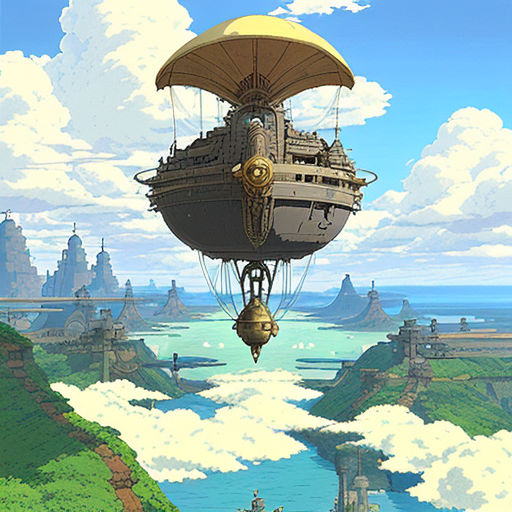
Steampunk airship by me using Playground AI
This is a model assignment for a semester-long medium-length research article that integrates AI into every phase of the research and writing process. The overaching goal is for students to practice using AI tools in a reflective way, and move towards collaborating with AI instead of simply delegating work to a model.
The assignment has five phases, covering the entire process of topic generation, background research, outlining, drafting, and editing. For each phase, I supply example prompts that students can use to interact with an AI tool. Students also maintain a logbook where they record their prompts, the AI's responses, and their reflections and iterations. The logbook is a key element of the assignment: it allows me to see how students are developing their ideas and assess their critical engagement with AI.
This framework is based on lessons I learned in 2023 and 2024 courses at Rollins. It also incorporates ideas I've picked up from a number of sources, notably Ethan Mollick's writing on teaching with AI. I used Anthropic's Claude as part of the brainstorming process, and for help drafting the content of some sections and the example prompts.
The sections below are based on the version I developed for my Ancient Algorithms course in the Rollins Honors program. The class is survey of math, technology, and computation throughout history, with an emphasis on exploring the developments of different time periods and cultures.
The assignment easily generalizes to other courses, so you should feel free to modify it to meet the goals of your course. My colleagues and I have now used this framework successfully in several classes at Rollins, including general education courses, capstones, and upper-level STEM electives.
The steps below can be done with any leading model. I personally use prefer Claude and recommend it to my students, but the frontier offerings from ChatGPT and Gemini are also highly capable. You may find that each model has a certain personality and some work better for you that others.
This work is licensed under the Creative Commons CC0 license. You're free to use, reproduce, modify, or share it, in whole or in part, as if it was in the public domain. Attribution to the original author (Dan S. Myers) is always appreciated, but not required.

Snoop Dogg in classic TV series by Reddit user u/Larry-fine-wine
This course is about the development of computation, mathematics, and technology in the ancient world. In this, our major research project, you’re going to choose one particular historical innovation and write about why it’s important. This could be a new technology, a tool, a theorem, a computational method, or something else related to the broad themes of the course.
We’re also using this assignment to practice researching and writing with AI tools. Each phase integrates AI and you will be able to practice using AI in all phases of the writing process. Note that, while I expect you to use AI to complete this assignment, some parts must still be done by you, yourself, without AI assistance. Review the AI statement on the course syllabus.
The overall goal of this assignment is for you to practice using AI in a moderate-length research-based essay. In addition to developing a deeper understanding of your research topic, you will also:
-
Understand the strengths and weaknesses of AI. Language models are powerful, but aren’t good at everything. You should have a nuanced understanding of the strengths and weaknesses of AI and know how to choose the right tool for a particular task, which includes choosing between different AI tools (for example, Copilot vs. Claude) and knowing when a search engine is a better choice than an AI.
-
Understand how to use AI in the writing process, beyond simply giving it a prompt that generates a complete essay. We’ll practice using AI to generate ideas, refine a thesis statement, formulate a research plan, and collaboratively edit your work.
-
Maintain agency and critically evaluate AI output for both correctness and quality. Remember that you are always in control and you’re free to accept, reject, or modify any output the AI gives you. Use AI to refine the expression of your own vision, not to outsource your own thinking.
-
Reflect on your experiences. AI is new for all of us, so you need to think carefully about what you’ve learned and how to integrate it into your future work.
This assignment is broken up into five phases, described in detail below. Each phase has a particular deliverable that you’ll submit. Read each phase carefully, because I will give you specific steps and prompts to use with AI tools for each part.
You will also maintain a logbook keeping track of each step in your process. This is where you’ll record the prompts you give to the AI, the output it produces, and your responses and revisions. The directions for each phase will tell you when to record something in the log; make sure to read them carefully. The log serves two purposes:
- It’s the record of your work-in-progress, so you don’t have to worry about losing anything if you accidentally delete an AI conversation.
- It demonstrates your thinking and reflection. Remember: your goal is to use AI as a tool to execute your own vision.
-
Don't simply hand-off work to the AI. Think about using AI as a collaborator and have conversations.
-
Don't come empty-handed. Bring your current work-in-progress (even if that's just an idea) and start chatting about the next steps.
-
AI models can easily hallucinate information, including facts, references, and dates. Don’t trust the output of a model unless you know it’s true or can verify it with a reliable third-party source.
-
Balance AI assistance with doing your own analysis and using your own voice. Maintain agency over your work!
-
Use the right tool for each task. I recommend using either Copilot in Creative mode or Claude as your main model. Remember that Copilot can access the Internet, but sometimes a conventional search engine is a better choice. ChatGPT-4o and Google's Gemini are the other major foundation models; you might want to experiment with them and compare their results to Claude.
-
Consider the ethical implications of relying on AI for various tasks. Reflect on when human effort is still essential.

Residential street in the solarpunk city of the future by me using Playground AI
To begin, you will use an AI tool to help generate some initial topic ideas that you can choose from for your research paper. The goal here is to get your creative juices flowing—the AI will suggest a wide range of possibilities to consider.
Start by thinking about your interests. What might you like to write about? You don't need to have a specific idea yet, but just a general sense of the direction you might like to explore. For example, you might be interested in writing about something related to Rome, or maybe military technology. There's no specific requirement here, just take a few minutes to come up with something as a starting point. If you have multiple topics, that's also fine.
Open your logbook document. Write the following prompt:
Please generate 10 potential topics for my research paper in the course 'Ancient Algorithms'. The topics should relate to innovations in ancient technology, mathematics, or computation from before 1800 CE. The subject of the paper should be a specific tool, invention, theory, written work, or intellectual movement. Present each topic idea as a title. I'm most interested in writing about <LIST OF TOPICS>.
Input the prompt into Claude. Copy the generated list of 10 topic ideas into your logbook. Write a few sentences reflecting on the topic ideas. Do they seem interesting? Are they appropriate for the scope of this assignment? Would you revise or modify any of them? Note your thoughts in your logbook.
Tip: If you need to, prompt the AI to generate more ideas. Try refining the prompt to make it more restrictive; for example, prompting it to consider only tools related to astronomy.
Based on the AI generated ideas and your own interests, choose 2-3 topic ideas to explore further. Write a few sentences explaining why you chose them.
Next, gather some information on your potential topics. Think of this as “pre-research” to give you high-level background on the topics so you can further evaluate them. Make sure you have web search enabled on your model if it's not enabled by default. Here’s an example prompt:
I’d like to learn more about [insert topic]. Please provide an overview of its historical background and significance. Include information on what it is, when and where it was created, why it was an important innovation in its time period, and its relevance to modern society.
Repeat the query for each of your potential topics. Review the background summary (keeping in mind that it might contain errors), then write your own assessment of the topic and its suitability for your paper. After evaluating each topic, select the one that you feel is most interesting and write a few sentences about why you chose it.
Now, let’s use the AI to refine your idea and get some reflective feedback. Use the following prompt in Claude:
One topic idea I want to develop is [insert topic]. Please provide feedback to refine this topic for a 5-7 page research paper. Clarify the scope, reduce ambiguity, and suggest 3-5 kinds of evidence I should look for to properly investigate this topic.
Review the AI output and use it to refine your topic idea. Record the original prompt, AI response, and your reflections on the AI’s feedback in your logbook. Write down your revised topic idea.
Using your refined topic, prompt the AI to outline specific steps for finding sources and evidence to research your chosen innovation. Develop your own prompt for this step and record it in your logbook. Record the AI suggested research plan in your logbook. Make any revisions to the plan you think would improve it. If you think the plan isn’t clear, revise your prompt and try again until you get a more useful response.
At the end of this phase, you’ll submit:
- Your topic.
- Your research plan.
- The logbook detailing your conversations with the AI and reflections on its responses.

Nike x Van Gogh sneaker collab by Ethan Mollick using Midjourney.
Use academic search engines and databases to find four relevant scholarly sources on your topic, following the research plan developed in Phase 1.
Start by using your AI's deep research tool. Here’s an example prompt:
Please research academic articles giving an overview of scholarship on [insert topic] and recommend accessible papers that I can use to begin researching it in more detail.
The output will give you a summary of the topic with links to background articles. Read the summary, follow those links, and take a look at the articles. Perform some follow-up queries as you look for more relevant threads. Your initial goal is to build a general understanding of the background of your topic area and identify some major themes.
Once you've explored the topic a bit with a general model, switch to Scopus AI, a stronger engine that actually searches academic databases for peer-reviewed work.
- To access it, go here and scroll down to the Scopus link.
- Once you're on the Scopus page, click on "Scopus AI" in the menu bar near the top.
Again, iterate with Scopus AI as you look for relevant articles. It will provide summaries for you, but you still want to look at the actual underlying papers: the summaries may not be 100% accurate, or they may not have complete details relevant to your question.
In your logbook, summarize the search process. Explain why you chose the papers that you did. Reflect on the quality of the results you obtained. At the end of this process, you should have 4-5 promising sources relevant to your topic.
Carefully read your articles. This will take some time. For each one — by yourself, without an AI tool — write a list of the key points it makes related to your topic. What arguments does it make or what factual evidence does it supply? How does its content relate to your topic?
Tip: Because you have already done the work of refining your topic and creating a research plan, you should have a general sense of what kinds of information are useful for your paper.
Once you have prepared your bulleted summaries, use an AI model to convert your summaries into paragraphs. If your articles are in PDF files, you can upload them to Claude and then ask it to produce a summary of the article following your bullet points.
Paste each summary into your log, then write reflections on the accuracy and quality of the AI summaries. Make any necessary edits directly in the logbook.
Now use the following prompt to synthesize the main points from all of your sources:
I am researching [topic] and have summarized several academic sources as part of my annotated bibliography. The key points from my summaries are:
- [Bullet point summary of key points from Source 1]
- [Bullet point summary of key points from Source 2]
- [Bullet point summary of key points from Sources 3]
- Continued summaries of other sources
Please synthesize these main points from my source summaries into a coherent 2-3 paragraph overview. Identify common themes and relationships between the sources. What collective conclusions can be drawn about my research topic from these sources?
Again, put the results in your logbook and write a response. What does this synthesis suggest about the direction of your paper? What ideas about your topic seem more relevant and interesting?
Compile citations for each source in APA format, the revised summaries, and synthesis paragraphs from your logbook into an annotated bibliography document.
Submit the annotated bibliography and logbook showing your process and reflections as the Phase 2 deliverables.

Edward Hopper's 'Bored Women Looking at Their Smartphones' by Reddit user u/uriba
Prompt the AI conversationally to discuss potential thesis ideas related to your research topic. For example:
I have been researching [topic]. Based on what I've learned, here are some ideas I'm considering for my thesis statement: [summarize main findings and interests here]. What are your thoughts on these concepts? What would make a compelling and defensible thesis based on this research?
Have a back-and-forth discussion prompting the AI to help refine and focus your main claims and ideas. Record the full conversation in your logbook.
Based on your topic exploration so far, draft 1-2 potential thesis statements that present an insightful, defensible central claim. Aim for precision and significance.
In your logbook, reflect on what makes an effective thesis statement, then prompt the AI:
Please provide feedback on my draft thesis statement for my paper on [topic]. My thesis is [insert thesis]. The thesis needs to
- Provide the reader with clear expectations on what I'm setting out to prove or deeply analyze
- Explore an interesting or not obvious ideas about ancient math or technology
- Have an argumentative element to it requiring support from multiple sources
- Be appropriate for a 5-7 page college research paper in an Honors course
Comment on how the thesis fits the criteria above, and suggest ways to improve clarity, focus, and compellingness.
Refine your thesis based on the AI feedback. Record iterations in your logbook.
Create a rough outline with the major sections of your paper—introduction, body paragraphs, conclusion—and short summaries of the key points and evidence to be covered in each section. Prompt the AI: Please review the structure of my outline and provide feedback. Are there any missing elements or logical gaps?
Refine the structural outline based on the AI feedback. As before, enter the starting outline, the AI’s output, and your reflective revisions into your logbook.
You’re now going to create a detailed outline that bridges the gap between your high-level structural outline and the actual draft you’ll write in the next phase. Use the following prompt:
I have created a structural outline for my research paper:
[Outline]
Please take this structural outline and expand it into a detailed paragraph-level outline. Indicate places in the detailed outline that should be supported by relevant evidence, quotes, or citations.
Record the detailed outline in your logbook.
Submit a document containing your thesis statement and detailed outline as the deliverable for this phase.

Retrofuturistic Japan in space by Reddit user u/jedzsol
It’s now time to turn the detailed outline you produced in Phase 3 into a full draft of the paper.
You have broad freedom to complete this phase in the way that you feel is best, including developing your own AI prompts.
I do, however, have one important guideline: don’t try to create your draft by running one single prompt, and then repeatedly editing that prompt. As a rough rule, it's hard to generate more than about one decent paragraph of text per sentence of the prompt. The more details you leave unspecified, the more the model has to fill in to generate the required amount of text, which increases the chance of hallucinations and empty writing.
Here are three techniques you may find helpful:
-
Get HUGE. Make a big prompt containing everything: your topic, thesis statement, outline, annotated bibliography, paper summaries, all of your notes, and so forth. Fill that context window! The more information you supply, the more relevant info the model has to draw from.
-
Partial writing. Write some parts yourself, then ask the AI to fill in the details. For example, you might write the introduction, conclusion, and first sentences of each paragraph, then try generating the rest of the body. This mixes well with the big prompt approach.
-
Collaborate. Just write as normal, but use the AI as a partner-in-the-loop to help you solve writing problems as you go. If you get stuck, ask for help getting unstuck. You can quickly free-write ideas, then ask the AI to clean them up. This approach is less flashy, but works well because it's fundamentally built around your voice.
Once you generate your initial draft, enter it in your log. As you make revisions, record your thought process and any prompts that you use into the log, so you have a record of your AI interactions (and manual edits) that led up to the final draft. You don't need to log a complete draft for every revision of the paper that you make, just describe your thoughts and changes.
You’ll need to include a list of references at the end. I recommend using APA-style citations with the (Name, Year) form. Here are some other tips:
-
"Make it better" is surprisingly useful for improving a draft. It prompts the model to self-evaluate and reflect on the draft content. A couple of rounds of this will often make a more elaborate and detailed (but maybe overhyped) draft that you can then smooth out and return to a neutral tone.
-
If the style seems too "default AI", give it a specific persona to use when writing.
-
Be careful about asking for revisions of length or style over the entire text; they can often lead to major content rewrites.
-
You will need to include references to your cited works and relevant factual information. Remember that AI tools often struggle with this. Carefully check all factual information in your draft. You will probably need to make hand edits to make sure the information you include is correct.
-
Maintain your agency! Remember that you are in charge and the AI is there to execute your vision. Don’t outsource your thinking!
Once you have completed your draft, ask the AI to take on the role of a peer reviewer and provide feedback:
Please take on the role of a peer reviewer for the first draft of my research paper on [topic]. Read through my draft and provide constructive feedback as if you were a classmate. Specifically, please comment on:
- The clarity and strength of my thesis statement in the introduction
- How well my evidence and sources support the claims in each paragraph
- The logic and flow of the overall structure and arguments
- Any sections that need better transitions or more explanation
- The quality of my conclusion in summarizing the main points
- Any grammar/spelling/style issues you noticed Please provide at least 5 specific and actionable suggestions for improving my draft, including identifying any areas that need to be expanded, reorganized, or reworked.
Enter the AI response into your log and then write a few sentences giving your evaluation of its feedback. Does the AI make good points? Record the changes, if any, that you make in response.
Submit your final revised draft and logbook and the deliverable for this phase. Remember that your log should record the AI interactions and your reflective responses that led to the creation of the final draft.

Freddie Mercury performing at the 2023 San Francisco Pride parade by Reddit user u/Legitimate-Room-1905
Finalize the content of your paper. You’re free to use AI to suggest edits, following the model of Phase 4. Experiment with prompting the AI in different ways to provide varying perspectives on your paper—for example, by asking it to take on different roles.
Prompt the AI to act as your coach and use it to have a reflective conversation. Enter the conversation, including your responses, into your logbook.
Imagine you are my coach. I just completed a research paper using AI writing tools to assist me through the process. Please have a reflective discussion with me as my coach to help me synthesize my learnings. Ask me questions like:
- What parts of the process went well or poorly when using the AI tools?
- Were there times when relying on my own analysis would have been better?
- How did I balance integrating AI input with maintaining my own perspective and voice?
- What criteria did I use to evaluate the AI's suggestions and determine what to incorporate or reject?
- How has this experience shaped my views on using AI tools ethically and effectively in research and writing moving forward?
- What advice would I give peers about getting the most out of AI tools while avoiding potential pitfalls?
You can prompt me with follow-up questions and prompts to push my reflection deeper. The goal is to synthesize my learnings and think critically about integrating AI thoughtfully. Please act as my coach guiding me through this reflective discussion.
For your final element, write a one-page summary talking about what you learned during this process. This is a reflection of your thoughts, so it should be written by you, without using any tools. You’re free to write your own thoughts, but some things you might want to consider include:
-
What were your previous experiences working with AI tools?
-
How do you feel about working with AI after having completed this project? What were some things that did (or did not) surprise you?
-
What advice would you give to others about working effectively with AI? What did you find useful (or not)?
-
How would you approach using AI on a future project?
-
Based on your experiences, how do you think education should (or should not) adapt to respond to AI?
Submit the completed final paper, your logbook containing the reflective conversation, and the final lessons learned write-up.
You are now done.