



WebCalendar is a multi-user, web-based calendar application built with PHP. It supports multiple database backends, features event management, user groups, access controls, and integrates with external applications. Designed for both personal and enterprise use, WebCalendar can be deployed on any web server with PHP support.
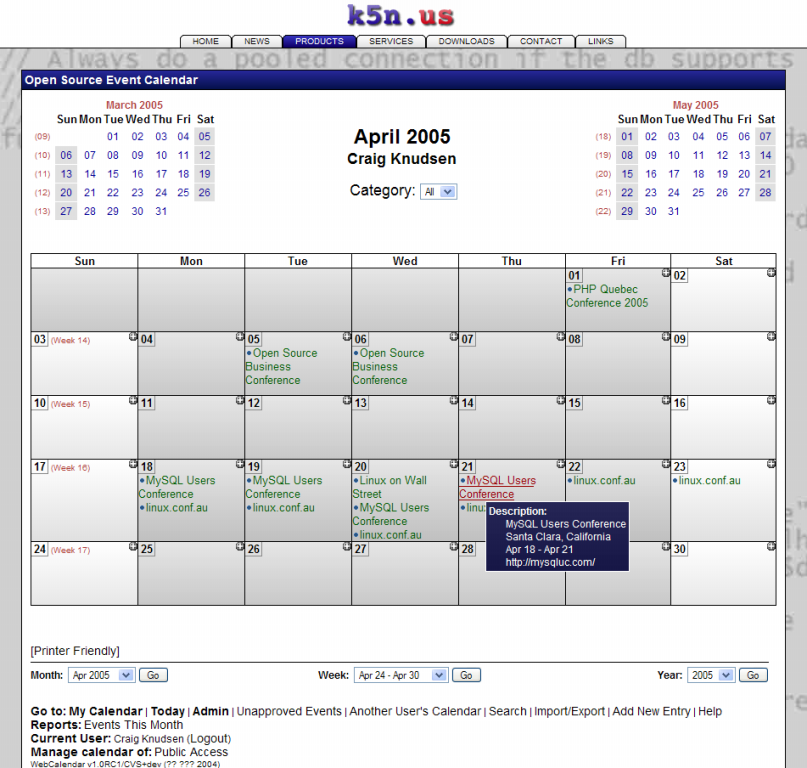
- Multiple Calendar Views - Month, week, day, year, and agenda views
- Multi-User Support - User management with groups and permissions
- Recurring Events - Support for complex event repetition patterns
- Access Control - Granular permissions for viewing and editing events
- Email Notifications - Event reminders and updates via email
- Responsive Design - Works on desktop and mobile devices
- Multi-Language - Translation files for 100+ languages (~35 human-contributed with substantial coverage)
- iCal Import/Export - Import and export calendar data in iCalendar format
- External Integration - LDAP, IMAP, and custom authentication bridges
- Docker Ready - Pre-built Docker images for easy deployment
- MCP Server - Model Context Protocol support for AI assistant integration
- PHP 8.2+ (tested against 8.2, 8.3, 8.4)
- Database: MySQL/MariaDB, PostgreSQL, or SQLite3
- Web server: Apache or Nginx with PHP support
# Clone the repository
git clone https://github.com/craigk5n/webcalendar.git
cd webcalendar

# Start with Docker Compose
docker-compose -f docker/docker-compose-php8.yml up

# Access at http://localhost:8080-
Download the latest release or clone the repository:
git clone https://github.com/craigk5n/webcalendar.git
-
Point your web server to the WebCalendar directory
-
Run the web-based installer by visiting your WebCalendar URL:
https://yourserver.com/webcalendar/The installer will automatically redirect to the setup wizard.
-
Follow the guided setup to configure your database and admin user
For automated deployments, use the headless installer:
php wizard/headless.phpSee the Installation Guide for detailed instructions.
Build and run a development environment with live file mounting:
# Start the development containers (MariaDB + PostgreSQL)
docker-compose -f docker/docker-compose-php8-dev.yml up

# Access at http://localhost:8080 (MariaDB) or http://localhost:8081 (PostgreSQL)
Changes to your local files are immediately reflected in the container.
See Docker Deployment for all available configurations.
WebCalendar supports containerized deployments via environment variables:
# Docker Compose example
environment:
  WEBCALENDAR_USE_ENV: "true"
  WEBCALENDAR_DB_TYPE: mysqli
  WEBCALENDAR_DB_HOST: db
  WEBCALENDAR_DB_DATABASE: webcalendar
  WEBCALENDAR_DB_LOGIN: webcalendar
  WEBCALENDAR_DB_PASSWORD: "your_secure_password"
  WEBCALENDAR_MODE: prod
For Apache deployments, add to .htaccess or web server configuration:
SetEnv WEBCALENDAR_USE_ENV true
SetEnv WEBCALENDAR_DB_TYPE mysqli
SetEnv WEBCALENDAR_DB_HOST localhost
SetEnv WEBCALENDAR_DB_DATABASE webcalendar
SetEnv WEBCALENDAR_DB_LOGIN webcalendar
SetEnv WEBCALENDAR_DB_PASSWORD "your_secure_password"
SetEnv WEBCALENDAR_MODE prod- ✅ MySQL / MariaDB (recommended)
- ✅ PostgreSQL
- ✅ SQLite3
Legacy backends (code present, untested on PHP 8): Oracle, DB2, ODBC, Interbase
Run the test suite with PHPUnit:
# Install dev dependencies (only needed for testing/development)
composer install

# Run PHPUnit tests
cd tests; ./run_unit_tests.sh; cd ..

# Syntax check all PHP files
cd tests; ./compile_test.sh; cd ..WebCalendar includes all required dependencies in the release (primarily in the pub/ directory). You do not need to run Composer unless you are adding or updating dependencies.
If you need to modify dependencies:
# Install PHP dependencies (only needed for adding/updating dependencies)
composer install

# Copy vendor assets to project directories (requires Linux — uses sha384sum)
makeWebCalendar can integrate with external systems for user authentication and configuration:
Create a bridge script in includes/user-app-yourapp.php:
// Implement required functions for authentication
function user_valid_login($login, $password) { ... }
function user_get_users() { ... }
See user-ldap.php and user-app-joomla.php for examples.
Create includes/config-app-yourapp.php to override settings dynamically.
- PHP 8.2+ required (tested against 8.2, 8.3, 8.4)
- New web-based installation/upgrade wizard
- Headless CLI installer for automated deployments
- MCP server for AI assistant integration
- Multi-database Docker test infrastructure
- Modernized codebase with PHP 8.2+ features
- Namespace implementation
- Enhanced security and access control
- Installation Guide - System requirements, setup wizard, Docker
- Admin Guide - User management, system settings, email
- User Guide - Calendar views, events, preferences
- Upgrade Guide - Upgrading from previous versions
- Database Schema - Table definitions
- Developer Guide - Architecture, coding standards, testing
- MCP Server - AI assistant integration
Browse the full documentation or see the docs index on GitHub.
To report a security vulnerability, please see SECURITY.md. Do not open a public issue for security reports.
Contributions are welcome! Please read the Contributing Guide for details.
- Fork the repository
- Create a feature branch (
git checkout -b feature/amazing-feature) - Commit your changes (
git commit -m 'Add amazing feature') - Push to the branch (
git push origin feature/amazing-feature) - Open a Pull Request
Bug reports and feature requests use GitHub issue templates.
This project has a Code of Conduct. Please follow it in all interactions.
WebCalendar is licensed under the GNU General Public License v2.0.
See CHANGELOG.md for release history.
- Website: https://k5n.us/webcalendar/
- Issues: https://github.com/craigk5n/webcalendar/issues
- Releases: https://github.com/craigk5n/webcalendar/releases
Craig Knudsen - craig@k5n.us - https://k5n.us
See AUTHORS for a complete list of contributors.