


Backstage plugin for integration with Conviso Platform. Import your Backstage catalog entities as assets in Conviso Platform.
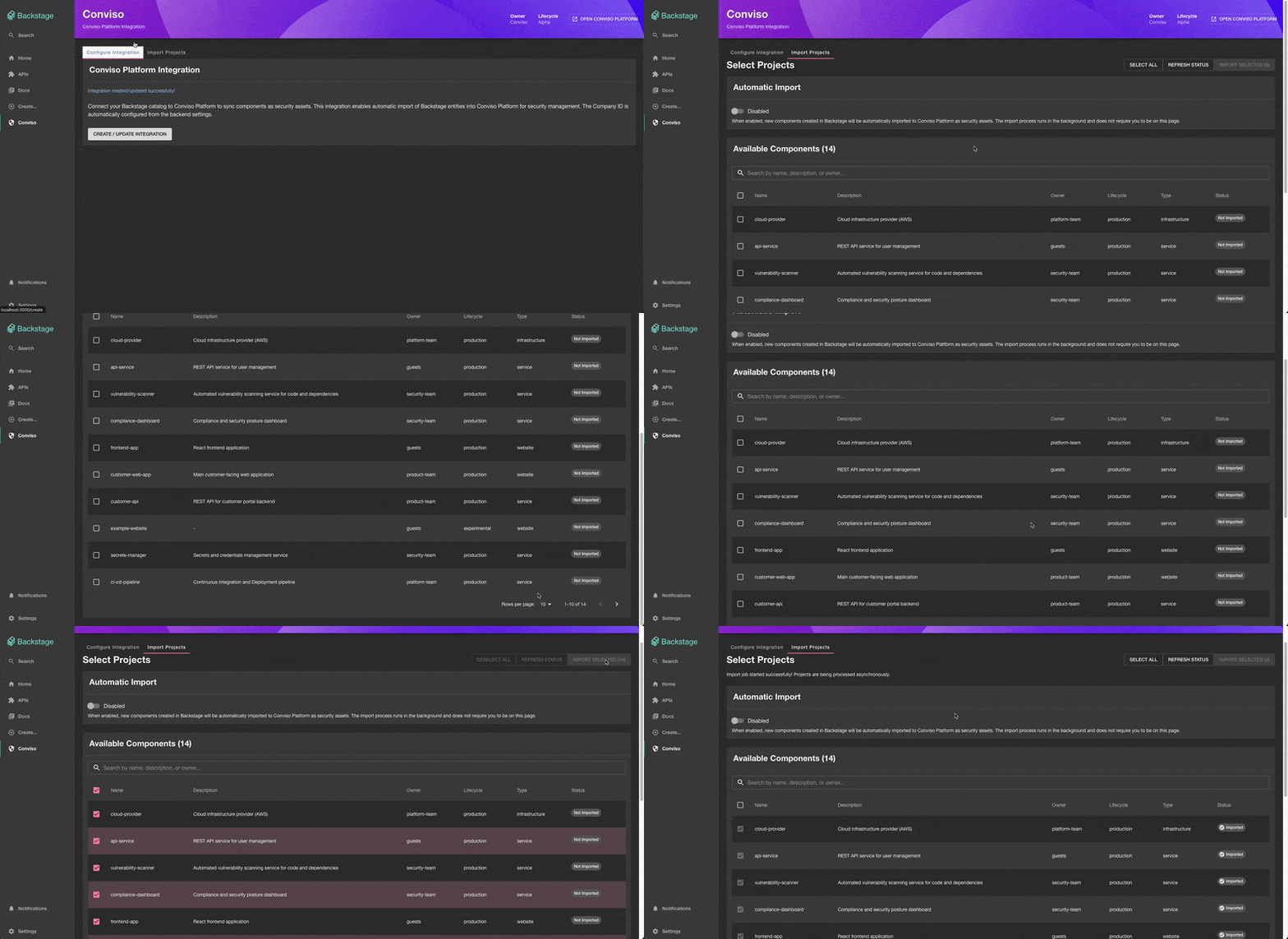
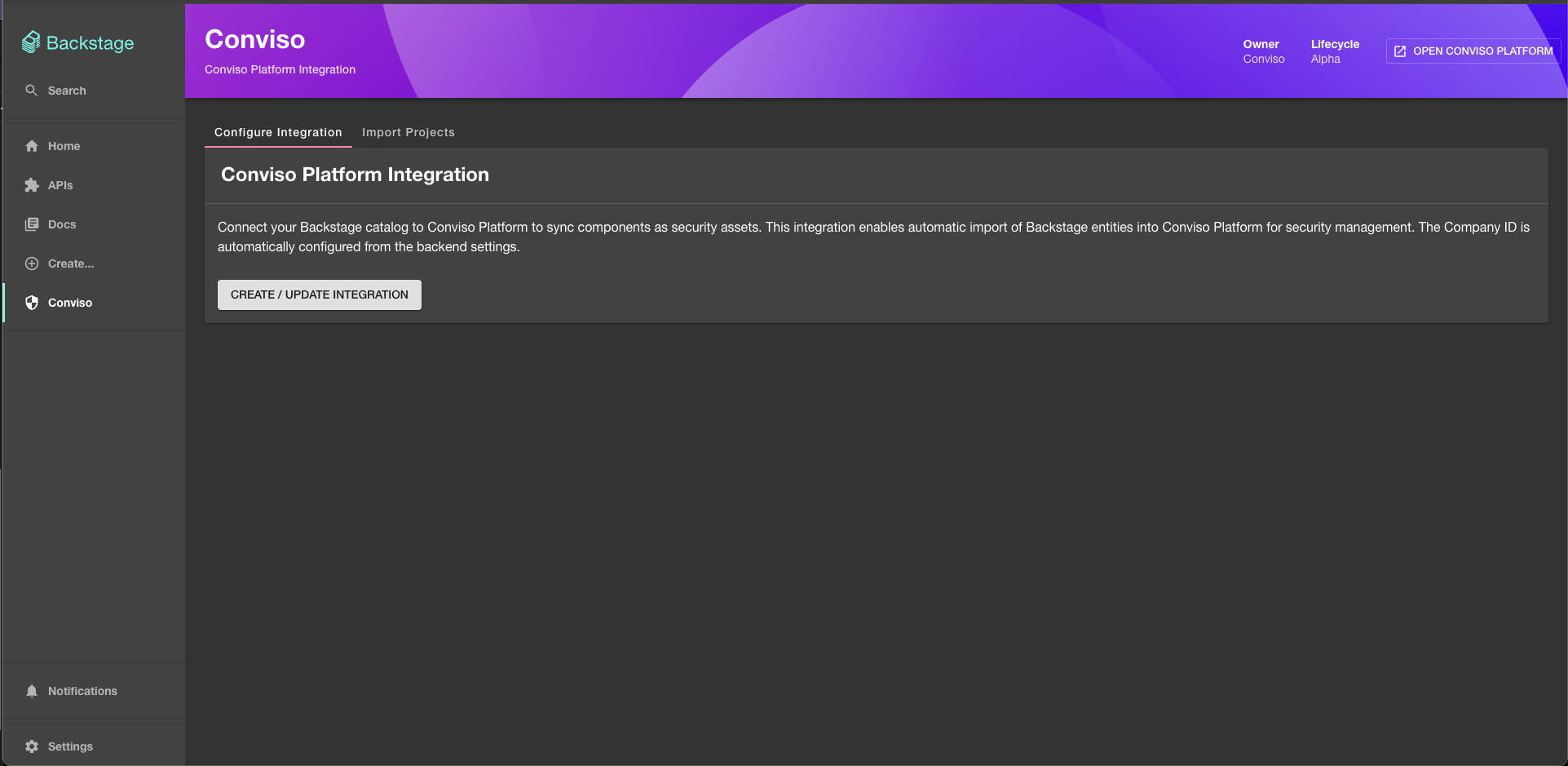
Integration Creation - Create and configure your Conviso Platform integration
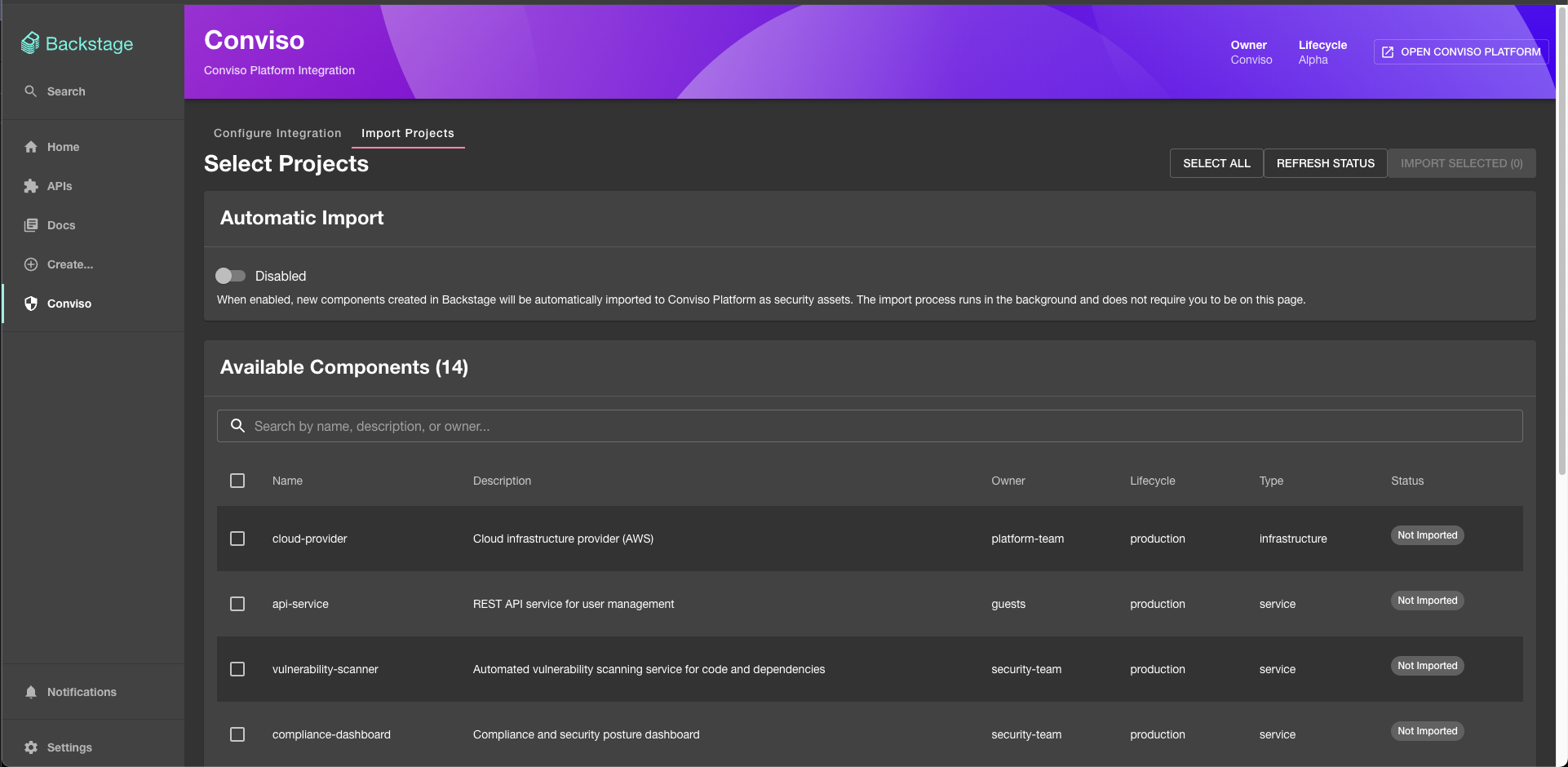
Entity List - Browse and view your Backstage catalog entities
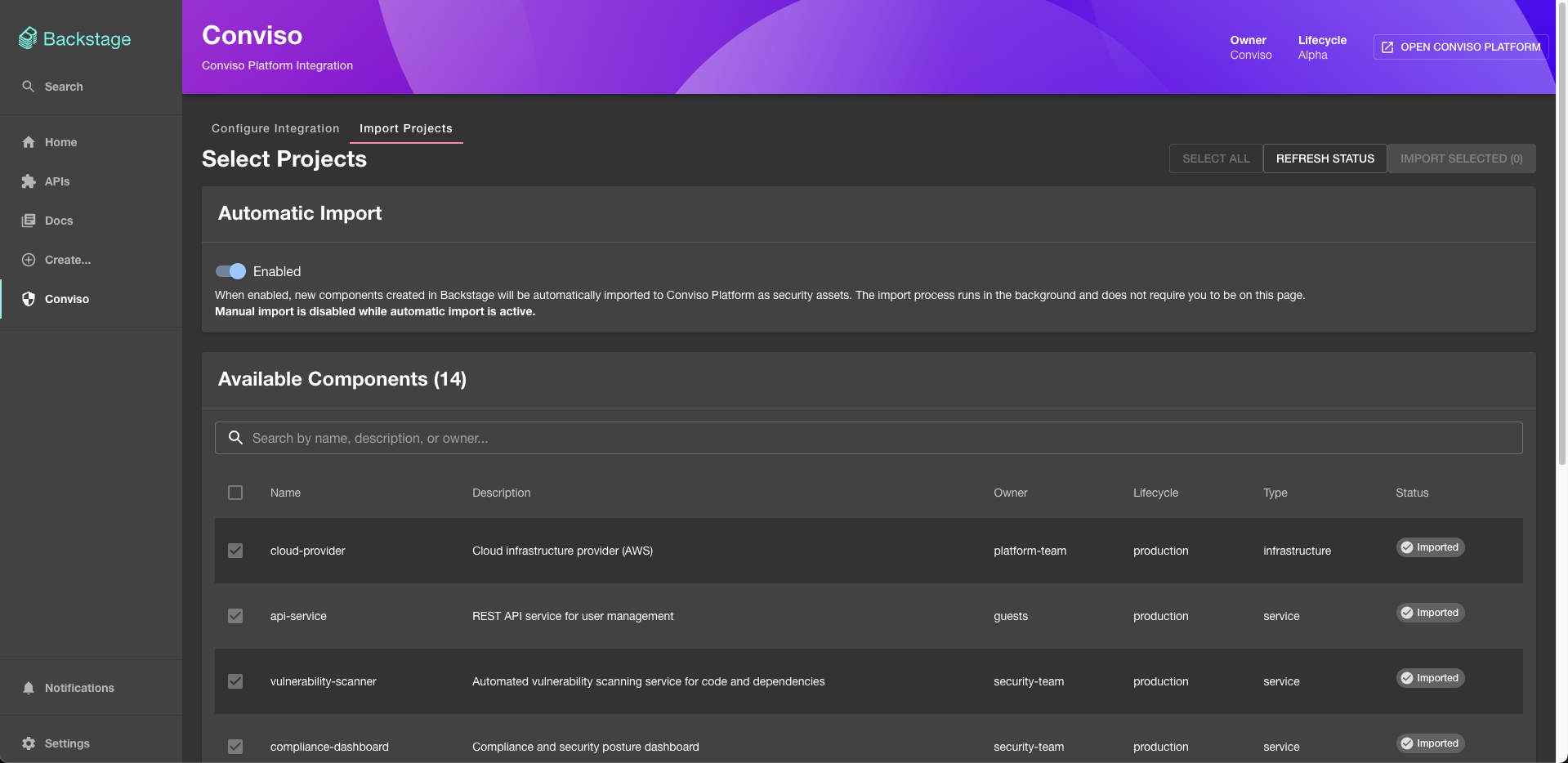
Entity Import - Select and import Backstage entities as security assets
- 🔄 Project Import: Import Backstage catalog projects as assets in Conviso Platform
- 🤖 Auto-Import: Automatically sync new entities from your Backstage catalog
- 📊 Status Tracking: View which projects are imported and their status
- 🔍 Search & Filter: Search projects by name, description, or owner
- ⚡ Performance: Multi-layer caching system for fast operations
- 🔐 Security: Secure API key authentication with Conviso Platform
- 📈 Scalable: Handles large catalogs with efficient pagination and batch processing
Install the plugin package in your Backstage app:
yarn add @conviso/backstage-plugin-convisoOr with npm:
npm install @conviso/backstage-plugin-conviso1.1. Add the route (packages/app/src/App.tsx):
import { BackstagePluginConvisoPage } from '@conviso/backstage-plugin-conviso';

// In your routes
<Route path="/conviso" element={<BackstagePluginConvisoPage />} />
1.2. Add sidebar navigation link (packages/app/src/components/Root/Root.tsx):
import { SidebarItem } from '@backstage/core-components';
import SecurityIcon from '@material-ui/icons/Security';

// Inside the SidebarGroup "Menu", add:
<SidebarItem icon={SecurityIcon} to="conviso" text="Conviso" />
This adds a "Conviso" link to the sidebar menu.
In your packages/backend/src/index.ts, add the backend plugin:
// Conviso plugin backend
backend.add(import('@conviso/backstage-plugin-conviso/backend.js'));
Note: The plugin follows the official Backstage plugin pattern, compiling the backend to CommonJS and exporting via the exports field in package.json.
The plugin uses environment variables with app-config.yaml for secure configuration.
- Export environment variables in your shell:
export CONVISO_API_KEY="your-api-key"
export CONVISO_COMPANY_ID="your-company-id"
export CONVISO_ENVIRONMENT="production"  # or "staging" or "local"
export CONVISO_API_BASE="http://localhost:3000" # Only if environment is 'local'- Add configuration to
app-config.yamlusing environment variable substitution:
# Conviso Platform configuration
conviso:
  apiKey: ${CONVISO_API_KEY}
  companyId: ${CONVISO_COMPANY_ID}
  environment: ${CONVISO_ENVIRONMENT:-production}
  apiBase: ${CONVISO_API_BASE}  # Required if environment is 'local'
Important: Always use environment variable substitution (${VAR}) in app-config.yaml to avoid committing sensitive values to Git. Never hardcode API keys or company IDs directly in the config file.
- Start Backstage:
yarn startConfiguration Priority:
- Exported environment variables (highest priority) -
export CONVISO_COMPANY_ID=1028 app-config.yaml(Backstage config file with variable substitution)
This ensures sensitive values are never committed to Git and remain secure.
After installation and configuration:
- Start your Backstage instance:
yarn dev(oryarn start) - Navigate to
http://localhost:3000/convisoin your browser - Start importing your Backstage catalog entities!
- Navigate to the Conviso plugin page in Backstage (
/conviso) - Browse your catalog entities in the table
- Select one or more projects you want to import (use checkboxes)
- Click "Import Selected" to sync them to Conviso Platform
- Wait for the import to complete (you'll see a success message)
Enable auto-import to automatically sync new entities from your Backstage catalog:
- Toggle "Auto Import" in the plugin interface
- New entities will be automatically imported when detected
- The system runs periodic checks to sync new projects
Use the "Refresh Status" button to update the import status of all assets, ensuring the plugin reflects the current state in Conviso Platform.
The backend plugin provides the following REST API endpoints:
GET /api/conviso/imported-assets/:companyId?- Get list of imported assetsPOST /api/conviso/import-projects- Import projects to Conviso PlatformPOST /api/conviso/check-imported-names- Check which names are already importedPOST /api/conviso/sync-imported-assets/:companyId?- Sync asset cacheGET /api/conviso/integration/:instanceId- Get integration detailsPOST /api/conviso/integration- Create or update integrationPOST /api/conviso/auto-import- Configure auto-import settings
Required:
CONVISO_API_KEY- Your Conviso Platform API key
Optional:
CONVISO_COMPANY_ID- Default company ID (can also be provided per integration)CONVISO_ENVIRONMENT- Environment:"production"(default),"staging", or"local"CONVISO_API_BASE- Custom API base URL (required ifCONVISO_ENVIRONMENT=local)CONVISO_CACHE_DIR- Custom cache directory path
conviso:
  apiKey: ${CONVISO_API_KEY}
  companyId: ${CONVISO_COMPANY_ID}
  environment: ${CONVISO_ENVIRONMENT:-production}
apiBase: ${CONVISO_API_BASE} # Required if environment is 'local'The frontend plugin reads configuration from:
localStorage: StorescompanyIdandinstanceIdper instance- Backend API: Fetches integration settings from the backend
yarn startThe plugin will be available at http://localhost:3000/conviso.
yarn build# Run all tests
yarn test
# Run tests with coverage
yarn test:coverage
# Run tests in watch mode
yarn test:watch- React components with Material-UI
- Custom hooks for state management
- Caching layer for performance optimization
- Real-time status updates
- Express.js REST API
- GraphQL client for Conviso Platform
- Kafka integration for async processing
- File-based caching system
- Background jobs for auto-import
Contributions are welcome! Please feel free to submit a Pull Request.
- Fork the repository
- Create your feature branch (
git checkout -b feature/amazing-feature) - Commit your changes (
git commit -m 'Add some amazing feature') - Push to the branch (
git push origin feature/amazing-feature) - Open a Pull Request
Copyright 2025 Conviso Application Security
Licensed under the Apache License, Version 2.0 (the "License"); you may not use this file except in compliance with the License. You may obtain a copy of the License at
http://www.apache.org/licenses/LICENSE-2.0
Unless required by applicable law or agreed to in writing, software distributed under the License is distributed on an "AS IS" BASIS, WITHOUT WARRANTIES OR CONDITIONS OF ANY KIND, either express or implied. See the License for the specific language governing permissions and limitations under the License.
- Documentation: GitHub Repository
- Issues: GitHub Issues
- Conviso Platform: https://convisoappsec.com/