

CamusDB is an open-source NewSQL distributed database written in C# on .NET 10. It combines a familiar SQL interface with a Raft-based distributed storage layer, supports multi-node clusters with automatic leader election and partition routing, and exposes a JSON/HTTP API. The project is alpha-quality — APIs and storage formats may change between versions.
This is an alpha project. Do not use it in production.

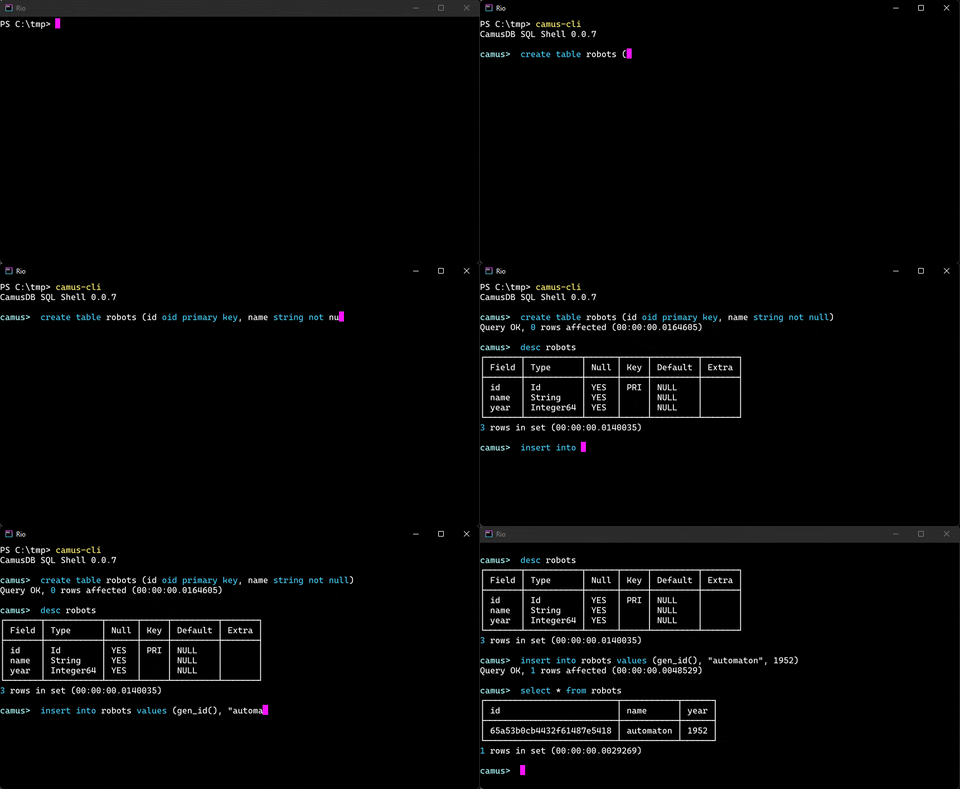
- SQL dialect — SELECT, INSERT, UPDATE, DELETE, CREATE/DROP/ALTER TABLE, transactions (BEGIN / COMMIT / ROLLBACK), parameterized placeholders, table aliases, derived tables, simple inner joins, comma joins, row-level DISTINCT, and case-insensitive identifier handling.
- Aggregation — COUNT, SUM, AVG, MIN, MAX with GROUP BY and HAVING filters.
- Filtering and ordering — WHERE clauses with =, !=, <, >, <=, >=, AND, OR, LIKE, ILIKE, BETWEEN, IS NULL, IN, NOT IN, scalar subqueries, and EXISTS subqueries; ORDER BY (ASC/DESC), projection aliases, ordinal references, LIMIT, and OFFSET.
- Scalar functions — string, math, date/time, cast, object id, and JSON helpers including
json_valid,json_type,json_extract,json_value,json_array_length, andjson_contains. - Query planning — physical plan trees for table scans, index scans, joins, aggregation, distinct, sorting, and limits, with predicate/projection/limit pushdown, index-based sort elision, join-order heuristics, index nested-loop joins for eligible equi-joins, semi/anti-join rewrite of indexed
IN/NOT INsubqueries, index-driven value-listIN, and streamingDISTINCT. A small statistics-backed cost model (row counts, per-index counts, per-column min/max) chooses between index and full scans. - Query introspection —
EXPLAIN,EXPLAIN (LOGICAL),EXPLAIN (PHYSICAL), andEXPLAIN (ANALYZE)return the plan as result rows (node names, details, estimated rows/cost, and — forANALYZE— actual row counts and KV access counters). - Indexes — PRIMARY KEY, inline UNIQUE column constraints, UNIQUE indexes, multi-column indexes, CREATE INDEX IF NOT EXISTS, CREATE UNIQUE INDEX IF NOT EXISTS, and ALTER TABLE ADD/DROP INDEX.
- Database management — databases must be created explicitly (
CREATE DATABASE,DROP DATABASE [IF EXISTS],RENAME DATABASE old TO new); there is no magic creation. Each database is assigned an immutable internal id at creation time; the name is a display-only label that can be renamed without moving any data. - Schema management — CREATE TABLE IF NOT EXISTS, DROP TABLE IF EXISTS, ALTER TABLE ADD/DROP COLUMN.
- ACID transactions — pessimistic locking; serializable isolation is the default (range/predicate locks with wait-die deadlock avoidance and snapshot reads), with read-committed available per transaction (
SET TRANSACTIONor the begin-request field) or as a process default; cross-partition writes use two-phase commit (2PC). - Multi-node cluster — Raft consensus (via Kommander) partitions data across nodes; each partition elects its own leader. Nodes join a cluster with
--mode=clusterand a static peer list. - Standalone mode — runs as a single embedded process with no cluster configuration required.
- HTTP API — all database operations are accessible over a JSON/HTTP endpoint.
- Multi-platform — runs on any platform supported by .NET 10.
stringint64float64boolobjectId
CREATE TABLE IF NOT EXISTS app_users (
  id STRING PRIMARY KEY NOT NULL,
  email STRING UNIQUE NOT NULL,
  display_name STRING NOT NULL,
  password_hash STRING NOT NULL,
  role STRING NOT NULL,
  created_at_utc STRING NOT NULL
);

CREATE UNIQUE INDEX IF NOT EXISTS app_users_email_idx ON app_users (email);

SELECT DISTINCT role FROM app_users ORDER BY role;

SELECT role, COUNT(*) AS users
FROM app_users
GROUP BY role
HAVING users > 0
ORDER BY 2 DESC;

SELECT r.id, r.name, ur.amount
FROM robots r
JOIN user_robots ur ON r.id = ur.robots_id;

SELECT r.id, r.name, ur.amount
FROM robots r, user_robots ur
WHERE r.id = ur.robots_id;

SELECT *
FROM robots
WHERE id NOT IN (SELECT robots_id FROM user_robots);

SELECT json_value(payload, "$.name")
FROM robots
WHERE json_valid(payload) = true;

EXPLAIN SELECT * FROM app_users WHERE email = 'a@example.com';

EXPLAIN (ANALYZE) SELECT role, COUNT(*) FROM app_users GROUP BY role;
SELECT DISTINCT is row-level distinct. Aggregate-level distinct such as COUNT(DISTINCT code) is not supported yet.
A three-node cluster can be started with Docker Compose:
docker compose -f docker/local.yml up --buildThis starts three nodes on a private bridge network:
| Node | HTTP API | Raft port |
|---|---|---|
| camus1 | localhost:5095 | 7070 |
| camus2 | localhost:5096 | 7072 |
| camus3 | localhost:5097 | 7074 |
To run a single node without Docker:
# Standalone (default)
dotnet run --project CamusDB

# Cluster node
dotnet run --project CamusDB -- \
  --mode=cluster \
  --raft-nodename=camus-1 \
  --raft-host=192.168.1.10 \
  --raft-port=7070 \
  --initial-cluster-partitions=3 \
--initial-cluster 192.168.1.10:7070 192.168.1.11:7072 192.168.1.12:7074The engine is structured as a pipeline of composable operators:
- SQL Parser — LALR(1) parser (YaccLexTools) that produces an AST. Identifiers are normalized to lowercase at parse time.
- Query planner — builds a physical plan tree from the bound SELECT model, choosing table scans, index scans, index lookup scans, nested-loop joins, index nested-loop joins, aggregate nodes, distinct nodes, sort nodes, and limit nodes based on query shape and available indexes.
- Query binder — resolves table aliases, derived table output columns, projection aliases, ordinal GROUP BY/ORDER BY references, aggregate scope, HAVING scope, and subquery scope before execution.
- Query operators —
QueryScanner,QueryFilterer,QuerySorter,QueryLimiter,QueryProjector,QueryAggregator,QueryDistincter,SemiJoinExecutor, andQueryJoinExecutorexecute the plan while keeping filtering, sorting, aggregation, projection, and limiting storage-agnostic. - Storage layer — row data and index entries are stored in an embedded Kahuna KV node.
KvTableStoremaps table rows and index entries onto Kahuna keys using a prefix layout that keeps all rows of a table on the same Raft partition. - Transaction layer —
KvTransactionsManagercoordinates BEGIN/COMMIT/ROLLBACK via Kahuna's transaction API; cross-partition writes go through Kahuna's 2PC protocol. - Catalog — table and index descriptors are kept in memory and persisted through the KV layer.
- Cluster mode — a process-level Kahuna node is shared across all databases, wired with real gRPC inter-node and Raft transports (
GrpcCommunication+StaticDiscovery). Standalone mode creates a per-database node with the embedded in-process transport.
See docs/query-planner.md for a full developer reference: pipeline stages, physical plan nodes, predicate analysis, index scan selection, join execution, the cost model and statistics, optimization passes, file map, and a checklist for adding new SQL features. For the user-facing EXPLAIN output format (node names, columns, and worked examples) see docs/explain.md.
See docs/distributed-schema-architecture.md for a full developer reference on how DDL works across a cluster: schema as a replicated state machine over an ordered Raft log, the schema-change delta and the two-version invariant, ack-based convergence, the staged online-schema state machine (DeleteOnly → WriteOnly → Public) with a convergence gate between steps, the resumable change coordinator and crash-safe index backfill, follower→leader DDL forwarding with idempotent dedup, positional row encoding (why renames are free), schema-version pinning, the checkpoint persist-failure policy, an invariants checklist, and known limitations.
CamusDB reads CamusDB/Config/config.yml at startup and merges CLI flags and environment variables into a single resolved configuration (precedence: CLI flag > environment variable > config.yml > built-in default). See docs/configuration.md for the full reference: the precedence model, the CLI ↔ YAML mapping, the isolation/locking and parser-cache tunables, the allow-listed kahuna: engine passthrough, and the validation error matrix.
- .NET 10 SDK
- Docker (optional, for cluster setup)
The test suite is split into two assemblies:
CamusDB.Tests— the fast unit/integration suite (run on every change):dotnet test CamusDB.Tests/CamusDB.Tests.csprojCamusDB.Cluster.Tests— the heavy in-process multi-node cluster suite (real Raft via Kahuna/Kommander). It is isolated in its own assembly so its accumulated in-process load (dozens of sequential clusters) stays out of the fast suite, where it caused load-induced bring-up flakiness. Run it separately / periodically:dotnet test CamusDB.Cluster.Tests/CamusDB.Cluster.Tests.csproj
This project is licensed under the MIT license.
Unless you explicitly state otherwise, any contribution intentionally submitted for inclusion in CamusDB by you, shall be licensed as MIT, without any additional terms or conditions.