Releases: amatino-code/amatino-python
Amatino Python v0.0.18

v0.0.18 makes the following changes. Code currently running on v0.0.16 should generally be backwards compatible with v0.0.18.
- Requests for resources that Amatino API cannot find will now raise a
ResourceNotFounderror, rather than a generic urllib.HTTPError. ResourceNotFound is a subclass of AmatinoError, allowing you to catch non-existent resources along with other Amatino library exceptions. - Internally,
ApiRequest.response_datais now immutable - In previous versions, ApiRequest responded to an undocumented command line argument
--debug. This argument is common and may clash with application command line arguments, causing unexpected behaviour. The argument has been renamed--amatino-debug. GlobalUnitno longer has a .session propertyGlobalUnitnow implements the equality operator via__eq__()- Added a new class:
GlobalUnitConstants, which enumerates a subset of commonGlobalUnits. For example:
# Previously, the only way to get USD was...
usd = GlobalUnit.retrieve(5, session)
# Now you can also...
usd = GlobalUnitConstants.USD
Install Amatino Python via Pip:
pip install --upgrade amatino
Note: 0.0.18 patches an import bug included in 0.0.17. For simplicity's sake, the 0.0.17 changelog has been renamed to 0.0.18.
Amatino Python 0.0.16
0.0.16 adds Entity listing, compatible with Amatino API 0.0.19. You can retrieve lists of Entities, and search them by name.
Changelog
- Added
Entity.retrieve_list() -> List[Entity]method - Fixed bad type annotation,
Entity.retrieve()now hints at return type ofOptional[Entity] - Added
Dispositionclass - Added
Entity.dispositionproperty - Remove debug print from
Signaturecomputation
Listing example
great_entities = Entity.retrieve_list(
    session=session,  # Instance of `amatino.Session` created elsewhere
    name='great'      # Find Entities whose name contains "great"
)
Listed Entities have a .disposition property, itself an object with integer properties .count, .sequence, .limit, and .offset, which together define the position of an Entity within a list of Entities.
Installation
Install / upgrade Amatino via PyPi:
pip install --upgrade amatinoAmatino Python 0.0.15
0.0.15 removes JSON bodies from HMAC calculations, for compatibility with Amatino API 0.0.18. There are no public facing changes in 0.0.15, and code written for 0.0.14 will continue to run as before.
0.0.14
0.0.13 - A Lens on History
Rejoice, Pythonistas! A new version of the Amatino Python library is now available. 0.0.13 adds new capabilities. Amatino Python is now nearing initial feature completion, with almost all existing API classes covered. Watch out, 0.0.13 is catastrophically breaking, many method signatures have changed and code written for 0.0.12 will not work.
Why all the breaks? Many methods in 0.0.12 required the provision of a Session independent of an Entity, despite that Entity having ready access to the Session used when it was itself initialised. This redundancy was needlessly verbose.
- Add new
UserListclass - Add
User.delete(),.create(), and.create_many()method - Add
TransactionVersionListclass - Conform
Ledgertocollections.Sequence - Simplify
Ledger,Balance,Account, andTransactionmethod signatures: No moreSessionrequirement - Publicise
User.decode_many()method - Conform
Transactiontocollections.Sequence - Add
Transaction.magnitudeproperty - Conform
BalanceandRecursiveBalancetoDenominatedprotocol - Conform
LedgerandRecursiveLedgertoDenominatedprotocol
Ledger and Transaction may be now be directly iterated over, revealing constituent LedgerRows and Entries respectively. They may also be subscripted.
An example using Ledger:
ledger = Ledger.retrieve(
   entity=mega_corp,
   account=revenue
)

for row in ledger:
   print("[{date}] {balance}".format(
      date=row.transaction.time.strftime("%Y-%m-%d"),
      balance='{:,.2f}'.format(row.balance)
   ))

print("Last row balance: {balance}".format(
   balance='{:,.2f}'.format(ledger[-1].balance)
))
And Transaction:
sale = Transaction.retrieve(
   entity=mega_corp,
   id_=42,
   denomination=USD
)

print("Largest single entry: {amount}".format(
   amount='{:,2f}'.format(
      max([entry.amount for entry in sale])
   )
))
The new UserList allows you to retrieve all white-labels managed by your billing account. Draw on the State enum to refine the retrieval to all, deleted, or active users.
active_users = UserList(
   session=session,
   state=State.active
)

print("Currently paying for {num} users".format(
   num=str(len(active_users))
))
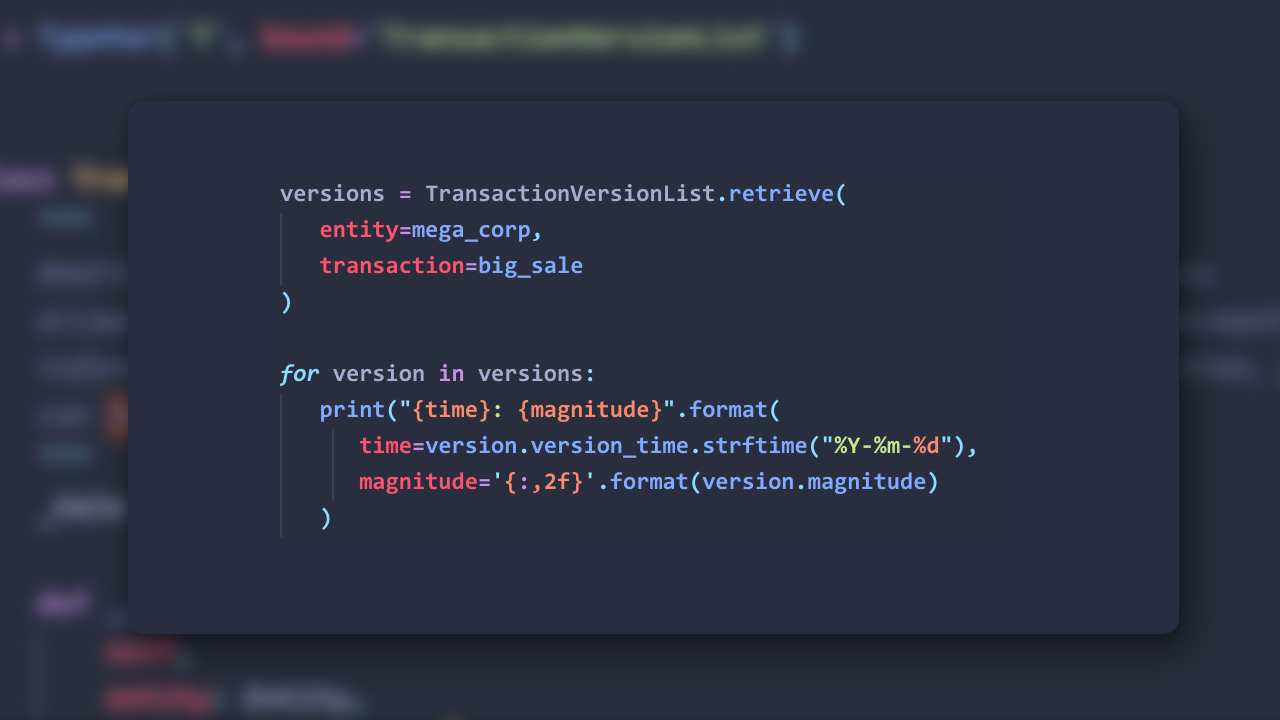
Review the history of modifications to a Transaction using the TransactionVersionList.
versions = TransactionVersionList.retrieve(
   entity=mega_corp,
   transaction=big_sale
)

for version in versions:
   print("{time}: {magnitude}".format(
      time=version.version_time.strftime("%Y-%m-%d"),
      magnitude='{:,2f}'.format(version.magnitude)
   )
For detailed documentation of the properties and methods of all Amatino classes, check out the Amatino Python Documentation.
You can install Amatino via PyPi:
$ pip install amatino
Or, if you already have Amatino Python installed, upgrade:
$ pip install --upgrade amatino
Your feedback is most welcome on the Amatino discussion forums, or on Twitter.
0.0.12 - Growing Trees
Hot on the heels of 0.0.11, Amatino Python 0.0.12 has been released. 0.0.12 enhances the capabilities of the Position and Performance classes added in 0.0.11, and introduces the new Tree class.
- Add
Treeclass - Add total account balance properties to
Performance - Add total account balance properties to
Position - Add tests for all new features
Position and Performance give you quick access to key financial data describing an entity.
print("{name} total assets: ${assets}".format(
   name=mega_corp.name,
   assets='{:,}'.format(position.total_assets)
)
# Example output:
# Mega Corp total assets: $1,543
Check out the Amatino Python documentation to see all the new properties.
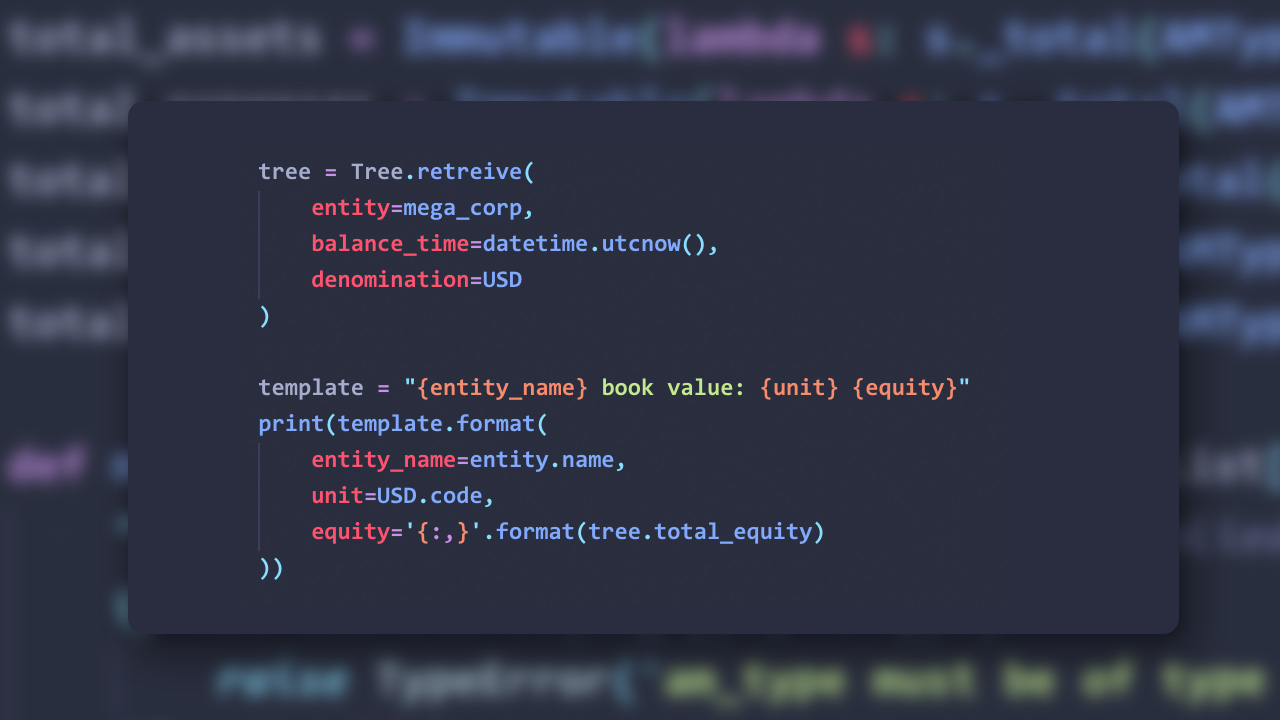
The new Tree class is a beast, combining all accounts in an entity into a single recursive object, at a particular balance date. Like Position and Performance, Tree accounts are of type TreeNode, which means you have access to recursive and individual balances and other useful data.
from amatino import Tree
from datetime import datetime

tree = Tree.retrieve(
   entity=mega_corp,
   balance_time=datetime.utcnow()
)

print("{name} equity: ${equity}".format(
   name=mega_corp.name,
   equity='{:,}'.format(tree.total_equity)
)
For detailed documentation of the properties and methods of the Tree class, check out the Amatino Python Documentation.
You can install Amatino via PyPi:
$ pip install amatino
Or, if you already have Amatino Python installed, upgrade:
$ pip install --upgrade amatino
Be sure to leave your feedback on the Amatino discussion forums, or on Twitter, we'd love to hear what you think about Amatino Python.
0.0.11 - Position & Performance
A new version of the Amatino Python library is now available! 0.0.11 introduces Python versions of the powerful Position and Performance objects.
- Add Position class
- Add Performance class
- Add TreeNode class
- Add Denominated protocol
- Add Decodable protocol
- Add tests for Position & Performance retrieval
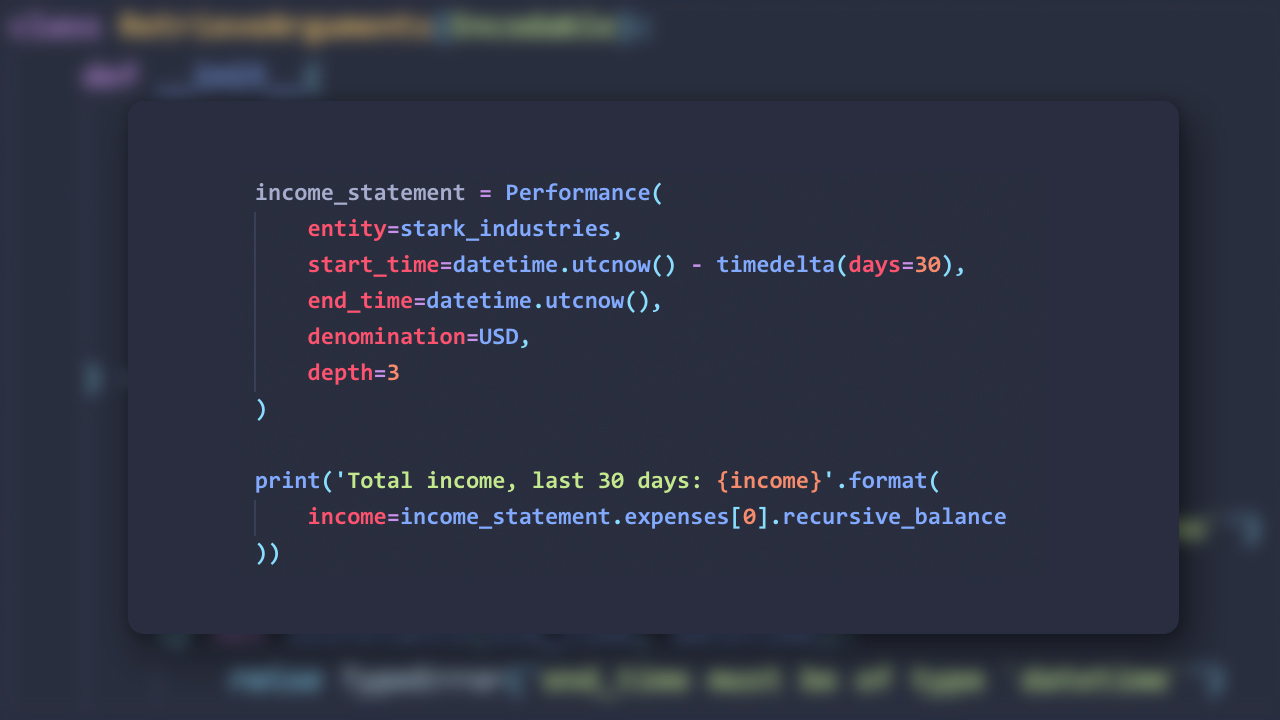
A Position is analogous to a balance sheet or statement of financial position. A Performance is analogous to an income statement or statement of financial performance.
You may retrieve the new objects like so:
from amatino import Performance

income_statement = Performance.retrieve(
  entity=mega_corp,
  start_time=(datetime.utcnow() - timedelta(days=365))
  end_time=datetime.utcnow()
  denomination=USD
)
from amatino import Position

balance_sheet = Position.retrieve(
  entity=mega_corp,
  balance_time=datetime.utcnow()
  denomination=USD
)
For detailed documentation of the properties and methods of these new classes, check out the Amatino Python Documentation.
You can install Amatino via PyPi:
$ pip install amatino
Or, if you already have Amatino Python installed, upgrade:
$ pip install --upgrade amatino
Enjoy!
0.0.10 - Achieving Balance
Amatino Python 0.0.10 has been released! 0.0.10 is all about balance. 0.0.10 is backward compatible with 0.0.7. 0.0.8 and 0.0.9 were skipped because... software. Changes in 0.0.10:
- Add
Balanceclass - Add
RecursiveBalanceclass - Add tests for
Balance&RecursiveBalance - Resolve bug causing amounts > 1,000 units to raise errors on retrieval
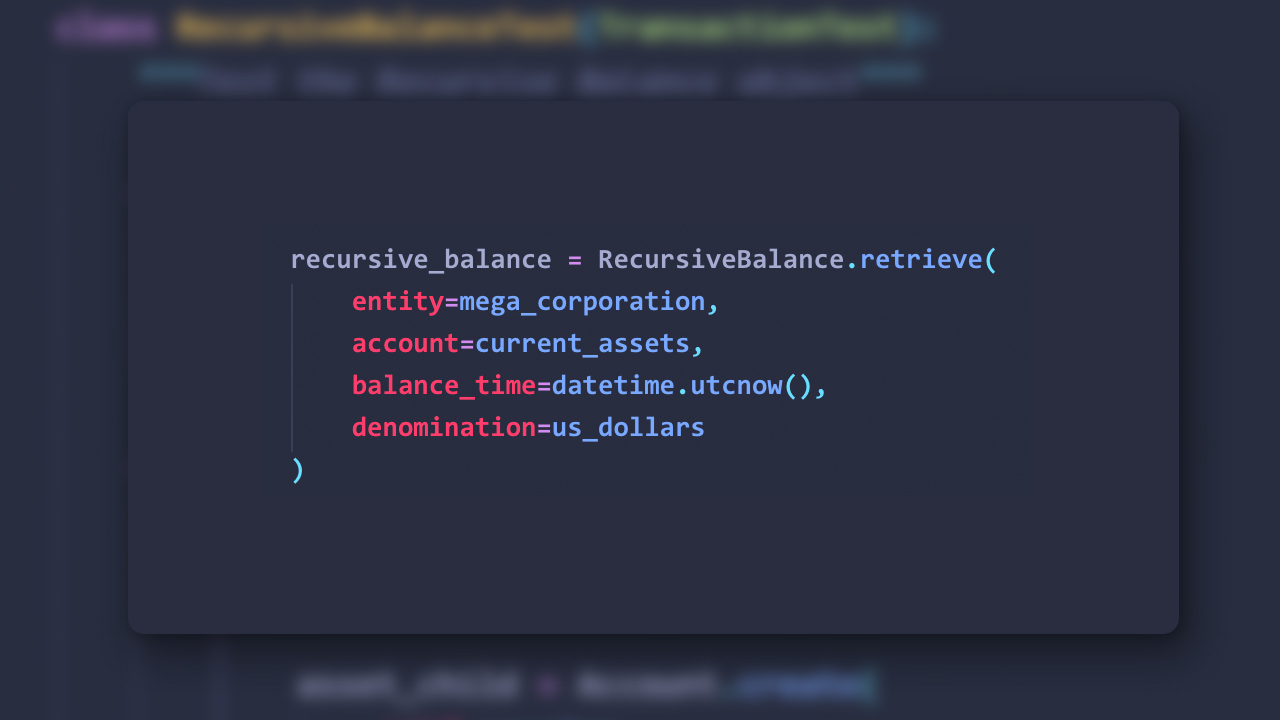
.retrieve() method signature...
balance = Balance.retrieve(
   entity=mega_corporation,
   account=current_assets,
   balance_time=datetime.utcnow(),
   denomination=us_dollars
)
... Wherein balance_time is optional (defaults to "now") and denomination is optional (defaults to account.denomination).
For detailed documentation of the properties and methods of these new classes, check out the Amatino Python Documentation.
You can install Amatino via PyPi:
$ pip install amatino
Or, if you already have Amatino Python installed, upgrade:
$ pip install --upgrade amatino
0.0.7 - Foundational Capabilities
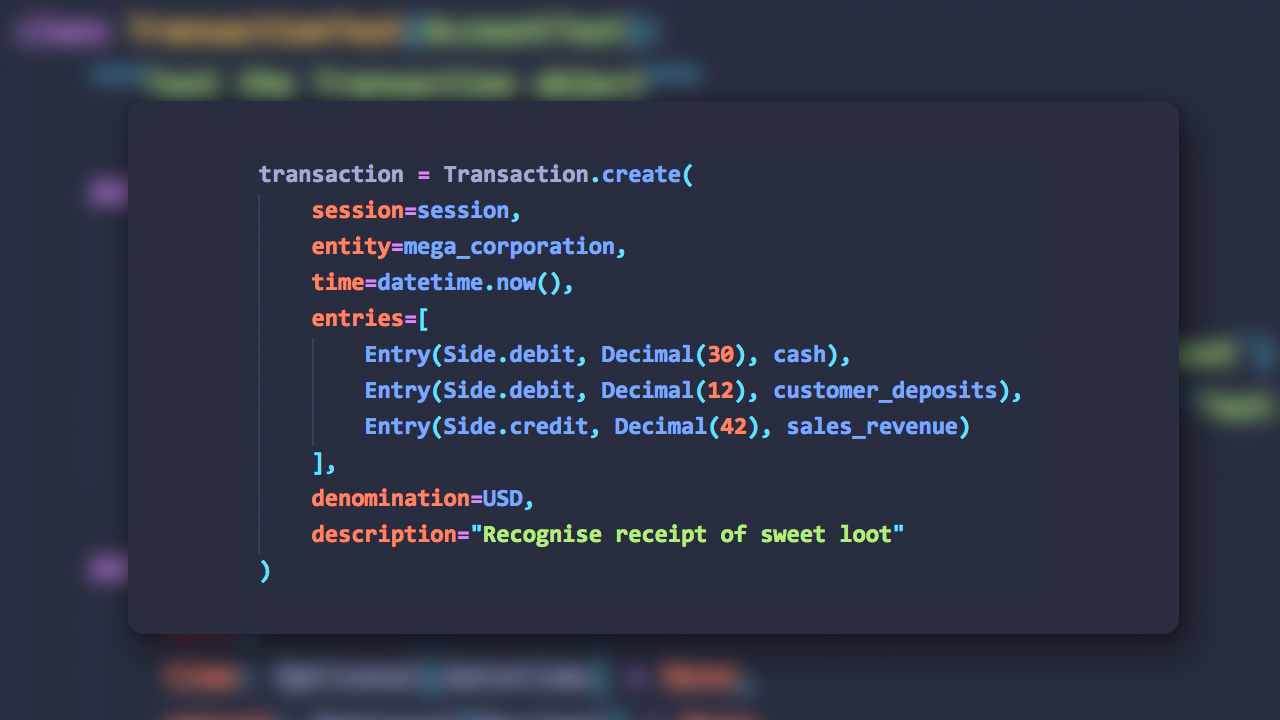
Amatino Python 0.0.7 has been released! This is a major new release, introducing a vast array of capabilities. It is not backwards compatible with 0.0.6. You can install Amatino via PyPi:
$ pip install amatinoOr, if you already have Amatino Python installed, upgrade:
$ pip install --upgrade amatino
Here’s the full list of changes:
- Added Entity class including .create(), .retrieve()
- Added Account class including .create(), .retrieve(), .update()
- Added Transaction class including .create(), .retrieve(), .update(), .delete()
- Added Entry class including various convenience initialisers
- Added GlobalUnit class including .retrieve()
- Added CustomUnit class including .create(), .retrieve()
- Added User class including .retrieve()
- Added Ledger & RecursiveLedger classes
- Added internal Denomination abstract class
- Added internal enumeration HTTPMethod
- Added internal interface Encodable
- Added some internal error types to provide more robust error explanations
- Added tests for new classes
- Removed AmatinoAlpha class & attendant tests
The high level
0.0.7 is the first Amatino Python release to include expressive, object-oriented syntax. Previous releases required manual composition of requests using the AmatinoAlpha object.
Documentation
So many new goodies. But how do we use them? Documentation to the rescue! All the new classes included in 0.0.7 are documented in Amatino Python’s GitHub Wiki. For example, you can check out the Transaction page to see all the Transaction class’s properties and methods.
The future
The most glaring omissions are 0.0.7 are probably Balance, Position, and Performance. Expect 0.0.8 to add those bad boys in the near future.
Enjoy!