Async-and-sync child-process management for Python with a kernel-backed no-orphan guarantee: every process you start — and everything it spawns — lives in a kill-on-exit container (a Windows Job Object, a Linux cgroup v2, or a POSIX process group), so no descendant ever outlives your program.
Beyond spawning a subprocess: run-and-capture, line streaming, interactive stdin, shell-free pipelines, readiness probes, timeouts & cancellation, supervision with restart/backoff, resource-limited sandboxes, and a mockable runner seam for subprocess-free tests — each in a synchronous and an asyncio-native form.


from processkit import Command

# Require success and get trimmed stdout; a failure raises a typed exception.
version = Command("python", ["--version"]).run()
print(version)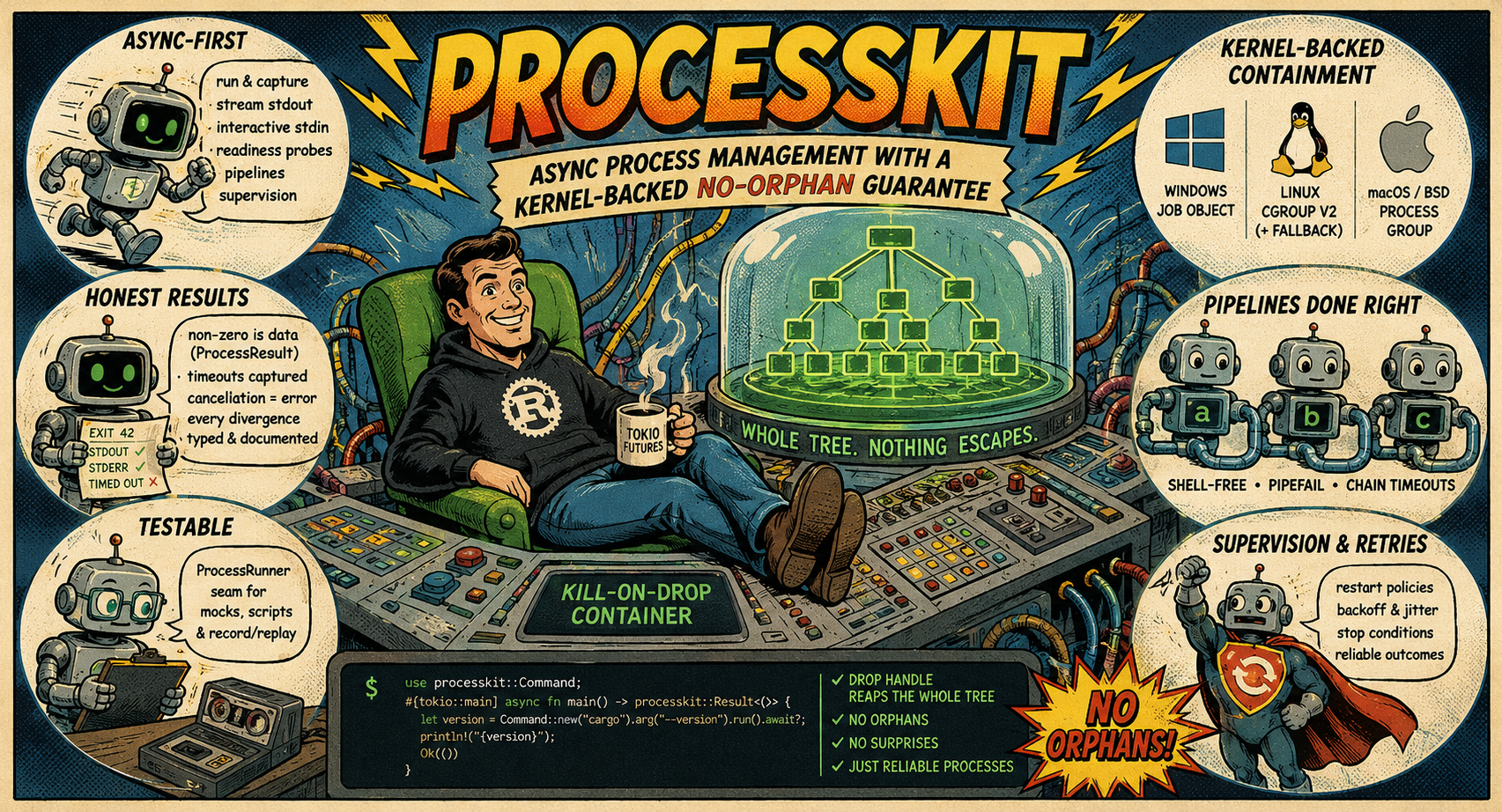
subprocess and asyncio.subprocess reach (at most) the direct child. The
processes it spawned — a build tool's compiler children, the real payload
behind a wrapper (cmd /c …, sh -c …), a test's helper servers — survive a
timeout, an exception, or a cancelled task, and keep running as orphans.
processkit spawns every child into the operating system's own containment
primitive — a Job Object on Windows, a cgroup v2 on Linux (with a
process-group fallback), a POSIX process group on macOS/BSD — so teardown is
a kernel operation over the whole tree, not a best-effort signal to one pid:
- Nothing escapes silently. Exiting a
with/async withblock reaps every descendant, grandchildren included. Where a mechanism has a genuine weakness (asetsidchild can escape a POSIX process group),ProcessGroup.mechanismreports the active backend instead of pretending — never a silent downgrade. - Sync and async, first-class. The run-&-capture verbs, pipelines, and
supervision each exist as a plain synchronous call and an
a-prefixed asyncio coroutine, sharing one set of types. The inherently-streaming surfaces — live line streaming, interactive stdin, readiness probes — are asyncio-native (awaited on a started process), not duplicated as blocking calls. - Honest results. A non-zero exit is data (
ProcessResult) until you ask for success; a timeout is captured in the result; a cancellation is always an error; every platform divergence raisesUnsupportedor is documented. Raised exceptions carry structured fields and alias the stdlib's (Timeoutis aTimeoutError,ProcessNotFoundaFileNotFoundError,PermissionDeniedaPermissionError). - Testable. One runner seam swaps the real spawner for scripted doubles or record/replay cassettes — no subprocess in your tests.
| whole-tree kill-on-exit | async | sync | limits / stats | streaming · pipelines · supervision | |
|---|---|---|---|---|---|
subprocess |
— | — | ✓ | — | — |
asyncio.subprocess |
— | ✓ | — | — | — |
processkit |
✓ | ✓ | ✓ | ✓ | ✓ |
The first column is the differentiator: a child's descendants are contained and reaped as a unit (Job Object / cgroup v2 / process group), not just the direct child.
Status: 1.0 — API frozen. The public API follows Semantic Versioning: breaking changes land only in a new major version, so
1.xupgrades are backward-compatible. See CHANGELOG.md, and ROADMAP.md for how it was built.
This is a thin PyO3 binding to the published
processkit Rust crate — not a
reimplementation. All the hard platform code (Job Object containment, cgroup v2,
race-free spawn, POSIX process groups) lives in the crate; the Python layer
exposes a typed, asyncio-native surface with context-manager teardown.
pip install processkitDistributed as abi3 wheels for CPython 3.10+ (one wheel per OS/arch runs on every supported minor version, 3.14 included), plus a version-specific free-threaded wheel for CPython 3.14t (PEP 703 — importing the extension does not re-enable the GIL). (Until the first PyPI release lands, build from source — see below.)
Every run starts with the same Command builder; the verb you finish with
decides what you get back. Each has an a-prefixed asyncio twin
(run/arun, …):
| You want | Call | You get |
|---|---|---|
| stdout, success required | .run() |
trimmed str; non-zero exit / timeout / kill → typed exception |
| the full outcome, exit code as data | .output() / .output_bytes() |
ProcessResult / BytesResult — code, stdout, stderr, timed_out; never raises on a non-zero exit |
| just the exit code | .exit_code() |
int (a timed-out / killed run raises instead of inventing -1) |
| a yes/no answer | .probe() |
bool — exit 0 → True, 1 → False, anything else raises |
| a live handle — streaming, stdin, probes | .astart() |
RunningProcess |
The same vocabulary repeats on every layer (Runner, CliClient).
Deeper: Running commands.
from processkit import Command, ProcessGroup

# Capture output; a non-zero exit does not raise on its own.
result = Command("git", ["rev-parse", "HEAD"]).output()
print("HEAD is", result.stdout.strip(), "·", result.code)

# Require success and get trimmed stdout directly.
version = Command("python", ["--version"]).run()

# Feed stdin.
sorted_out = Command("sort").stdin_text("banana\napple\n").run()

# Share one kill-on-exit group across several children; the block exit reaps the
# whole tree, grandchildren included.
with ProcessGroup() as group:
    group.start(Command("dev-server"))
    # ... work ...
# graceful teardown on exit
The asyncio surface mirrors it with the a prefix and adds streaming:
import asyncio
from processkit import Command, ProcessGroup

async def main():
    result = await Command("git", ["rev-parse", "HEAD"]).aoutput()

    # Stream a child's stdout; the context manager reaps the tree on exit.
    async with await Command("my-build", ["--watch"]).astart() as proc:
        async for line in proc.stdout_lines():
            print(line)

    async with ProcessGroup() as group:
        await group.astart(Command("dev-server"))

asyncio.run(main())This README is the quick tour. The docs/ guide set goes
deeper on every capability, with more examples and the platform fine print in one
place. New here? Skim the Cookbook first — it maps "I want
to …" tasks to working snippets — then read
Running commands end to end:
| Guide | Covers |
|---|---|
| Cookbook | Task → snippet recipes for everything below; the fastest way in |
| Running commands | The full Command builder and every consuming verb, with error semantics |
| Process groups | Containment, teardown, signals, suspend/resume, members, limits, stats |
| Streaming & interactive I/O | Line streaming, conversational stdin, readiness probes, per-run profiling |
| Pipelines | Shell-free a | b | c, pipefail attribution, chain timeouts |
| Timeouts & cancellation | Captured vs raised deadlines, Ctrl+C, asyncio cancellation |
| Supervision | Restart policies, backoff & jitter, stop conditions, outcomes |
| Testing your code | The runner seam, scripted/record-replay doubles, CliClient |
| Platform support | Mechanisms, all capability matrices, every caveat |
Each section below is a taste with a pointer to its full guide.
Everything started in a ProcessGroup — and everything those processes spawn —
is reaped when the block exits:
from processkit import Command, ProcessGroup

with ProcessGroup() as group:
    group.start(Command("dev-server"))
    group.start(Command("worker"))
    print(group.mechanism)        # "job_object" | "cgroup_v2" | "process_group"
    print(group.members())        # live member pids
# the whole tree, grandchildren included, is gone here
The with / async with exit (and ordinary GC) reaps the tree on every
platform; surviving a hard kill of the Python process itself is a Windows-only
property. Lean on the context managers, not __del__ / atexit.
Deeper: Process groups ·
Platform support.
Bound a whole tree's memory, process count, and CPU at creation, so a runaway or untrusted child tree can't exhaust the host:
from processkit import Command, ProcessGroup

tool = (
    Command("untrusted-tool")
    .env_clear().inherit_env(["PATH"])     # locked-down environment
    .output_limit(max_bytes=8 * 1024 * 1024)
)
with ProcessGroup(max_memory=512 * 1024 * 1024, max_processes=64, cpu_quota=1.0) as group:
    group.start(tool)
    print(group.stats().active_process_count)
Limits need a Windows Job Object or a Linux cgroup-v2 root; under a
container, systemd session, or other non-root cgroup the kernel forbids them and
ResourceLimit is raised — never a silently-unbounded group.
Deeper: Process groups → resource limits.
with ProcessGroup() as group:
    group.start(Command("my-server"))
    group.signal("hup")        # term | kill | int | hup | quit | usr1 | usr2
    group.suspend()            # freeze the whole tree…
    group.resume()             # …and let it run again
Signals are POSIX-real; on Windows only kill is deliverable (it maps to the
Job Object terminate) and every other name — including term — raises
Unsupported. Deeper: Process groups.
output_all runs a whole batch with a concurrency cap, so fanning out
hundreds of commands can't exhaust file descriptors or the process table:
from processkit import Command, ProcessResult, output_all

cmds = [Command("convert", [f"{i}.png", f"{i}.jpg"]) for i in range(200)]
results = output_all(cmds, concurrency=8)            # never >8 alive at once
failed = sum(not (isinstance(r, ProcessResult) and r.is_success) for r in results)
It is collect-all: each slot is one command's ProcessResult, or a
ProcessError for a spawn/I/O failure — a non-zero exit never short-circuits the
batch. aoutput_all / output_all_bytes / aoutput_all_bytes round out the
set. Deeper: Cookbook → run many at once.
A Supervisor keeps a child alive: it restarts the command per policy
whenever it exits, with bounded restarts and exponential, jittered backoff:
from processkit import Command, Supervisor

outcome = Supervisor(
    Command("my-server", ["--port", "8080"]),
    restart="on_crash",           # always | on_crash | never
    max_restarts=5,
    backoff_initial=0.2, backoff_factor=2.0, max_backoff=30.0,
    stop_when=lambda r: r.code == 0,   # a clean exit ends supervision
).run()                                # or: await ....arun()
print(outcome.restarts, outcome.stopped)
Deeper: Supervision.
"Start a server, then use it" needs the server to be ready, not merely started. Three async probes replace the arbitrary sleep:
from processkit import Command, wait_for, wait_for_port, wait_for_line

proc = await Command("my-server").astart()
lines = proc.stdout_lines()
await wait_for_line(lines, lambda l: "listening on" in l, timeout=10)   # a log line
await wait_for_port("127.0.0.1", 8080, timeout=10)                      # a TCP port
await wait_for(lambda: health_check(), timeout=10, interval=0.1)        # any condition
A probe that doesn't pass in time raises TimeoutError and does not kill the
child — you decide what happens next.
Deeper: Streaming → readiness probes.
a | b | c without a shell string — stages connected in-process (a relay, not a
shell), so no quoting or injection surface, and every stage lives in one shared
kill-on-exit group:
authors = (
    Command("git", ["log", "--format=%an"])
    | Command("sort")
    | Command("uniq", ["-c"])
).run()
The outcome is pipefail: stdout is the last stage's, while the exit code,
stderr, and reported program come from the first stage that didn't exit cleanly.
.timeout(d) bounds the whole chain. Deeper: Pipelines.
Command("worker").inherit_env(["PATH", "HOME", "LANG"]).run()        # allow-list on a cleared env
Command("worker").gid(1000).groups([1000]).uid(1000).setsid().run()  # POSIX: drop privileges, new session
Command("helper").create_no_window().run()                           # Windows: no console window
Command("daemonish").kill_on_parent_death().astart() # die with a hard-killed parentuid/gid/groups/setsid are POSIX-only — on Windows the run raises
Unsupported rather than silently skipping a privilege drop. When dropping
privileges, set all three of gid/groups/uid — uid alone leaves the
child holding the parent's (often root's) supplementary groups.
Deeper: Running commands → privileges.
A blocked sync call honors Ctrl+C (raises KeyboardInterrupt and reaps the
tree). Cancelling an awaited async run — directly, or via asyncio.wait_for
/ asyncio.timeout — tears down the whole tree and raises
asyncio.CancelledError:
import asyncio

task = asyncio.ensure_future(Command("long-job").aoutput())
task.cancel()        # the process tree is reaped; CancelledError propagates
Unlike a timeout — whose expiry is captured in the result as timed_out —
cancellation is always terminal.
Deeper: Timeouts & cancellation.
The one-shot verbs buffer the whole output. For long-running or conversational
children, astart() returns a live RunningProcess:
# Conversational stdin: write a request, read the response.
proc = await Command("bc").keep_stdin_open().astart()
stdin = proc.take_stdin()
await stdin.write_line("2 + 2")
print(await anext(proc.stdout_lines()))   # 4
await stdin.close()
Deeper: Streaming & interactive I/O.
CliClient binds a program to default timeout/env, so repeated calls pass only
their args:
from processkit import CliClient

git = CliClient("git", default_timeout=30.0)
head = git.run(["rev-parse", "HEAD"])     # or: await git.arun([...])
clean = git.probe(["diff", "--quiet"])
For testable code, inject a Runner / ScriptedRunner at the Command level
instead — CliClient always uses the real runner.
Deeper: Testing your code.
Write your code against a runner, then inject a ScriptedRunner in tests:
from processkit import Command, Reply, ScriptedRunner

scripted = ScriptedRunner()
scripted.on(["git", "rev-parse"], Reply.ok("deadbeef"))
assert scripted.run(Command("git", ["rev-parse", "HEAD"])) == "deadbeef"
RecordReplayRunner captures real tool output once and replays it offline, and
RecordingRunner spies on what your code ran.
Deeper: Testing your code.
processkit follows Semantic Versioning. As of 1.0 the
public API — everything re-exported from import processkit and declared in the
type stubs — is stable: breaking changes land only in a new major version, so
1.x upgrades are backward-compatible. Anything underscore-prefixed is internal.
- Python 3.10 or later (abi3 wheel), including CPython 3.14 and the free-threaded (PEP 703) build 3.14t.
- See platform support & caveats for per-OS behaviour and the wheel/architecture matrix.
The first release to PyPI is pending (pip install processkit is the supported
path once published). Until then — or on a platform without a prebuilt wheel
(Windows on ARM, 32-bit) — build from source, which needs a
Rust toolchain:
git clone https://github.com/ZelAnton/processkit-py
cd processkit-py
uv run maturin developSee CONTRIBUTING.md for build/test instructions and conventions. To report a security issue, follow SECURITY.md.
This project is licensed under the MIT License.