The World's Smallest Arduino Compatible Board

The MicroBit328 is an ultra-compact Arduino-compatible development board measuring just 11mm × 16mm - small enough to fit on your fingertip. Despite its tiny footprint, it packs the full power of an Arduino Uno, making it perfect for space-constrained projects.
This project was originally designed in 2014 as a Kickstarter campaign that never launched. After 11 years, it's now open-sourced under the Apache License 2.0 for the maker community to build, modify, and use freely.
⚠️ Project Status: This project is no longer actively supported, but the designs remain relevant. All files are provided as-is for the community to use, modify, and build upon.
In 2014, Arduino was at the peak of its popularity. While Arduino boards were powerful and easy to use, they were simply too large for many compact projects. The MicroBit328 was born from the need for a truly miniature Arduino-compatible board.
After months of iteration, countless design revisions, and working with extremely small 0201 components (requiring assembly under a microscope), the board was ready. The Kickstarter campaign was prepared, graphics were made, and everything was set to launch.
However, due to employment contract restrictions at the time, the project was put on hold. Now, 11 years later, the MicroBit328 is finally being open-sourced so that anyone can build and use this tiny powerhouse.
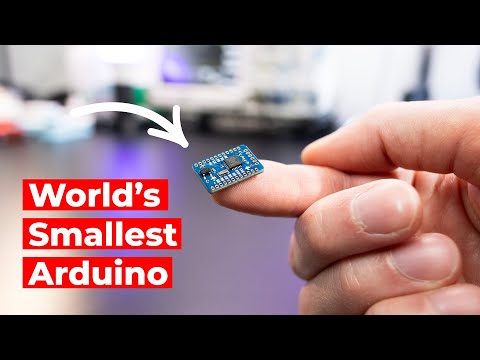
- Microcontroller: ATmega328P (same chip as Arduino Uno)
- Clock Speed: 16 MHz crystal oscillator
- Dimensions: 11mm × 16mm
- Voltage Regulator: LP2985-50DBVR (5V output)
- Component Size: 0201 capacitors and resistors (extremely small - requires microscope for assembly)
- Power LED: Built-in power indicator
- Pin Compatibility: (Almost) Fully compatible with Arduino Uno pinout
The board features standard Arduino Uno pinout (minus 2 pins), allowing you to:
- Develop your project on an Arduino Uno
- Transfer the code directly to the MicroBit328
- Use the same sketches without modification

- ✅ Full Arduino Uno Compatibility - Same ATmega328P chip, same 16MHz clock
- ✅ Ultra-Compact Design - Smallest Arduino-compatible board at 11×16mm
- ✅ Built-in Voltage Regulator - Power external components directly
- ✅ Shield Ecosystem - Multiple expansion shields available
- ✅ Easy Development - Develop on Arduino Uno, deploy on MicroBit328
- Latest revision with KiCad design files
- Pulled up the reset pin
- Changed orientation and location of the DTR 0.1uF capacitor
- Changed position of the voltage regulator
- Changed position of the PWR LED
- Changed vias
- Increased pin label sizes
- Changed order of the voltage marking
- Added pads for a connector on the bottom of the board
- Changed DTR via
- Added indication of PWM ~ pins
- Initial release
The project includes several expansion shields to extend functionality. Note: Most shields were created using Fritzing, and some shields are unfinished or in various stages of completion.
- FTDI USB Plug-in Shield - Easy programming and USB connectivity
- Free IMU Shield - Inertial measurement unit for motion sensing
- I2C Shield - I2C pull-up resistors for I2C communication
- RGB LED Shield - Multi-color LED control
- Servo Shield - Servo motor control
- Breakout Board - General-purpose prototyping shield
- HC-05 Shield - Bluetooth connectivity (may be unfinished)
- I2C Module - Standalone I2C pull-up module
Note: Shield designs are provided as-is. Some may require completion or verification before use in production.
- A microscope for assembly
- Precision soldering equipment
- Experience with surface-mount soldering
-
Choose a Version: The latest version (0.6) is available in KiCad format. Earlier versions (0.1-0.5) are available in Fritzing format. Most shields were also designed in Fritzing.
-
Order PCBs: Use the Gerber files in the
gerber/folders to order PCBs from your preferred manufacturer. -
Source Components: Refer to the schematic and BOM (Bill of Materials) for component requirements:
- ATmega328P-MMH-ND (QFN28 package)
- 16MHz crystal oscillator
- LP2985-50DBVR voltage regulator
- Various 0201 capacitors and resistors
- Power LED
- Headers for pin connections
-
Assembly:
- Use a microscope and fine-tipped soldering iron
- Follow the placement files for component positioning
- Take care with component orientation
-
Programming:
- Use the FTDI shield or an FTDI breakout board
- Connect to Arduino IDE
- Select "Arduino Uno" as the board type
- Upload your sketches as normal
Once assembled and programmed:
- Develop your project on an Arduino Uno using the standard Arduino IDE
- Upload your sketch to the MicroBit328 (using FTDI adapter)
- The code will run identically to the Arduino Uno
- Solder the board into your project or use with shields
MicroBit/
├── version 0.6 328 - kicad/    # Latest KiCad design files
├── version 0.5 328/            # Version 0.5 with Gerber files
├── version 0.4 328/            # Version 0.4 with Gerber files
├── version 0.2 328/            # Version 0.2 with Gerber files
├── version 0.1 328/            # Initial version
├── shields/                     # Expansion shields
│   ├── FTDI USB plug in shield/
│   ├── Free IMU v.0.1/
│   ├── I2C shield v.0.1/
│   ├── RGB LED v.0.1/
│   ├── servo shield v.0.1/
│   └── ...
└── png's/                       # Documentation images
This project is licensed under the Apache License 2.0. See the LICENSE file for details.
You are free to:
- Use the design commercially
- Modify the design
- Distribute the design
- Patent improvements
While this project is no longer actively maintained, contributions are still welcome! Whether it's:
- Design improvements
- Completing unfinished shields
- Converting Fritzing designs to other formats (KiCad, etc.)
- Documentation enhancements
- Bug fixes
Feel free to submit pull requests or open issues.
- Designed and open-sourced by the original creator
- Built on the Arduino platform and community
- Inspired by the need for smaller embedded solutions
I'll monitor the issues, but I am unlikely to fix them.
Happy Making! 🚀
