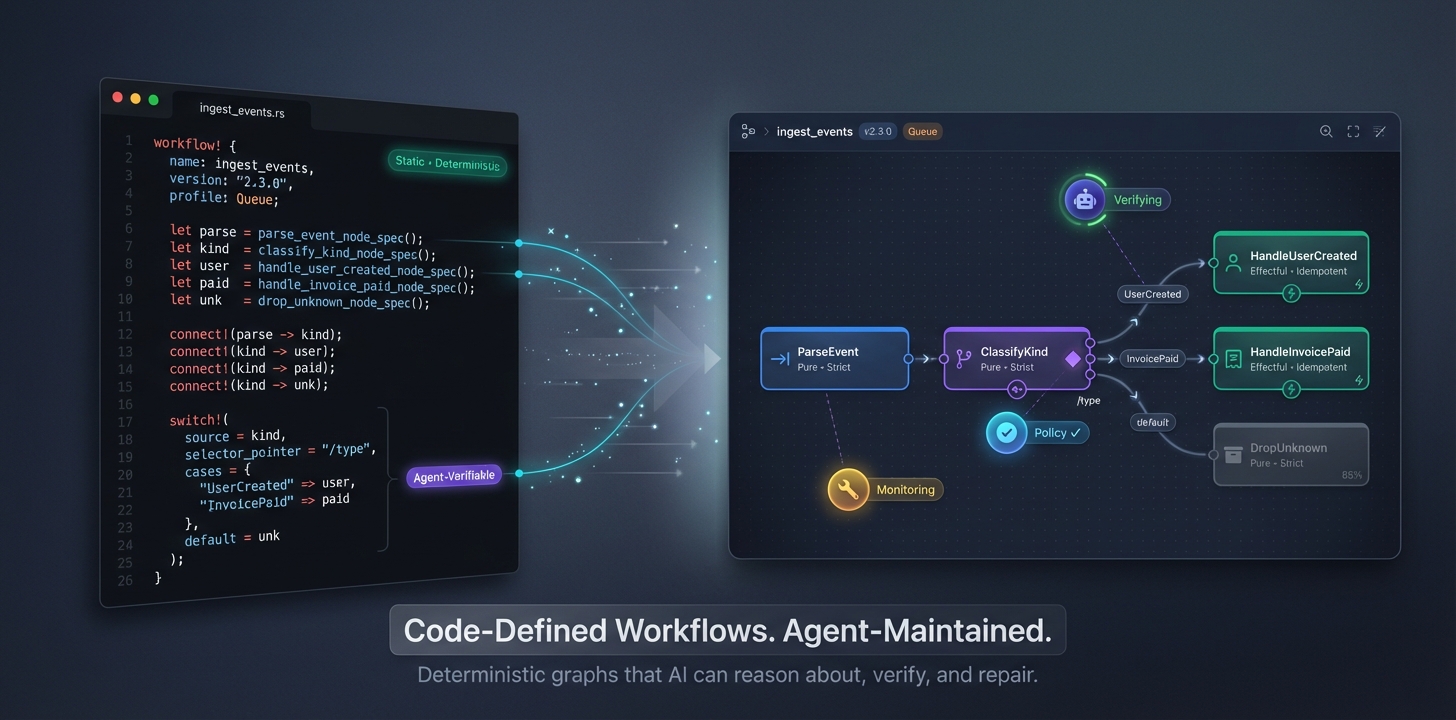
Lattice is a Rust-first workflow automation platform designed to give human and AI authors a typed, policy-aware alternative to low-code orchestrators such as n8n or Temporal JSON definitions. Authors express flows through a macro DSL that expands to:
- Native Rust execution units (
#[def_node],flow!) - A canonical Flow Intermediate Representation (Flow IR) captured as JSON
- Validation diagnostics with stable error codes (e.g.
DAG201,IDEM020) - Execution plans that target multiple hosts (Tokio/Web, Redis queue, Temporal, WASM, Python gRPC)
The workspace provides everything needed to go from macro-authored code to running workflows on local executors, queue workers, or edge WASM packs, with gating harnesses for policy, determinism, and idempotency.
- Code-first: Rust is the source of truth. Macros add structure without hiding control flow so developers and agents retain full language power.
- Typed contracts: All ports, params, capabilities, and policies flow through Flow IR and JSON Schemas, enabling automated tooling and Studio visualisation.
- Determinism & effects: Every node declares its effects (
Pure,ReadOnly,Effectful) and determinism (Strict,Stable,BestEffort,Nondeterministic) so the runtime can enforce caching, retries, and compensations. - Policy & compliance: Capabilities, secrets, and egress are gated at compile time, certification, and runtime. Error codes map directly to policy remediation steps.
- Extensibility: Plugins (WASM, Python) and connector specs allow external teams or agents to extend the platform while preserving sandboxing and evidence trails.
- Macro-authored flows with compile-time metadata and stable validation diagnostics.
flows graph check,flows entrypoints check,flows run local, andflows run serve.- In-process execution via
host-inprocand HTTP serving viahost-web-axum. - Run-scoped workspace capability with native and Workers backends.
- Host-owned connector runtime/bindings substrate with local OAuth2 refresh and service-account JWT providers.
- Runnable connector-owned examples for GitHub Issues and Google Sheets.
- Workerd/Miniflare-backed
host-workerscoverage for durability and workspace semantics.
- Workers parity for richer connector binding/provider execution.
- Connector trigger runtime, inbound verifier providers, and activation lifecycle.
- Larger connector farming surface beyond the first serious Google Sheets slice.
- Broader real-world workflow example coverage across multiple domains.
host-temporalregistry-certimporter-n8nplugin-pythonplugin-wasistudio-backend
/Cargo.toml                       # Workspace manifest (MSRV 1.90, shared deps)
/impl-docs/                       # Contract specs, ADRs, diagnostics, and acceptance stories
/schemas/                         # Flow IR JSON Schema + reference artifacts
/crates/                          # Primary library, runtime, tooling, and adapters
  dag-core/                       # Flow IR types, diagnostics, builder utilities
  dag-macros/                     # Authoring DSL (`#[def_node]`, `flow!`, control surfaces)
  kernel-plan/                    # Flow IR validators + lowering and policy checks
  kernel-exec/                    # Runtime for execution plans, resume, and resource overlays
  capabilities/, cap-*            # Capability typestates + concrete providers
  host-inproc/, host-web-axum/, host-workers/, bridge-queue-redis/, host-temporal/  # Runtime + execution bridges
  plugin-wasi/, plugin-python/    # Sandbox runtimes for WASM and gRPC plugins (early scaffold)
  exporters/                      # Flow IR exporters (JSON, DOT, future OpenAPI/WIT)
  registry-client/, registry-cert/# Certification + registry publication tooling
  connector-spec/, connectors-std/# Connector generation + curated packs
  policy-engine/                  # CEL-based policy evaluation (scaffold)
  testing-harness-idem/           # Idempotency harness utilities
  cli/                            # `flows` CLI commands
/examples/s1_echo/                # Canonical S1 webhook example using macros
- 0.1 contract specs:
impl-docs/spec/ - Flow IR schema:
schemas/flow_ir.schema.json - User stories & acceptance criteria:
impl-docs/user-stories.md - Diagnostic registry:
impl-docs/error-codes.md
| Crate | Purpose |
|---|---|
dag-core |
Canonical types: Flow IR structs, builder helpers, diagnostics, effects/determinism. |
dag-macros |
Procedural macros expanding Rust nodes/triggers/flows and emitting Flow IR. Includes trybuild suites for diagnostics. |
kernel-plan |
Validation engine enforcing DAG rules, port compatibility, cycle detection, and idempotency preconditions. Produces ValidatedIR. |
kernel-exec |
In-process executor with scheduling, deadlines, resource overlays, and resume integration points. |
exporters |
Flow IR exporters (to_json_value, to_dot) consumed by CLI and Studio. |
flows-cli |
CLI entrypoint for graph validation, entrypoint checks, local execution, and local serving. |
capabilities, cap-* |
Typestate traits and concrete implementations for HTTP, KV, blob, cache, dedupe, clock, workspace, etc. |
host-* |
Host adapters for Axum/web, Cloudflare Workers, Redis queue workers, and future Temporal lowering. |
plugin-* |
Sandboxed plugin runtimes (WASM/Wasmtime + WIT, Python gRPC). |
registry-* |
Publishing, signing, and certification harness integration. |
connector-spec, connectors-std |
YAML schema/codegen for connectors, curated packs. |
testing-harness-idem |
Duplicate injection + evidence capture for idempotency certs. |
- Define nodes & triggers using macros in your crate:
#[def_node(name = "Normalize", effects = "Pure", determinism = "Strict")]
async fn normalize(event: Order) -> NodeResult<SanitisedOrder> { ... }

#[def_node(trigger, name = "Webhook")]
async fn webhook(req: HttpRequest) -> NodeResult<WebhookEvent> { ... }
- Assemble flows with
flow!, usingnode!(...)helpers for bindings. The macro emits both Rust wiring and Flow IR JSON artefacts. - Inspect Flow IR using the CLI:
cargo run -p flows-cli -- graph check --input flow_ir.json --emit-dot
- Validate with
kernel-plan::validate(automatically invoked by CLI) to catch cycles, port mismatches, or missing idempotency keys. - Export DOT or JSON for Studio/agents via
exporterscrate or CLI options.
The examples/s1_echo crate demonstrates a minimal Web profile flow with trigger, inline logic, and responder nodes.
- Serialization:
dag-core::FlowIRderives serde/schemars; schema atschemas/flow_ir.schema.json. - IDs:
FlowIdderived from{name, semver}using UUID v5 (string-encoded for schema friendliness). - Nodes: Capture alias, kind (
Trigger,Inline,Activity,Subflow), port schemas, effects, determinism, idempotency spec, docs. - Edges: Include delivery semantics (
AtLeastOnce,AtMostOnce,ExactlyOnce), ordering, partition key, timeout, buffer policy. - Control surfaces: Document branching (
Switch,If), loops (ForEach,Loop), temporal hints, rate limits, error handlers. - Diagnostics: All lints/errors map to
impl-docs/error-codes.md.dag-coreexportsDiagnosticand registry accessor for consumers.
Validation highlights implemented in kernel-plan::validate:
- Duplicate aliases (
DAG205) - Edge references to unknown nodes (
DAG201) - Cycle detection via DFS (
DAG200) - Port schema compatibility (named schema equality)
- Malformed idempotency declarations (
DAG004)
Additional rules (delivery requirements, capability overlap, policy waivers) are outlined in the RFC and queued for future phases.
- kernel-exec: In-process executor for validated flows, including resource overlays, run identity plumbing, and checkpoint/resume integration points.
- host-inproc: Shared runtime harness used by examples, tests, and higher-level hosts to execute validated flows in-process.
- host-web-axum: Axum adapter that mounts HTTP triggers, handles request facets, streaming responses, deadlines, and cancellation propagation.
- host-workers: Cloudflare Workers adapter with workerd/Miniflare coverage, DO-backed durability substrate, and Workers workspace wiring.
- bridge-queue-redis: Queue bridge for Redis-backed execution lanes; still earlier than the web/native path.
- host-temporal: Present in the workspace, but still scaffold-level rather than product-ready.
- plugin-wasi / plugin-python: Present as extension seams, but still scaffold-level rather than stable public integration surfaces.
- Capabilities: Traits in
capabilitiesensure compile-time enforcement of effect/determinism contracts (e.g., stable reads require pinned resources). Concrete providers live incap-*crates. - Current recommended local stack:
cap-http-reqwest,cap-workspace-fs,cap-blob-opendal(filesystem backend where appropriate), andcap-kv-opendal(SQLite backend where appropriate). - Current recommended Workers stack:
cap-http-workers,cap-workspace-workers,cap-kv-workers, andcap-do-workers. - Important distinction: workspace is run-scoped scratch; blob is durable artifact/object storage. Keep those capabilities separate even if they share a filesystem-backed implementation locally.
- Future SQL note: if Lattice grows a real SQL/DB capability, it should remain separate from
resource::kveven when a KV provider happens to use SQLite internally. - ConnectorSpec: Declarative YAML schema + Rust codegen for connectors, including manifest metadata (effects, determinism, egress, rate limits, tests).
- connectors-std: Umbrella crate re-exporting provider-specific connectors once generated.
- Registry:
registry-clientandregistry-certcoordinate publishing, sigstore signing, SBOM snapshots, determinism/idempotency/test harness runs.
# Validate a Flow IR document (from file)
cargo run -p flows-cli -- graph check --input schemas/examples/s2_site.json

# Validate trigger/capture wiring
cargo run -p flows-cli -- entrypoints check --input schemas/examples/s2_site.json

# Execute a built-in example locally
cargo run -p flows-cli -- run local --example s1_echo --payload '{"value":" Hello "}'

# Serve a built-in example over HTTP
cargo run -p flows-cli -- run serve --example s1_echo --addr 127.0.0.1:8080

# Serve a bundled workflow artifact over HTTP
cargo run -p flows-cli -- run serve \
  --bundle /tmp/flow.bundle \
  --addr 127.0.0.1:8080

# Execute the connector-owned Google Sheets example via bindings.lock
cargo run -p flows-cli -- run local \
  --example connector_google_sheets_local_flow \
  --bindings-lock /tmp/google-sheets-live.bindings.lock.json
Still planned / incomplete:
- queue-first operator flows and richer bridge commands
- registry certification / publish flows
- importer-driven
n8ntranslation path
- Rust 1.90 (workspace MSRV;
mise.tomlcurrently pins 1.93.0 for local tooling) misefor the repo-managed task/toolchain entrypoints- Optional: Redis (queue profile), Wasmtime (plugin host), Temporal dev server (later phase)
# Fast local validation
mise run validate

# Native + wasm validation + secret scan (CI-shaped aggregate)
mise run validate-ci

# Build core crates directly
cargo check -p dag-core
cargo check -p dag-macros
cargo check -p kernel-plan
cargo check -p flows-cli

# Run macro UI tests (requires a writeable target dir; use env var to sidestep sandbox limits)
CARGO_TARGET_DIR=.target cargo test -p dag-macros --test trybuild

# Execute canonical examples
cargo test -p example-s1-echo
cargo run -p flows-cli -- run local --example s1_echo --payload '{"value":" Hello "}'
Note: When running tests inside sandboxed environments (e.g., the Codex CLI harness), set a workspace-local
CARGO_TARGET_DIRto avoid cross-device link errors:CARGO_TARGET_DIR=.target cargo test ....If you work with encrypted private docs locally, keep
fnox.tomluntracked and start fromfnox.example.tomlrather than committing a real secret-manager config.
Implementation is organised into discrete phases (impl-docs/impl-plan.md):
- Phase 0: Workspace scaffold, linting, diagnostic registry (completed here).
- Phase 1: Core types/macros/IR/validator/exporters/CLI (partially implemented).
- Phase 2: In-process executor + Web host + inline caching.
- Phase 3: Queue profile, Redis dedupe/cache, idempotency harness.
- Phase 4: Registry, certification harness, connector spec infrastructure.
- Phase 5: Plugin hosts (WASM, Python) and capability extensions.
- Phase 6: WASM edge deployment + n8n importer.
- Phase 7+: Automated connector farming, Studio backend polish.
Each phase has explicit exit criteria, test suites, and CLI milestones to ensure incremental value delivery.
- Diagnostics carry structured metadata: code, subsystem, severity, message.
- Consumers retrieve the registry via
dag_core::diagnostic_codes(). - Validation and macro errors should use the canonical codes to enable consistent remediation playbooks and agent automation.
- Runtime diagnostics (e.g.,
RUN030,TIME015) will be emitted through the kernel runtime and surfaced in CLI/Studio once implemented.
Outlined in the RFC (impl-docs/rust-workflow-tdd-rfc.md, §16):
- Unit: Macro expansion, capability typestates, Flow IR serialization, validator rules.
- Property: Cycle detection, partition semantics, idempotency keys.
- Golden: Example flows (S1 echo, S2 SSE site) compiled and exported.
- Integration: HTTP runtime, queue dedupe & spill, Temporal workflows, plugin hosts.
- Certification harnesses: Determinism replay, idempotency duplicates, policy evidence.
Current repository includes unit/trybuild coverage for macros, Flow IR builder tests in dag-core, kernel-plan validation tests, exporter smoke tests, workerd/Miniflare coverage for host-workers, and runnable connector-owned example packages.
- Expand the real-world example suite across multiple domains, not just substrate demos.
- Harden capability ergonomics for KV/blob/workspace-first authoring patterns.
- Improve Workers parity for connector bindings, auth providers, and connector-bound flows.
- Grow the connector ecosystem beyond GitHub Issues and Google Sheets, especially into richer trigger/webhook families.
- Land clearer stability tiers for scaffold vs preview vs supported public surfaces.
- Continue importer, registry certification, plugin, and studio work from their current scaffold baselines.
Refer to impl-docs/impl-plan.md and impl-docs/surface-and-buildout.md for detailed sequencing.
- Ensure your Rust toolchain is at least 1.90.
- Run formatting (
cargo fmt) and linting (cargo clippy -- -D warnings). - Execute relevant
cargo check/cargo testcommands (setCARGO_TARGET_DIR=.targetif needed). - Adhere to the diagnostic registry when adding new validations or lints.
- Update documentation (README,
impl-docs, schemas) alongside code changes. - Review
AGENTS.mdfor contributor guidelines tailored to agent-assisted workflows.
For large features, coordinate across phases to keep milestones achievable and to avoid bypassing gating harnesses (policy, certification, importer SLOs).
impl-docs/rust-workflow-tdd-rfc.md: Full technical design (macros, IR, runtime, policy, importer).impl-docs/user-stories.md: Scenario-driven requirements (S1–S8 and beyond).AGENTS.md: Contributor guidelines for human/agent collaboration.schemas/examples/etl_logs.flow_ir.json: Reference Flow IR example matching schema, validators, and exporters.crates/dag-macros/tests/: Trybuild suites for DSL diagnostics.crates/kernel-plan/src/lib.rs: Validation implementation & tests (great starting point for additional rules).
Lattice is early in its implementation, but the scaffolding above lays the foundation for a robust, typed, policy-aware workflow engine that balances code-first ergonomics with the automation opportunities AI agents demand. Dive into the examples, run the CLI, and extend the crates to bring the next phases to life. Happy building!