A Production-Grade Hybrid Lakehouse connecting Big Data ETL with Generative AI.
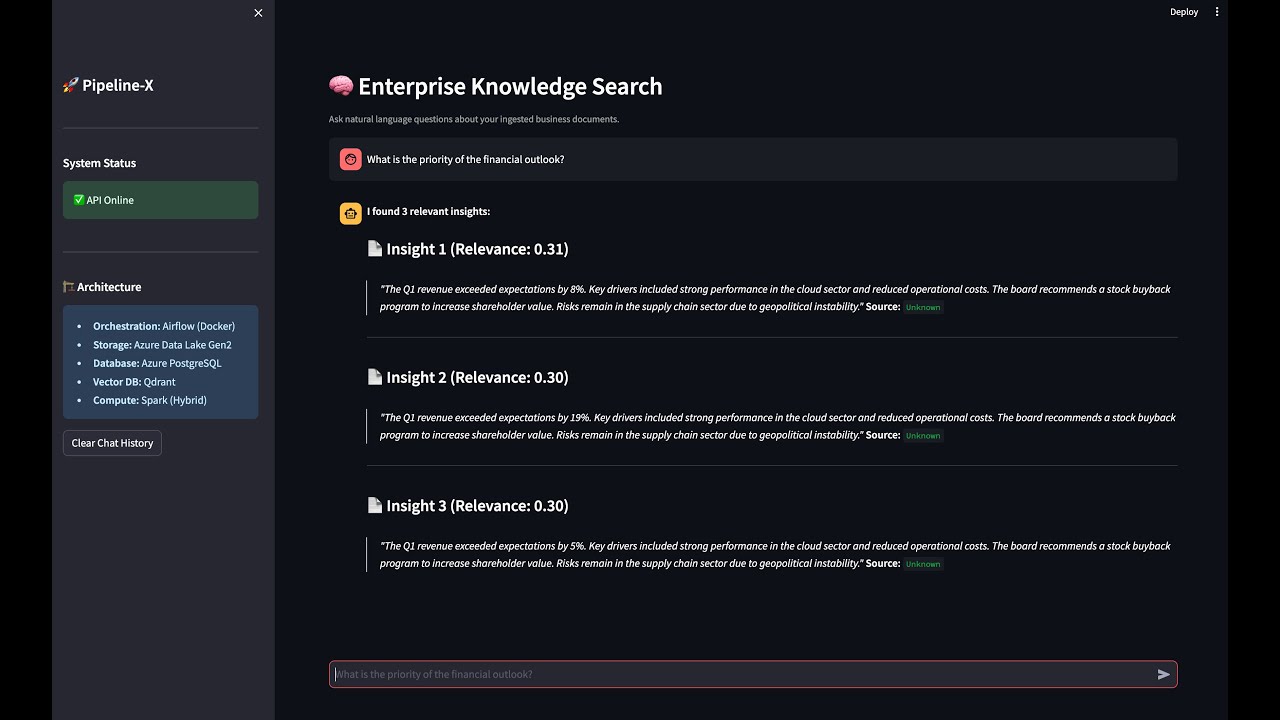
📺 Watch the Platform Demo featuring Apache Spark distributed processing, Airflow orchestration, and Azure Hybrid Cloud deployment.












Pipeline-X is a reference architecture for a Modern Data Platform. It demonstrates how to bridge the gap between traditional Data Engineering (ETL) and AI Engineering (RAG) using a Hybrid Cloud approach. It runs compute locally (Docker) while offloading durable storage to the cloud (Azure), ensuring scalability, cost-efficiency, and data resilience.
Building reliable data pipelines for AI is complex. Most projects fail because the underlying data foundation is brittle. Pipeline-X solves common engineering pitfalls by demonstrating a robust, unified architecture that scales from "Local Dev" to "Enterprise Cloud":
| The Problem | Pipeline-X Solution |
|---|---|
| Data Gravity | Training data is stuck in silos (CSVs, SQL). |
| Scalability | Pandas scripts crash on datasets >10GB. |
| Contextual AI | Standard search misses meaning. |
| Security | Hardcoded credentials in code. |
Pipeline-X implements a Polyglot Architecture, utilizing the "Right Tool for the Job" strategy.
The Data Lifecycle: Ingest
graph LR
    Source[Raw Data Sources] -- "Ingest" --> Airflow[Airflow Orchestrator]

    subgraph "Processing Layer (Docker)"
        Airflow -- "Trigger Job" --> Spark[Spark Cluster]
        Spark -- "Write Parquet" --> Lake[Data Lake]
        Airflow -- "Embed Chunks" --> Embed[Embedding Service]
    end

    subgraph "Storage Layer (Azure + Hybrid)"
        Lake -- "Load Metadata" --> SQL[(Azure PostgreSQL)]
        Embed -- "Upsert Vectors" --> Vec[(Qdrant Vector DB)]
    end

    User[Data Analyst] -- "Streamlit UI" --> API[FastAPI Gateway]
    API -- "RAG Query" --> Vec
    API -- "SQL Query" --> SQL

    style Source stroke:#333,stroke-width:2px
    style Airflow stroke:#333,stroke-width:2px
    style Spark stroke:#333,stroke-width:2px,color:white
    style SQL stroke:#333,stroke-width:2px,color:white
    style Vec stroke:#333,stroke-width:2px,color:white
How we orchestrate Analytics (SQL), Big Data (Spark), and AI (Vectors) in parallel.
sequenceDiagram
    participant A as Airflow
    participant S as Spark
    participant D as DB (Postgres)
    participant V as Qdrant

    Note over A: 01:00 AM Daily Schedule
    A->>S: Submit Job (Spark Transformation)
    S-->>S: Self-Healing Check (Create Container?)
    S-->>A: Job Success (Parquet Written to Azure)

    par Analytics Stream
        A->>D: Load Metadata (Authors, Dates)
    and AI Stream
        A->>A: Chunk Text (RecursiveSplitter)
        A->>V: Batch Upsert Embeddings
    end
Strategic infrastructure choices for a scalable data platform.
| Component | Decision | Alternatives Considered | Justification (The "Why") |
|---|---|---|---|
| Compute Engine | Apache Spark | Pandas / Dask | Horizontal Scale: Pandas is memory-bound to a single machine. Spark allows us to add worker nodes seamlessly as data grows from GBs to TBs without rewriting code. |
| Orchestration | Airflow | Cron / Prefect | Dependency Management: We need complex DAGs where the Vector Store update must not start unless the Data Quality checks pass. Airflow handles these retry logics natively. |
| Infrastructure | Terraform | Azure Portal (ClickOps) | Reproducibility: The entire database layer (Postgres Flexible Server) is defined as code. This allows us to spin up identical "Staging" and "Prod" environments in minutes. |
| Search Engine | Qdrant | PGVector / Pinecone | Performance: Qdrant is written in Rust and optimized for high-throughput vector search. We use it locally to avoid vendor lock-in but it scales easily to cloud. |
Unlike simple Python scripts, Pipeline-X uses a dedicated Apache Spark Cluster (Master/Worker topology) running inside Docker to process heavy datasets.
- Self-Healing Infrastructure: The Spark job (
spark_transformer.py) implements Infrastructure as Code (IaC) logic. It checks for the existence of the target Azure Data Lake container (processed-data) and automatically provisions it via the Azure SDK if it's missing. - Cloud-Native Storage: Data is processed locally but written directly to Azure Data Lake Storage (ADLS) Gen2 in Snappy-compressed Parquet format.
- Schema Validation: The Spark job enforces strict schema on ingestion. If a column is missing in the source CSV, the pipeline halts before polluting the data lake.
- Idempotency: Airflow DAGs are designed to be re-runnable. If the job fails halfway, re-running it will overwrite the specific partition rather than duplicating data.
- Decoupled Service Layer: Exposes data via a FastAPI microservice, allowing frontend applications (Streamlit) to consume RAG capabilities without direct database access.
| Layer | Technology | Role |
|---|---|---|
| Orchestration | Apache Airflow 2.9 | DAG Scheduling, Dependency Management, Retries. |
| Compute | Apache Spark 3.5 | Distributed processing of large-scale datasets. |
| Storage | Azure Data Lake Gen2 | Cloud "Landing Zone" for Parquet files. |
| Database | Azure PostgreSQL 15 | Relational storage for structured metadata. |
| Vector DB | Qdrant | High-performance vector similarity search. |
| Frontend | Streamlit + FastAPI | Interactive AI Chat Interface. |
| Infrastructure | Terraform | IaC for Azure Resource Groups, Storage, and Networking. |
- Docker Desktop (with at least 8GB RAM allocated)
- Azure Account (Free Tier works)
- Terraform CLI (Optional, for auto-provisioning)
We use Terraform to spin up the Azure Data Lake and PostgreSQL database.
make infra-init
make infra-up
- This will output your Azure connection details. You will need them for the next step.
Create a .env file in the root directory. This configures both Local Docker services and Cloud Connectivity.
# ==========================================
# 1. System & Airflow Configuration
# ==========================================
AIRFLOW_UID=50000
AIRFLOW_PROJ_DIR=./dags

# ==========================================
# 2. Database Configuration (PostgreSQL)
# ==========================================
# OPTION A: LOCAL DOCKER (Default)
POSTGRES_HOST=postgres
POSTGRES_USER=airflow
POSTGRES_PASSWORD=airflow
POSTGRES_DB=airflow
POSTGRES_PORT=5432

# OPTION B: AZURE HYBRID CLOUD (From Terraform Output)
# POSTGRES_HOST=pipeline-x-db-<id>.postgres.database.azure.com
# POSTGRES_USER=airflow_admin
# POSTGRES_PASSWORD=SecurePassword123!

# ==========================================
# 3. Azure Data Lake (For Spark)
# ==========================================
# Required for 'Self-Healing' Spark jobs to write to Cloud
AZURE_STORAGE_ACCOUNT_NAME=pipelinex<your_id>
AZURE_STORAGE_ACCOUNT_KEY=<your_primary_key>

# ==========================================
# 4. Vector Database & API
# ==========================================
QDRANT_HOST=qdrant
QDRANT_PORT=6333
API_URL=http://api:8000
We use a unified Makefile to handle the Docker build process and network setup.
make build
- Access Airflow at
http://localhost:8080(User:admin, Pass:admin). - Trigger the
pipeline_x_ingestionDAG. - Watch the graph execute the 3 parallel streams (SQL, Spark, AI).
- AI Interface: Go to
http://localhost:8501and ask: "What is the financial outlook?" - Spark Cluster: Check
http://localhost:8081to see the completed application. - Azure Portal: Verify the
.parquetfiles have landed in your Storage Account.
pipeline-x/
├── Makefile                  # Command Center (Build, Deploy, Clean)
├── docker-compose.yml        # Service Definitions (Airflow, Spark, Qdrant)
├── infra/                    # Terraform (Azure Infrastructure)
│   ├── main.tf               # Cloud Resources (Storage, Postgres)
│   └── outputs.tf            # Connection String Outputs
├── dags/                     # Airflow Orchestration
│   ├── ingestion_pipeline.py # Main DAG
│   └── utils/                # DB Connectors
├── src/                      # Application Logic
│   ├── etl/
│   │   ├── spark_transformer.py # Self-Healing Spark Job
│   │   └── transformer.py       # Pandas Logic
│   ├── ai/
│   │   ├── embedder.py          # Vector Generation (Batch + Realtime)
│   │   └── chunker.py           # Text Splitting
│   ├── api/                  # FastAPI Backend
│   └── ui/                   # Streamlit Frontend
└── requirements.txt          # Python Dependencies
Scenario: Processing 100GB Daily.
| Resource | Strategy | Est. Cost |
|---|---|---|
| Compute | Hybrid Offloading: We run Spark locally (or on cheap spot instances) and only pay for Cloud Storage. | $0.00 (Compute) |
| Storage | Azure Blob (Hot): Parquet compression reduces size by ~70% vs CSV. | ~$2.50/mo |
| Database | Azure Postgres (Burstable): B1ms tier is sufficient for metadata. | ~$15.00/mo |
Nahasat Nibir Senior Data Engineer & Cloud Architect
"Pipeline-X proves that you don't need Databricks to build a Data Lake. With the right architecture, you can build a robust, self-healing, and scalable platform using Open Source tools and smart Cloud integration."