AI-powered job orchestration system with production-oriented full-stack architecture.
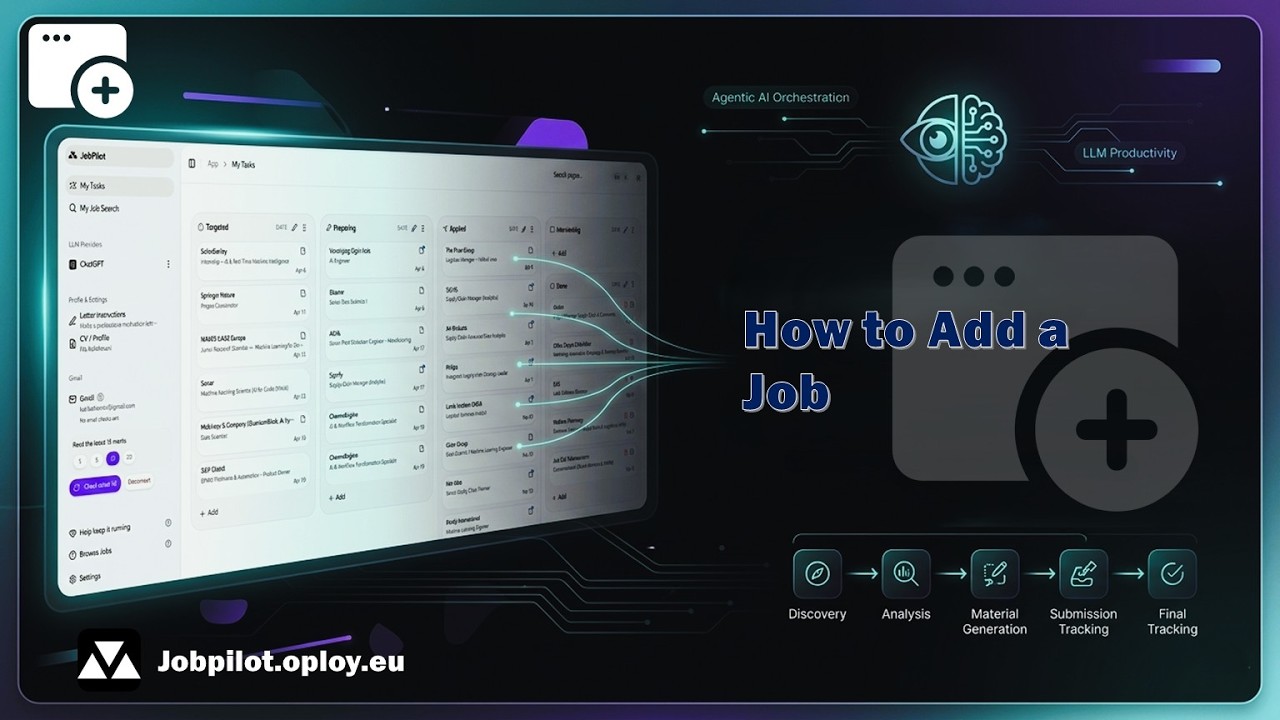
JobPilot is an open-source platform for managing job applications, running personalized job search workflows, and integrating AI into real user operations without reducing the system to prompt-only automation.
JobPilot is designed around a simple product goal: help users run a serious, structured job search with less manual coordination.
At the product level, it combines:
- a Kanban workflow for application tracking
- a personal search engine for discovery, scoring, and filtering
- Gmail-assisted automation for detecting interview, rejection, and acceptance signals
- AI-assisted task execution for parsing jobs, enriching records, and generating application artifacts
At the engineering level, the project demonstrates how to build an AI-enabled system with explicit boundaries, persistence layers, failure handling, deployment discipline, and evaluation loops.
This repository (JobPilot) is the main application layer for JobPilot. It is backed by a broader multi-service workspace that includes a dedicated Python search backend, data/evaluation modules, and deployment infrastructure.
- Kanban-based job application tracking with structured stages and task metadata
- AI task assistant for parsing job descriptions, enriching task details, and generating motivation-letter content
- Gmail integration that detects operational job-search signals and maps them into task updates
- Personal job search engine with scraping, normalization, scoring, filtering, and persistence
- Power search mode for extended search behavior and higher-coverage runs
- Hybrid enrichment pipeline combining heuristics with LLM-assisted refinement
- Task-agent reliability features including cleanup flows, retry-aware logic, and stuck-state recovery
- Full-stack app orchestration across SvelteKit, Convex, Supabase, and external APIs
- Evaluation-oriented development through a dedicated
evals/module with datasets and scorers - Production-minded deployment setup spanning environment-specific configuration, CI checks, and serverless deployment workflows
JobPilot is not a single UI app with an API wrapper. It is a multi-component system with clear responsibilities across frontend orchestration, backend services, persistence, AI workflows, and evaluation.
- Built with SvelteKit
- Serves the main product UI and route orchestration
- Handles authentication, Kanban workflows, Gmail connection UX, task interactions, and personal search presentation
- Built on Convex
- Handles user state, task persistence, Gmail token storage, agent orchestration, support workflows, and reactive queries/mutations/actions
- Built with Python + FastAPI
- Handles scraping, normalization, deduplication, ranking, and search orchestration
- Persists structured search outputs to Supabase/Postgres
- Convex for application state and orchestration data
- Supabase/Postgres for search profiles, runs, canonical jobs, and match persistence
- Datasets, scorers, and result tracking for iterative improvement
- Supports measurable prompt/system changes rather than intuition-only tuning
The sequence below shows the high-level runtime interaction between the user-facing app, orchestration layer, search backend, persistence, and evaluation loop.
%%{init: {'theme': 'base', 'themeVariables': { 'actorBkg': '#111827', 'actorBorder': '#60A5FA', 'actorTextColor': '#F8FAFC', 'signalColor': '#94A3B8', 'signalTextColor': '#E5E7EB', 'labelBoxBkgColor': '#111827', 'labelBoxBorderColor': '#F59E0B', 'labelTextColor': '#F8FAFC', 'loopTextColor': '#F8FAFC', 'noteBkgColor': '#1F2937', 'noteBorderColor': '#C084FC', 'noteTextColor': '#F8FAFC', 'activationBorderColor': '#34D399', 'activationBkgColor': '#0F172A', 'sequenceNumberColor': '#F8FAFC', 'fontSize': '15px'}}}%%
sequenceDiagram
    autonumber

    actor User
    participant UI as SvelteKit App
    participant CVX as Convex Orchestration
    participant GMAIL as Gmail Integration
    participant SEARCH as FastAPI Search Backend
    participant LLM as LLM / Enrichment Layer
    participant SUPA as Supabase
    participant EVAL as Evals / Scorers

    User->>UI: Manage tasks, search jobs, review recommendations
    UI->>CVX: Read/write task state, auth context, workflow actions
    UI->>SEARCH: Trigger personalized job search via API route
    UI->>GMAIL: Connect mailbox and read job-related email signals

    CVX->>LLM: Parse jobs, enrich tasks, generate supporting content
    SEARCH->>LLM: Selective job enrichment and ranking support
    SEARCH->>SUPA: Persist search runs, jobs, and matches
    GMAIL->>CVX: Map inbox events to task updates
    SUPA-->>UI: Return matched jobs and recent runs
    EVAL->>LLM: Measure prompt and system changes
    EVAL->>SEARCH: Score quality and iteration outcomes
    CVX-->>UI: Reactive task and workflow updates
    UI-->>User: Updated Kanban state, search results, next actions
- The main app is implemented in SvelteKit and uses Convex for reactive backend state, mutations, actions, and orchestration.
- Personalized search runs through a separate FastAPI service, which keeps scraping/ranking concerns outside the UI runtime.
- Search results are persisted in Supabase/Postgres, while task/application state lives in Convex.
- Gmail integration is not cosmetic: inbox events are converted into task-level operational signals such as interview, rejection, and follow-up updates.
- Enrichment is heuristic-first and uses LLMs selectively rather than treating every record as a model call.
- The workspace includes a dedicated evaluation loop with datasets and scorers to track quality improvements over time.
- The system includes cleanup and stuck-state handling for task-agent workflows, reflecting attention to failure modes rather than just happy-path UX.
- Deployment is split across app/runtime boundaries with environment-specific configuration, CI workflows, and serverless-friendly packaging patterns.
LLMs are used inside bounded workflows rather than as a substitute for application logic. The system combines:
- deterministic heuristics
- structured persistence
- domain-specific matching/scoring
- selective enrichment
- user-authenticated AI actions where appropriate
The task/agent flow includes explicit handling for real operational issues such as:
- stale or stuck work items
- error-state cleanup
- duplicate-prevention logic
- controlled retry behavior
- user-visible state transitions
The repository reflects architectural separation between:
- product UI and route orchestration
- reactive backend logic
- search-specific scraping/ranking services
- persistence responsibilities
- evaluation and iteration workflows
The project shows practical engineering decisions around:
- environment-based configuration
- rate-limit and runtime budget awareness
- selective LLM usage instead of maximum LLM usage
- deployment packaging and CI automation
- maintaining local/dev/prod paths across multiple services
JobPilot uses AI as a system component, not a UI gimmick.
- job/task parsing
- motivation-letter generation support
- selective enrichment of job records
- keyword suggestion from user profile/CV context
- support/task-assistant workflows
- heuristics-first where possible to reduce unnecessary model usage
- batched or selective enrichment for cost and latency control
- structured app logic around model calls rather than free-form agent behavior everywhere
- explicit persistence and post-processing so outputs become usable application state
- user-authenticated and environment-aware flows where external model access is involved
- naive “send everything to a model” architecture
- undocumented prompt-only business logic
- hiding failure cases behind a chat interface
The result is a system where AI is useful because it is integrated into the surrounding engineering constraints.
The personalized search subsystem is intentionally separated from the UI runtime. The flow below highlights the minimal data path from user request to persisted, ranked results.
%%{init: {'theme': 'base', 'themeVariables': { 'primaryColor': '#111827', 'primaryTextColor': '#F9FAFB', 'primaryBorderColor': '#60A5FA', 'lineColor': '#94A3B8', 'secondaryColor': '#1F2937', 'tertiaryColor': '#0F172A', 'fontSize': '15px'}}}%%
flowchart LR
    classDef actor fill:#1f2937,stroke:#60a5fa,color:#f9fafb,stroke-width:2px;
    classDef script fill:#111827,stroke:#f59e0b,color:#f9fafb,stroke-width:2px;
    classDef store fill:#0b1220,stroke:#8b5cf6,color:#f9fafb,stroke-width:2px;
    classDef runtime fill:#052e2b,stroke:#34d399,color:#ecfeff,stroke-width:2px;

    USER([User Request]) --> UI[/SvelteKit API Proxy/]
    UI --> ORCH([FastAPI Orchestrator])
    ORCH --> PIPE([Scrape → Normalize → Score])
    PIPE --> ENRICH([Selective LLM Enrichment])
    ENRICH --> SUPA[(Supabase)]
    SUPA --> UI
    UI --> TASKS([Optional Send to Tasks])

    class USER actor;
    class UI script;
    class SUPA store;
    class ORCH,PIPE,ENRICH,TASKS runtime;
The wider workspace includes a dedicated evals/ module with:
- datasets
- scorers
- reproducible evaluation runs
- before/after results tracking
This matters because prompt or workflow changes are not treated as purely subjective improvements. The evaluation layer supports:
- baseline measurement
- failure analysis
- trace-based debugging
- scorer-driven iteration
- measurable improvement loops
This is an important part of the project’s engineering maturity: AI behavior is improved through instrumentation and evaluation, not only ad hoc manual inspection.
The repository is set up with production-minded deployment patterns rather than a local-only developer experience.
- SvelteKit app build via Bun/Vite
- Convex for backend deployment and runtime state management
- Vercel-oriented configuration for the main web app
- Lambda-style deployment structure in the broader workspace for Python services
- environment-specific configuration files for local, CI, deployment, and backend runtime
- GitHub Actions workflows for static checks and preview/e2e automation
- deployment scripts and packaging support across services
- support for serverless/cloud execution models
- Convex for app/runtime state
- Supabase/Postgres for structured search data
- Gmail OAuth for inbox-driven workflow updates
- analytics and operational integrations where needed
The full system spans multiple services, but the main app can be started locally with a realistic development workflow.
- Bun
- Node.js
- Convex account/project
- optional: Supabase project for personal search
- optional: Gmail / Resend / analytics credentials depending on which integrations you want active
bun installCreate local environment files from the provided examples as needed:
.env.local.env.convex.local.env.deployment.example.env.test.example
At minimum, local development typically requires values for:
CONVEX_DEPLOYMENTPUBLIC_CONVEX_URL- personal search API / Supabase variables if using the job-search subsystem
- optional auth/email/analytics variables depending on enabled features
bun run devThis runs:
- SvelteKit frontend
- Convex development backend
bun run check
bun run lint
bun run testThe personalized search engine lives in the separate job-personal-search/ service. If you want full end-to-end search behavior, run that backend and connect the SvelteKit proxy route to it through the configured API URL.
JobPilot is free to use.
The intent behind open-sourcing it is twofold:
- make the tool usable and inspectable by others
- demonstrate how AI can be embedded into real user workflows with stronger engineering discipline than a demo-first prototype
The project also includes an optional donation/support path for people who want to help sustain development, but the core philosophy is that the system should remain useful without turning access into a paywall.
This project was originally inspired by earlier work and starter foundations, but the current system has been substantially extended into a broader multi-component product with:
- a job-search backend
- AI-assisted orchestration
- Gmail-driven operational updates
- evaluation workflows
- production-oriented architecture decisions
The result is meaningfully beyond a template or hackathon-only prototype.
JobPilot reflects a combination of skills expected from an AI Engineer / ML Systems Engineer / AI Solutions Engineer:
- full-stack product development across frontend, backend, and data boundaries
- AI workflow design with explicit operational constraints
- evaluation-driven iteration instead of prompt-only experimentation
- reliability thinking around failure recovery and state cleanup
- infrastructure awareness spanning deployment, configuration, CI, and service separation
For hiring managers and technical reviewers, the strongest signal in this project is not just “uses AI,” but how AI is integrated into a real system with architecture, measurement, and operational ownership.
MIT