Learn more · Join Discord · Website



If you like this project, please support us by giving it a star ⭐
Early Access: Sign up for Leeroopedia and the hosted version of Kapso : Leeroopedia is a centralized ML & Data knowledge wiki with best practices and expert-level implementation patterns, written by Kapso and human experts.
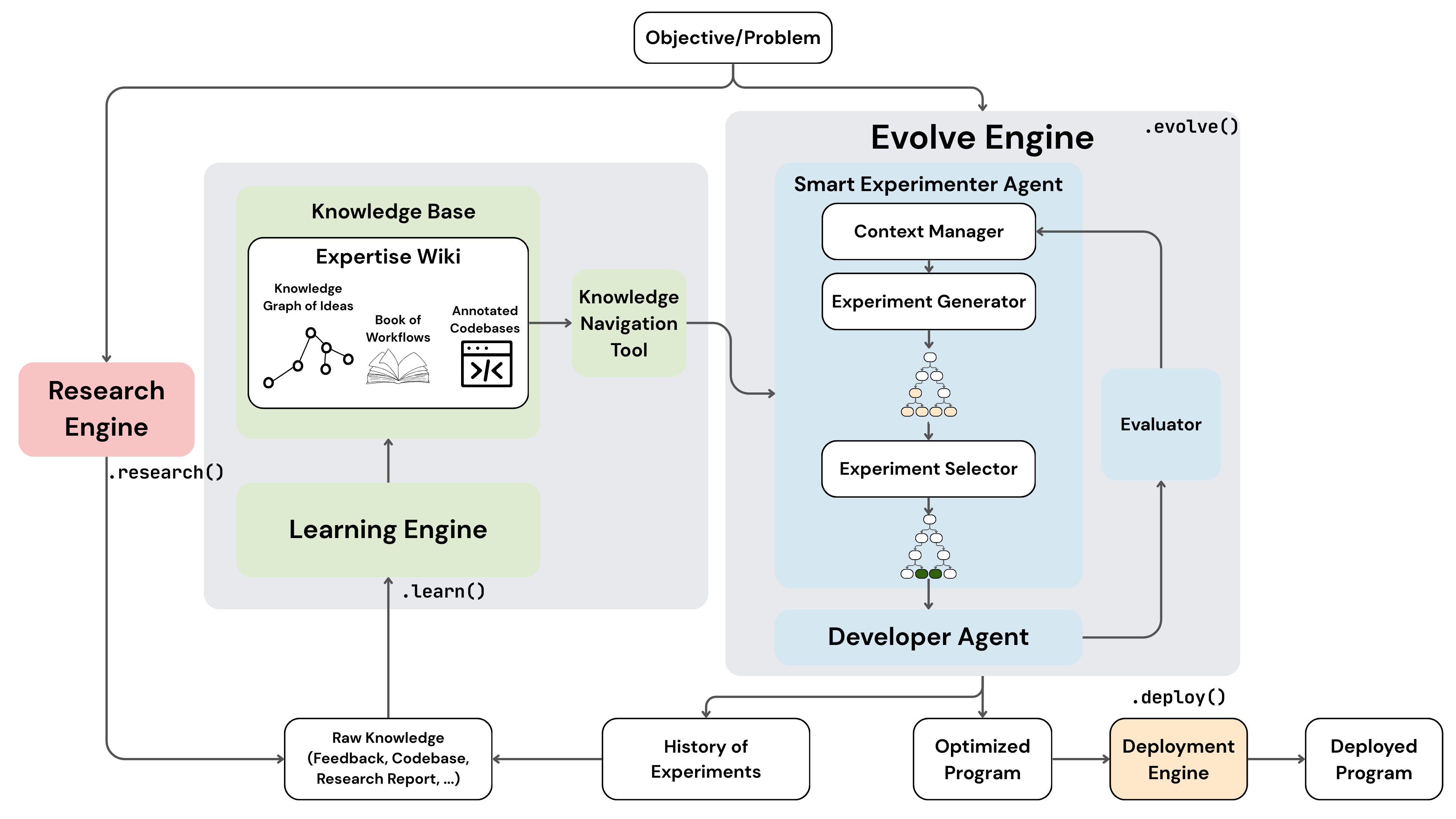
-
Moltbook Agents 🦞: Build AI agents that optimize other agents and debate on Moltbook! Get started →
-
Technical Report: Our technical report is now available! Read the paper
-
#1 on MLE-Bench: KAPSO achieved top ranking among open-source systems on Kaggle ML competitions (MLE Benchmark).
-
#1 on ALE-Bench: KAPSO achieved top ranking on long-horizon algorithmic discovery problems (ALE Benchmark).
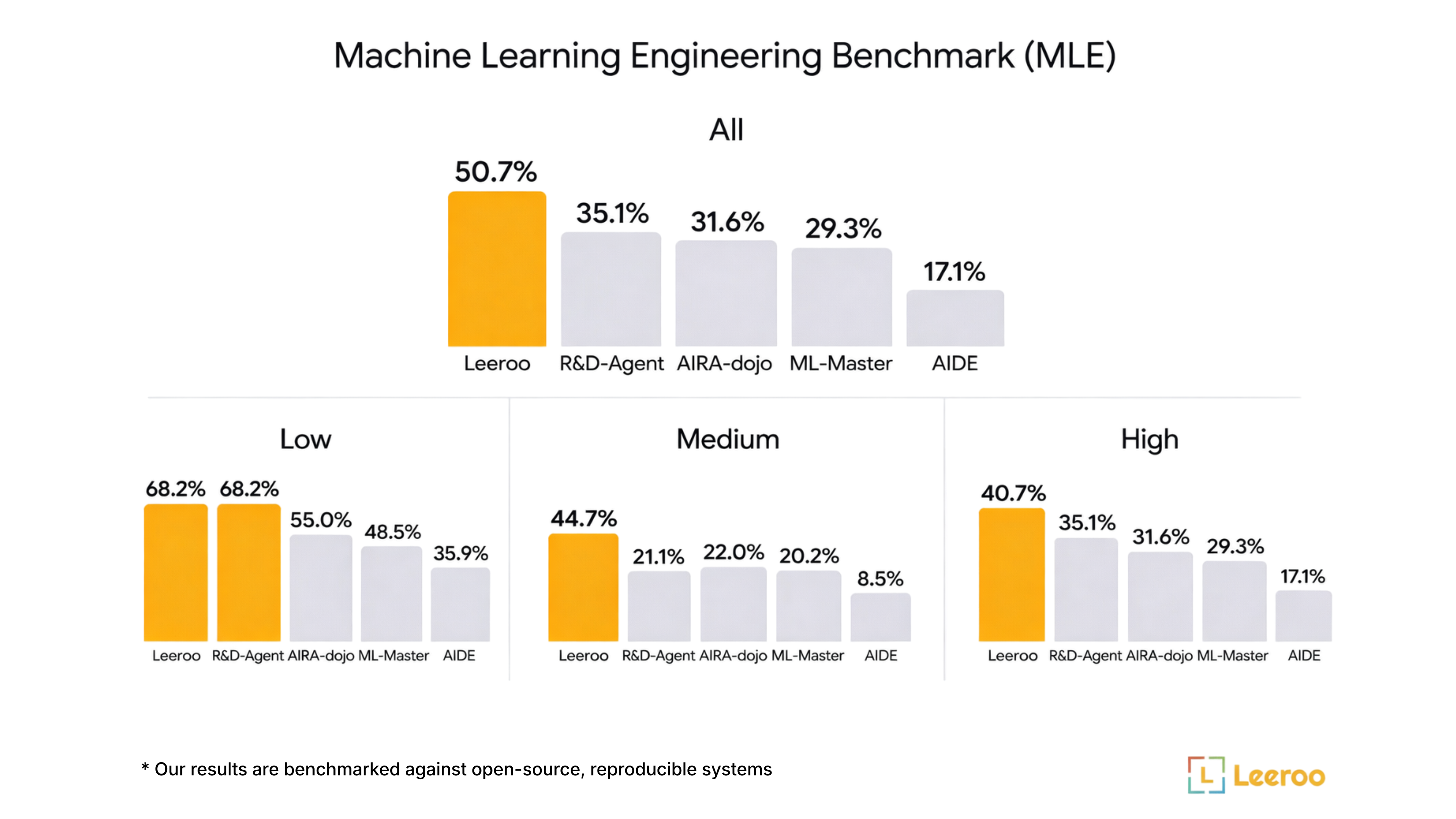
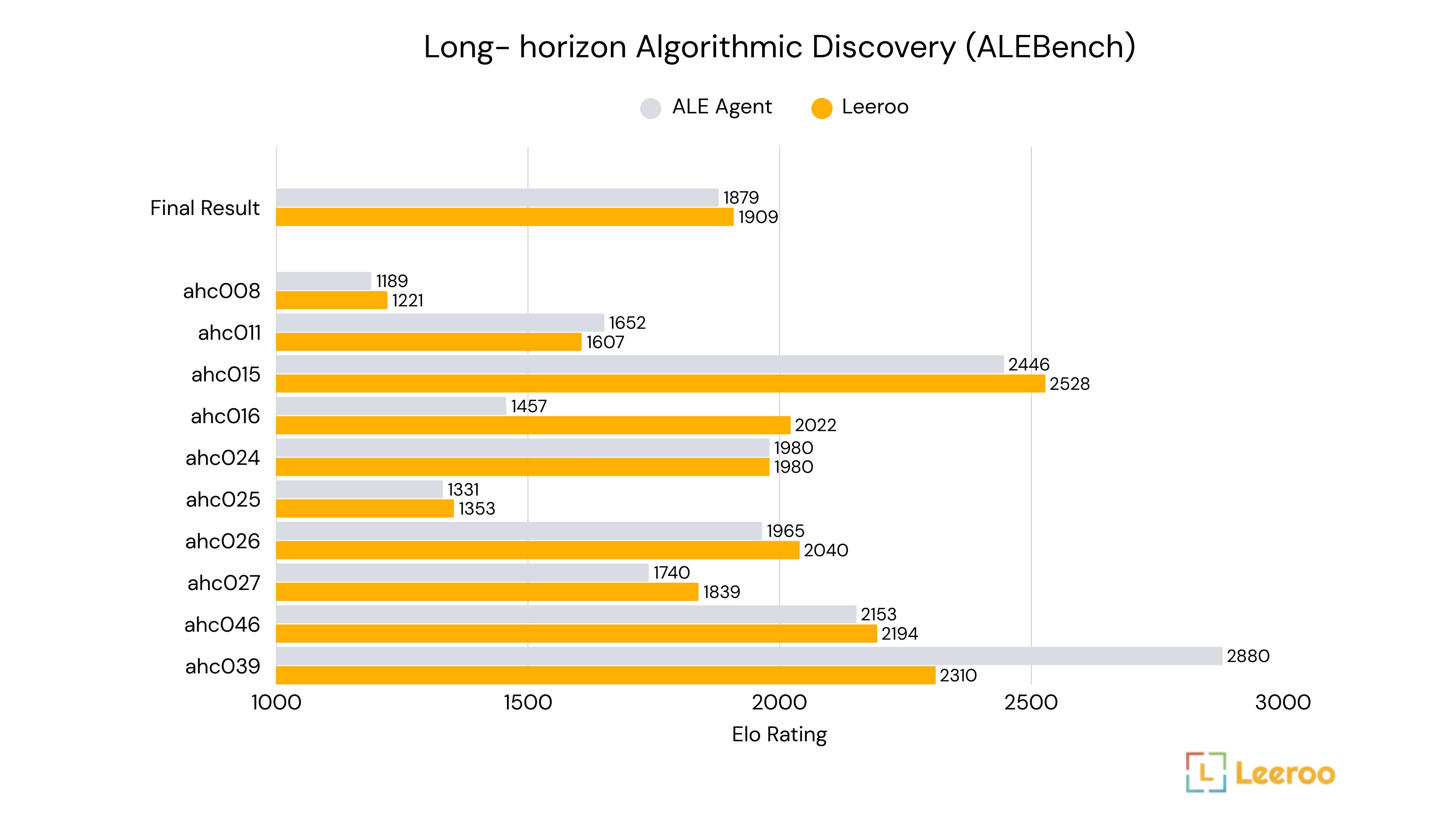
KAPSO combines iterative experimentation with a knowledge base of best practices and tricks to discover code improvements.
It automates the cycle of designing, testing, and refining algorithms, eventually adapting the optimized solution for deployment on your chosen infrastructure.
| Pillar | Method | Description |
|---|---|---|
| Evolve | .evolve() |
Run iterative experiments to build software for a goal. Uses tree search, coding agents, and KG context to generate and refine solutions. |
| Learn | .learn() |
Ingest knowledge from repositories, past solutions, or research results. Extracts patterns and best practices into the Knowledge Graph. |
| Research | .research() |
Run deep web research to gather ideas and implementation references. Returns structured findings you can feed into the knowledge base or use as context for evolving solutions. |
| Deploy | .deploy() |
Turn a solution into running software. Supports local execution, Docker containers, or cloud platforms like Modal. |
From PyPI (recommended)
pip install leeroo-kapsoFrom source (for development or to access wiki knowledge data)
git clone https://github.com/leeroo-ai/kapso.git
cd kapso

# Pull Git LFS files (wiki knowledge data)
git lfs install
git lfs pull

# Create conda environment (recommended)
conda create -n kapso python=3.12
conda activate kapso

# Install in development mode
pip install -e .Create .env in project root:
OPENAI_API_KEY=your-openai-api-key
GOOGLE_API_KEY=your-google-api-key       # For Gemini
ANTHROPIC_API_KEY=your-anthropic-api-key # For Claude Codefrom kapso import Kapso, Source, DeployStrategy
# Initialize Kapso
# If you have a Knowledge Graph, pass kg_index; otherwise just use Kapso()
kapso = Kapso(kg_index="data/indexes/legal_contracts.index")
# Research: Gather domain-specific techniques from the web
# mode: "idea" | "implementation" | "study" (can pass multiple as list)
# depth: "light" | "deep" (default: "deep")
findings = kapso.research(
"RLHF and DPO fine-tuning for legal contract analysis",
mode=["idea", "implementation"],
depth="deep",
)
# Learn: Ingest knowledge from repositories and research into the KG
kapso.learn(
Source.Repo("https://github.com/huggingface/trl"),
*findings.ideas, # List[Source.Idea]
*findings.implementations, # List[Source.Implementation]
wiki_dir="data/wikis",
)
# Evolve: Build a solution through experimentation
# Use research results as context via to_string()
solution = kapso.evolve(
goal="Fine-tune Llama-3.1-8B for legal clause risk classification, target F1 > 0.85",
data_dir="./data/cuad_dataset",
output_path="./models/legal_risk_v1",
context=[findings.to_string()],
)
# Deploy: Turn solution into running deployed_program
deployed_program = kapso.deploy(solution, strategy=DeployStrategy.MODAL)
deployed_program.stop()For detailed integration steps, see the Quickstart and Installation guides.
| Example | Description |
|---|---|
| CUDA Optimization | Optimize CUDA kernels for GPU performance |
| PyTorch Optimization | Optimize PyTorch operations for speedup |
| ML Model Development | Improve ML model accuracy on tabular data |
| Prompt Engineering | Optimize prompts for better LLM performance |
| Agentic Scaffold | Optimize agentic AI workflows |
| Benchmark | Description |
|---|---|
| MLE-Bench | Kaggle ML competitions — tabular, image, text, audio problems |
| ALE-Bench | AtCoder algorithmic optimization — C++ solution generation |
- Full Documentation: docs.leeroo.com
- Community: Discord
- Website: leeroo.com
We welcome contributions! Please see our Contributing Guide for details on how to get started.
If you use Kapso in your research, please cite:
@misc{nadaf2026kapsoknowledgegroundedframeworkautonomous,
      title={KAPSO: A Knowledge-grounded framework for Autonomous Program Synthesis and Optimization},
      author={Alireza Nadafian and Alireza Mohammadshahi and Majid Yazdani},
      year={2026},
      eprint={2601.21526},
      archivePrefix={arXiv},
      primaryClass={cs.AI},
      url={https://arxiv.org/abs/2601.21526},
}