A Decentralized Multi-Agent Framework for Edge Devices with Beacon-Guided Task Routing and CoT Voting
Symphony is a decentralized multi-agent framework that enables intelligent agents to collaborate across heterogeneous edge devices through beacon-guided task routing and Chain-of-Thought (CoT) voting mechanisms.
- Overview
- Key Features
- Directory Structure
- Installation
- Quick Start
- Running Experiments
- Benchmark Data Generation
- Reproducing Paper Results
- Configuration Guide
- Citation
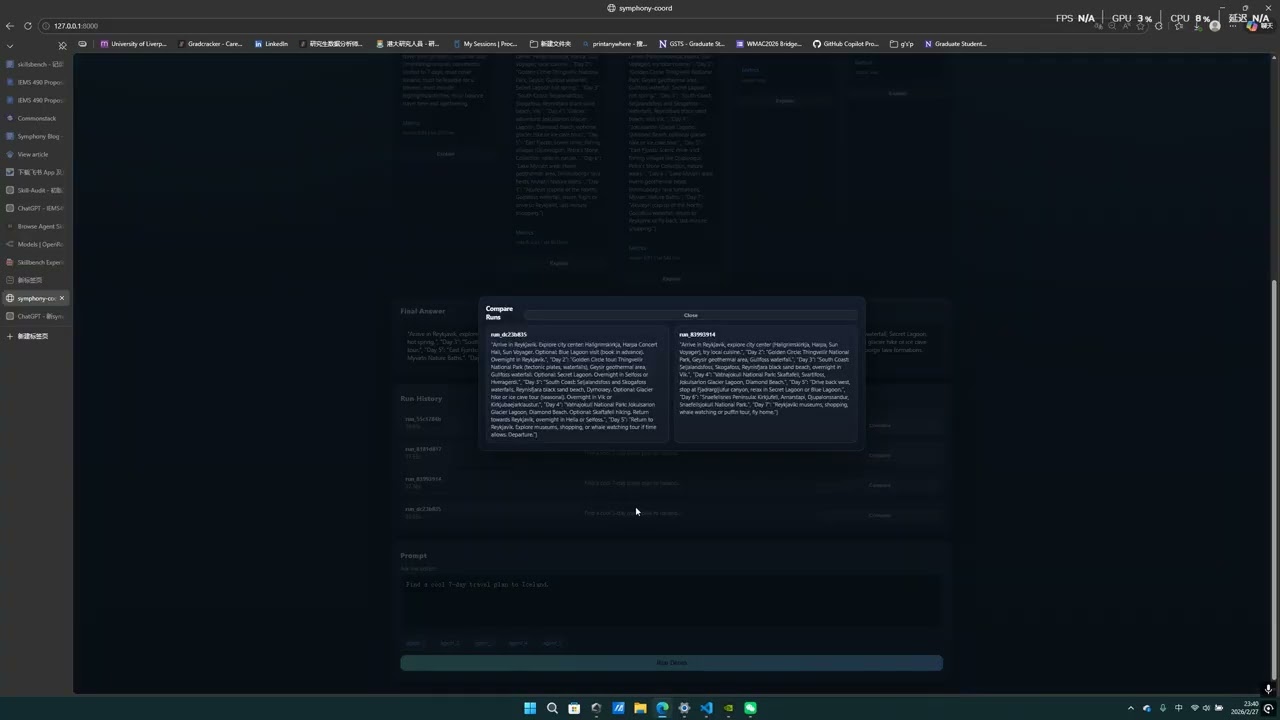
Symphony employs a three-stage pipeline:
- Planning Phase: Multiple planning agents decompose complex queries into executable sub-tasks
- Execution Phase: Beacon-guided routing matches sub-tasks to specialized agents using LinUCB-based selection
- Voting Phase: CoT voting aggregates multiple agent responses for robust final answers

User Query
    │
    ▼
┌─────────────────────────────────────────┐
│  Planning Phase                         │
│  - Task decomposition (k plans)         │
│  - LinUCB plan selection                │
└─────────────────────────────────────────┘
    │
    ▼
┌─────────────────────────────────────────┐
│  Execution Phase                        │
│  - Beacon broadcast for each sub-task   │
│  - Top-L agent candidate selection      │
│  - LinUCB agent selection               │
│  - Parallel CoT execution               │
└─────────────────────────────────────────┘
    │
    ▼
┌─────────────────────────────────────────┐
│  Voting Phase                           │
│  - CoT voting across responses          │
│  - Final answer aggregation             │
└─────────────────────────────────────────┘
    │
    ▼
Final Result
- Decentralized Architecture: No central orchestrator required, fault-tolerant
- Intelligent Task Routing: Beacon-based capability matching with LinUCB learning
- Advanced Reasoning: Multi-path CoT with majority voting
- Edge-Optimized: Runs on consumer-grade GPUs (RTX 3060/4090, Jetson, M-series Mac)
symphony/
├── README.md                    # This file
├── requirements.txt             # Python dependencies
├── pyproject.toml               # Package configuration
│
├── core/                        # Core algorithms
│   ├── capability.py            # Capability matching
│   ├── linucb_selector.py       # LinUCB bandit selector
│   ├── routing.py               # Task routing
│   └── voting.py                # CoT voting mechanisms
│
├── agents/                      # Agent implementations
│   ├── agent.py                 # Main Agent class
│   └── user.py                  # User client
│
├── protocol/                    # Protocol definitions
│   ├── task_contract.py         # Task data structures
│   └── beacon.py                # Beacon messages
│
├── infra/                       # Infrastructure
│   └── ISEP.py                  # Service exchange protocol
│
├── models/                      # Model loaders
│   └── base_loader.py           # LLM loading utilities
│
├── symphony.py                  # Core orchestrator
├── main.py                      # Simple entry point
├── agent_register.py            # Agent registration runner
├── user_register.py             # User registration runner
│
├── experiments/                 # All experiments
│   ├── README.md                # Experiments overview
│   ├── pretrain.py              # Main experiment runner
│   ├── configs/                 # Configuration files
│   ├── scripts/                 # Shell scripts
│   ├── exp1/                    # Exp1: Efficiency & Cost
│   ├── exp2/                    # Exp2: Robustness & Recovery
│   └── exp3/                    # Exp3: System Optimization
│
├── scripts/                     # Utility scripts
│   ├── plotting/                # Visualization
│   │   ├── paper_figures/       # Paper figure generation
│   │   └── routing/             # Routing analysis plots
│   └── analysis/                # Analysis utilities
│
├── symphony-data-generator/     # Benchmark data generation
│   ├── config/data_config.yaml  # Benchmark configurations
│   ├── src/data_generator.py    # Core difficulty scoring module
│   └── src/quick_start.py       # Quick start script
│
├── docs/                        # Documentation
├── examples/                    # Example configurations
└── tests/                       # Test suite
| Requirement | Minimum | Recommended |
|---|---|---|
| Python | 3.9 | 3.10 or 3.11 |
| RAM | 8 GB | 16 GB |
| GPU | Optional | CUDA-compatible (RTX 3060+) |
| OS | Linux, macOS, Windows | Linux (Ubuntu 20.04+) |
# 1. Clone the repository
git clone https://github.com/anonymous/symphony.git
cd symphony

# 2. Create and activate virtual environment
python -m venv venv
source venv/bin/activate  # On Windows: venv\Scripts\activate

# 3. Upgrade pip
pip install --upgrade pip

# 4. Install core dependencies
pip install -r requirements.txt

# 5. Install Symphony in development mode
pip install -e .

# 6. Verify installation
python -c "import symphony; print('Symphony installed successfully')"The requirements.txt includes:
Core Dependencies (required):
torch>=2.0.0- Deep learning frameworktransformers>=4.30.0- Hugging Face model librarynumpy>=1.24.0- Numerical computingpyyaml>=6.0- Configuration file parsingrequests>=2.28.0- HTTP client for API callspyzmq>=25.0.0- Distributed messagingaiohttp>=3.8.0- Async HTTP client
Optional Dependencies (for GPU acceleration):
accelerate>=0.20.0- Distributed trainingbitsandbytes>=0.41.0- 8-bit quantizationpeft>=0.4.0- Parameter-efficient fine-tuning
Symphony uses OpenRouter for LLM API access:
# Option 1: Export in terminal (temporary)
export OPENROUTER_API_KEY="sk-or-v1-your-key-here"

# Option 2: Add to shell profile (persistent)
echo 'export OPENROUTER_API_KEY="sk-or-v1-your-key-here"' >> ~/.bashrc
source ~/.bashrc

# Option 3: Create .env file (recommended for development)
echo 'OPENROUTER_API_KEY=sk-or-v1-your-key-here' > .env
Verify API key is set:
python -c "import os; print('API Key configured' if os.getenv('OPENROUTER_API_KEY') else 'API Key NOT set')"See docs/OPENROUTER_CONFIG_GUIDE.md for detailed API setup instructions.
from symphony import SymphonyOrchestrator
from agents.agent import Agent

# Initialize orchestrator
orchestrator = SymphonyOrchestrator(
    agents=["agent1", "agent2", "agent3"],
    topL=3,
    cot_count=3
)

# Execute a task
result = orchestrator.run_task(
    task_description="Solve: What is 25 * 37?",
    requirements=["math"]
)

print(f"Result: {result['final_answer']}")# Set API key
export OPENROUTER_API_KEY="sk-or-v1-..."
# Run with OpenRouter models
python experiments/pretrain.py \
--task-pool path/to/tasks.jsonl \
--agents "deepseek-v3" \
--runtime-dir experiments/configs \
--n 100All experiments are in the experiments/ directory. See experiments/README.md for detailed documentation.
| Experiment | Description | Type | Estimated Time |
|---|---|---|---|
| Exp1 | Efficiency & Cost Analysis | Simulation + Real | 30 min (sim) / 2-4 hrs (real) |
| Exp2 | Robustness & Recovery | Simulation + Real | 1-2 hrs |
| Exp3 | System Optimization | Simulation | 30 min |
| Pretrain | Main benchmark evaluation | Real | 4-8 hrs per benchmark |
Goal: Compare agent selection strategies (Always-A, Static Rule, Random, LinUCB).
Simulation Mode (no API key needed):
cd experiments/exp1/sim
python sim_efficiency_cost.py --n 1000 --seed 42

# Output: Results saved to exp1_sim_results/
Real Mode (requires OpenRouter API key):
cd experiments/exp1/real
python exp1_real_openrouter.py --n 100

# Output: Results saved to exp1_real_results/
Expected Output Files:
accuracy_by_strategy.csv- Accuracy comparisoncost_by_strategy.csv- API cost comparisonselection_trace.json- Agent selection decisions
Goal: Evaluate adaptation when agents become unavailable or degraded.
Run both simulation and real:
bash experiments/exp2/scripts/run_exp2_both.sh

# Or run separately:
python experiments/exp2/sim/exp2_sim.py --shock-type A_unavailable
python experiments/exp2/real/exp2_real.py --shock-type A_degraded
Shock Types:
A_unavailable: Agent suddenly becomes unavailableA_degraded: Agent performance drops significantly
Expected Output Files:
recovery_curve.csv- Accuracy over time after shockadaptation_metrics.json- Recovery time and final accuracy
Goal: Evaluate routing optimization under latency and load variations.
bash experiments/exp3/run_exp3.sh

# Or run directly:
python experiments/exp3/sim_system_optimization.py --scenario latency_heterogeneous
Scenarios (defined in experiments/exp3/configs/scenarios.yaml):
latency_heterogeneous: Agents with different response latenciesload_burst: Dynamic load spikescombined: Both latency and load variations
Expected Output Files:
latency_comparison.csv- Response time metricsload_balance_metrics.csv- Task distribution across agents
Goal: Evaluate Symphony on standard benchmarks (GSM8K, BBH, Medical QA).
Run individual benchmarks:
# GSM8K (math reasoning)
bash experiments/scripts/run_gsm8k_pretrain.sh

# BBH (Big-Bench Hard)
bash experiments/scripts/run_bbh_pretrain.sh

# Balanced sampling across all tasks
bash experiments/scripts/run_balanced_pretrain.sh

# All datasets sequentially
bash experiments/scripts/run_all_datasets.sh
Run with custom parameters:
python experiments/pretrain.py \
  --task-pool data/gsm8k_full.jsonl \
  --benchmark gsm8k \
  --n 600 \
  --cold-n 200 \
  --pretrain-n 300 \
  --test-n 100 \
  --topL 3 \
  --plan-k 3 \
  --cot-count 3 \
  --agents "deepseek-v3,openai-gpt-5-nano,openai-gpt-4-1-nano" \
  --runtime-dir experiments/configs
Expected Output (saved to pretrain_results/<timestamp>/):
accuracy_summary.csv- Per-phase accuracyucb_trace.md- LinUCB arm selection traceprogress_state.json- Checkpoint for resumption
Symphony includes a unified data generator for creating experiment-ready task pools with difficulty scoring across 5 benchmarks.
cd symphony-data-generator
pip install -r requirements.txt
python src/quick_start.py| Benchmark | Source | Tasks | Type |
|---|---|---|---|
| HumanEval | openai_humaneval |
164 | Code Generation |
| GSM8K | gsm8k |
1,319 | Mathematical Reasoning |
| BBH | lukaemon/bbh |
2,437 | Multi-hop Reasoning |
| AMC | AI-MO/aimo-validation-amc |
83 | Competition Math |
| MedicalQA | GBaker/MedQA-USMLE-4-options |
1,273 | Domain-Specific QA |
Each benchmark uses a domain-specific difficulty scoring function:
HumanEval (Code Generation):
GSM8K (Mathematical Reasoning):
BBH (Multi-hop Reasoning):
AMC (Competition Mathematics):
Medical QA (Domain-Specific):
Where
Tasks are categorized using percentile-based thresholds (P20/P80):
- Easy: score ≤ P20
- Hard: score ≥ P80
- Medium: P20 < score < P80
from src.data_generator import DatasetBuilder

builder = DatasetBuilder('config/data_config.yaml')

# Preprocess all benchmarks (one-time)
builder.preprocess_all_benchmarks(output_dir='data/benchmarks/full')

# Generate experiment stream
tasks = builder.build_task_stream(
    benchmarks_to_include=['humaneval', 'gsm8k'],
    difficulty_split='80:20',  # 80% easy, 20% hard
    n_total_tasks=1000,
    random_seed=2025,
)

builder.save_task_pool(tasks, 'data/exp1/task_pool.jsonl')This section provides step-by-step instructions to reproduce all results in the paper.
# Create fresh environment
python -m venv venv && source venv/bin/activate

# Install dependencies
pip install --upgrade pip
pip install -r requirements.txt
pip install -e .

# Set API key
export OPENROUTER_API_KEY="sk-or-v1-your-key"

# Verify setup
python -c "import symphony; import os; print('Ready!' if os.getenv('OPENROUTER_API_KEY') else 'Missing API key')"# Exp1: Efficiency & Cost Analysis (Table 2 in paper)
python experiments/exp1/real/exp1_real_openrouter.py --n 2000
# Exp2: Robustness & Recovery (Figure 4 in paper)
bash experiments/exp2/scripts/run_all_experiments.sh
# Exp3: System Optimization (Figure 5 in paper)
bash experiments/exp3/run_exp3.sh
# Main Benchmark Results (Table 1 in paper)
bash experiments/scripts/run_all_datasets.sh# Figure 3: Robustness bar charts
python scripts/plotting/paper_figures/plot_robustness_bars.py
# Figure 4: 3D robustness surface
python scripts/plotting/paper_figures/plot_robustness_3d_surface.py
# Figure 5: Gap analysis
python scripts/plotting/paper_figures/plot_gap_analysis.py
# Figure 6: Parallel coordinates
python scripts/plotting/paper_figures/plot_parallel_coordinates.py
# Routing analysis visualizations
python scripts/plotting/routing/plot_from_json.py pretrain_results/<your-result-dir>
python scripts/plotting/routing/plot_agent_donut.py pretrain_results/<your-result-dir>| Experiment | Key Metric | Expected Range |
|---|---|---|
| Exp1 (Efficiency) | LinUCB vs Always-A cost reduction | 15-25% |
| Exp2 (Robustness) | Recovery time after shock | < 50 tasks |
| Exp3 (Latency) | Load-balanced vs naive improvement | 10-20% |
| GSM8K | Test accuracy (LinUCB) | 75-85% |
| BBH | Macro-average accuracy | 60-70% |
1. ModuleNotFoundError: No module named 'symphony'
# Ensure you're in the project root and installed in dev mode
pip install -e .
2. OPENROUTER_API_KEY not set
# Check if key is exported
echo $OPENROUTER_API_KEY

# If empty, set it
export OPENROUTER_API_KEY="sk-or-v1-your-key"
3. CUDA out of memory
# Use CPU-only mode or reduce batch size
export CUDA_VISIBLE_DEVICES=""  # Force CPU
4. Connection timeout or Rate limit exceeded
# Reduce concurrent requests in config
# Edit experiments/configs/openrouter/<model>/config_*.yaml
# Add: rate_limit_delay: 1.0
5. FileNotFoundError: task-pool not found
# Ensure task data files exist
# Download from paper supplementary materials or generate:
python scripts/analysis/balanced_task_pool.py --output data/tasks.jsonl- Check experiments/README.md for experiment-specific issues
- Check docs/OPENROUTER_CONFIG_GUIDE.md for API setup
- Verify Python version:
python --version(requires 3.9+)
Configs in experiments/configs/openrouter/<model>/:
debug: false
role: "agent"
node_id: "agent-openrouter-016"
base_model: "openrouter:deepseek/deepseek-chat"
capabilities: [math, reasoning, code]
max_tokens: 512
temperature: 0.2| Parameter | Description | Default |
|---|---|---|
--task-pool |
Task JSONL file | Required |
--n |
Total tasks | 100 |
--topL |
Top-L candidates | 3 |
--plan-k |
Plans to generate | 3 |
--cot-count |
CoT paths | 3 |
--agents |
Agent IDs | Required |
See docs/OPENROUTER_CONFIG_GUIDE.md for detailed setup.
If you use Symphony in your research, please cite:
@article{symphony2025,
  title={Symphony: A Decentralized Multi-Agent Framework for Edge Devices with Beacon-Guided Task Routing and CoT Voting},
  author={Anonymous},
  journal={arXiv preprint},
  year={2025}
}