slughorn is modern C++20 library implementing the recent OSS release of the
"Slug" GPU vector graphics rendering technique by Eric Lengyel.
It makes no assumptions about what graphics environment being used (OpenGL,
Vulkan, WebGL, WebGPU, DirectX, etc) and instead focuses only on simplifying
the process of creating/ingesting vector data from various backends--or,
alternatively, by using an HTML "Canvas-like" API directly in code--so it can be
directly uploaded to the GPU as easily as possible. A backend is simply an
implementation that produces Bezier curves for slughorn to process to
facilitate drawing. Further code outside of slughorn draws the curves with a
graphics API like OpenGL, Vulkan, WebGL, WebGPU, Metal, DirectX or similar,
potentially using toolkits like but not limited to OSG / OpenSceneGraph or VSG /
VulkanSceneGraph. Companion projects ( https://github.com/AlphaPixel/osgSlug )
assist with this integration.
Furthermore, slughorn provides tools for traditional "offline asset"
processing (primarily in Python), as well as a glTF-compatible JSON file
format.
- NanoSVG
- Skia
- Cairo
- FreeType
In addition to the above backends, slughorn provides a "native" API for
authoring vector graphics inspired by the standard HTML Canvas element.
Adding support for other backends is generally as easy using a single helper
class: slughorn::CurveDecomposer. If your vector data can be reduced into
simple quadratic Bezier curves, slughorn can make it render.
The FreeType2 backend supports standard OTF/TTF glyphs, all of the COLRv0 specification, and a large portion of the COLRv1 spec!
| Preview | Description |
|---|---|
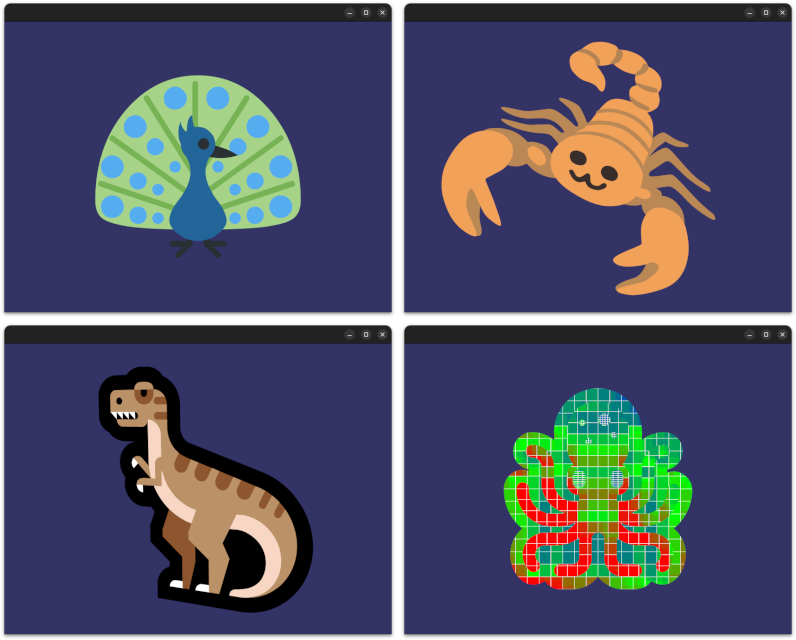 |
Emoji Demonstrates loading COLRv0 and COLRv1 emojis using the slughorn-freetype.hpp backend. Each layer of the emoji is composited into its own quad and positioned relative to the base.NOTE: Not all features of COLRv1 are currently supported, but will be soon. |
 |
Animated Glyphs Shader-driven animation applied to Slug-rendered glyph geometry, accomplished by adjusting the output positions in the vertex shader. |
 |
Layer Effects Shows how individual layers in a CompositeShape can not only be distinguished in the shader pipeline, but also how each layer can have its own unique fragment output. From left to right: basic fill, two GLSL algorithmic fills, traditional texture lookup, and finally an animated GLSL algorithmic fill. |
 |
Morphing Similar to the animated glyphs demo, this example shows both the shape, a simple triangle, and the debugging bounding box using the OSGSLUG_DEBUG=3 environment variable. |
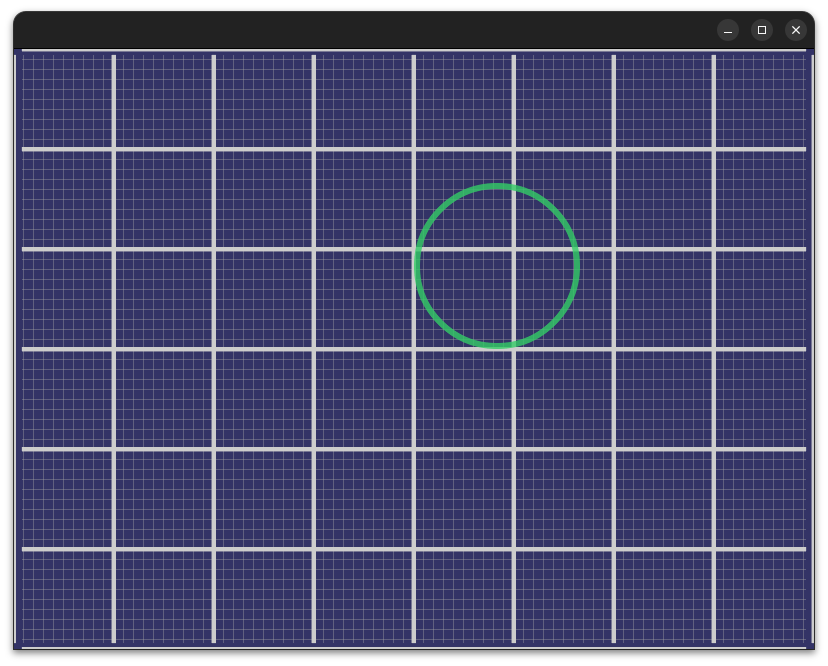 |
2D Projection The standard orthographic-style 2D placement/rendering. |
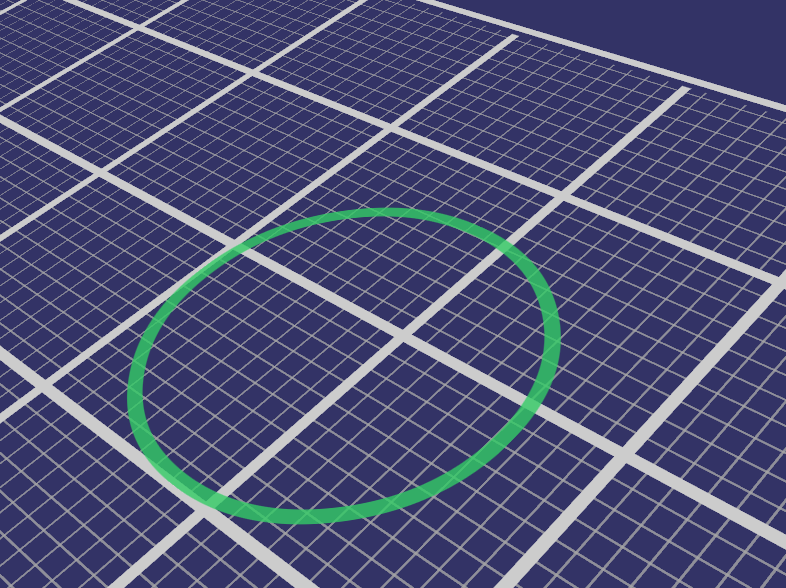 |
3D Projection The same scene as the 2D Projection above, but with a traditional perspective-style view. |
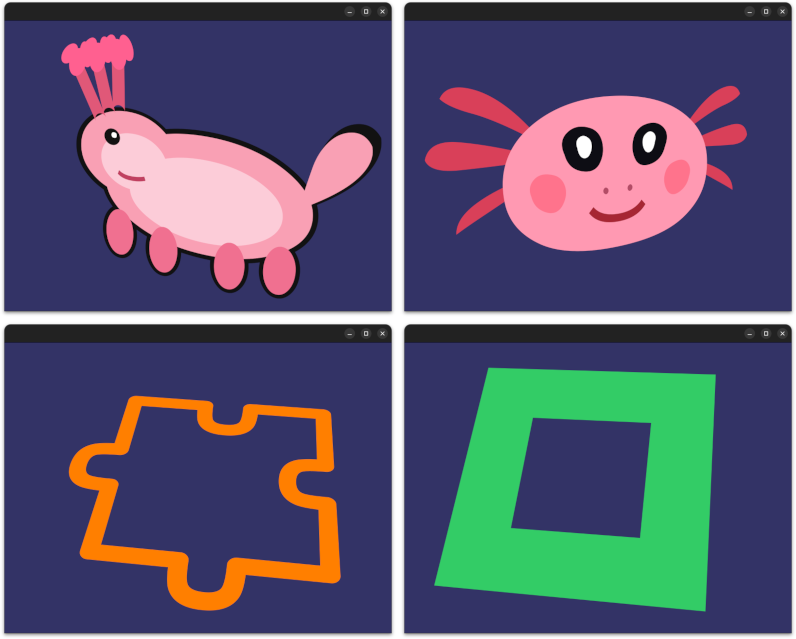 |
Shapes/CompositeShapes Each backend has its own examples of how to create both simple Shape and CompositeShape objects, groups of Shape instances layered together. The last screenshot demonstrates the slughorn-canvas.hpp backend, in addition to showing how the traditional punch-out effect can be achieved by manually using opposite winding directions in order to cut out one closed path from another.NOTE: The skia backend is currently the only backend that supports a true stroke-to-path feature, the jigsaw puzzle piece. |
 |
3D Objects Slug is not restricted to simple quads; any 3D object or mesh can be assigned compatible slughorn coordinate mappings, such as spheres, cubes, curved surfaces, etc. |
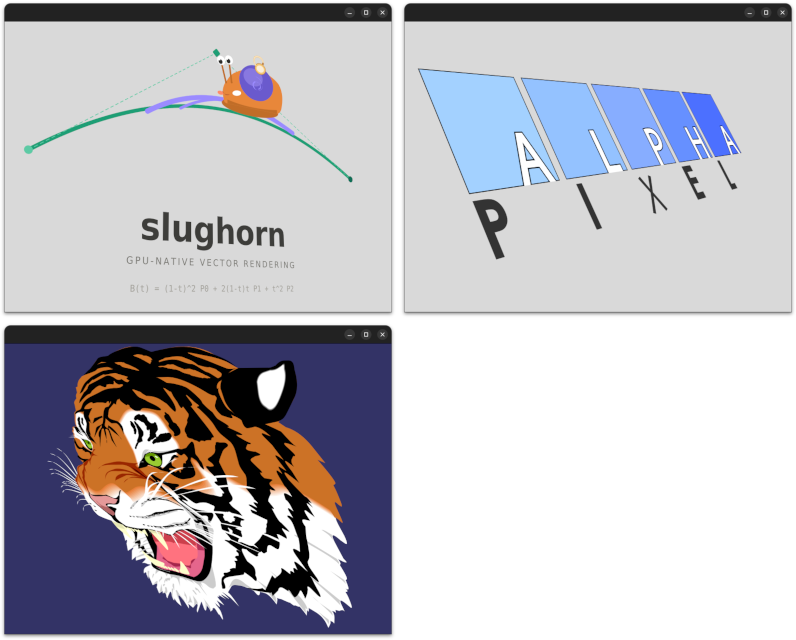 |
SVG SVG content fits easily within the slughorn ecosystem via the slughorn-nanosvg.hpp backend.NOTE: Similar to the emoji support, gradients are not currently supported. |
 |
Mixed Text Text glyphs are simply an instance of Shape, and can be freely mixed with any other Shape or CompositeShape object. This example demonstrates replacing the character F with a simple triangle, which fits seamlessly into the layout process. |
 |
Text Text was the original inspiration for Slug, and will always be incredibly well-supported. As mentioned above, each glyph in a text layout is nothing more than an instance of Shape, and can be manipulated in any way you can imagine. :) |
Note on demos: All video demonstrations below are captured from osgSlug, the intentionally separate OpenSceneGraph-based testbed developed alongside
slughorn.slughornitself has no graphics dependencies, andosgSlugexists to prove the integration story and serve as a reference implementation for other graphics backends.
Unbound/mismatched band/curve textures cause runaway per-fragment iteration, leading to GPU hang and system lock. A magic number at texel (0,0) or at the END of each row (where there is almost ALWAYS extra bytes) checked by the shader would allow clean discard instead of GPU DoS.
This would require:
- Writing 0x534C5547 ("SLUG") from C++ during packTextures()
- Adding guard in the fragment shader before any band reads
Avoidable by careful uniform naming. High value as a robustness/debug aid.
- Add
KeyIteratortoslughorn::nanosvg::load(instead of forcing numeric codepoint) - Emphasize
osgSlugas the "testbed" for visualization (when ready) - Change
slughorn_render.pyto dump SVG for thesave_curves_debug - Add CMake helpers for compiling in each backend
- Slug "mip-mapping"! Starting with osgSlug, introduce the ability to
"short-circuit" the Slug quad based on some "level of detail" rule; when the
shape is some threshold of distance AWAY, revert to simple texture lookup
approximations. NOTE:
slughornMIGHT be able to participate in this optmization as well ... somehow - Fix
numBands*auto-calculation and account for spatial curve distribution, not just count - pybind11 wrapper
- Change
compositestocompositeShapesin serialization, etc - Change the
autoMetricsdefault totrue - Rename
slughorn-ft2.hpptoslughorn-freetype.hpp - Enforce VERSION compatibility in backends
- UDL types for
slughorn::Key::from{String,Codepoint}, potentially as_ukey,_skeyor similar?
- Remove
slughorn::Key::from*helpers (if the ctors really cover everything) - Move
slug_tintoslughorn::literals, and introduce:using slugf_t = float; using slugi_t = std::uint16_t; using slugid_t = std::uint32_t; - Introduce
slughorn-harfbuzz.hpptext API, using Harfbuzz to "shape" it properly. Note: it will necessarily NEED to be built on top of the FreeType2 backend (slughorn-freetype.hpp)! - Qt6 QPainterPath provides moveTo / lineTo / quadTo / cubicTo / closeSubpath via elementAt() iteration; maps cleanly to CurveDecomposer. Quadratics are native to Qt6 (unlike Cairo which works in cubics). QFont / QRawFont provide glyph outline extraction as a potential FreeType2 complement. QSvgRenderer provides SVG loading as a potential NanoSVG complement. Structure to match slughorn-cairo.hpp: decomposePath(QPainterPath, Atlas&).
- Allow
serial::writeJSONfor ANY object (not JUSTAtlas) - Simulate a fragment processing frame in Python and inspect the math
- Tooling for "optimizing"
Atlas::build - Generate tight carrier mesh from Slug coverage via sampling + contour extraction + triangulation (offline). Preserve em-space UVs.
- Generate SDF/MSDF texture data with Python emulator
-
Atlas::Keytype conversion (uint32_t->Codepoint | Namediscriminated union) - Conic subdivision for Skia circular geometry (
iter.conicWeight()) - Minimal Skia
args.gnbuild config (trim from 25GB) - Non-square band grids (
bandMaxX != bandMaxY)
- Live
numBandsslider tool with real-time rebuild + heatmap feedback - VSG adapter (trivial now given
slughornseparation)
cd ~/dev/skia
rm -rf out/Release
bin/gn gen out/Release
ninja -C out/Release skia
Skia has two GPU backends: Ganesh (the older one, OpenGL/Vulkan/Metal) and Graphite (the newer one, designed for modern explicit APIs). Both work by:
- Tessellating paths into triangles on the CPU (or via compute shaders)
- Uploading those triangles to the GPU
- Rendering with relatively simple shaders
The key word is tessellation; Skia converts your curves into triangle meshes. This means:
- Quality is resolution-dependent; you have to choose a tessellation tolerance, and if you zoom in far enough you'll see faceting
- Every time the path transforms (scale, rotation, perspective), you either re-tessellate or accept quality loss
- Perspective projection of curves is fundamentally broken with tessellation; a cubic Bezier projected through a perspective matrix is no longer a cubic Bezier
Slug evaluates the exact curve equations per-fragment in the shader. This means:
- Quality is resolution-independent; zoom in infinitely, edges stay perfect
- Transforms are free; the vertex shader handles them, the fragment shader doesn't care
- Perspective is correct; because you're evaluating the curve at each pixel, not approximating it with triangles
- No CPU tessellation step; the atlas is built once and never rebuilt regardless of transform
| Skia GPU | Slug | |
|---|---|---|
| Edge quality at scale | Depends on tolerance | Perfect always |
| Perspective correctness | Approximate | Exact |
| CPU work per frame | Re-tessellate on change | Nothing |
| GPU fragment cost | Cheap (just triangles) | More expensive |
| Setup complexity | High (full GPU framework) | Moderate |
| OSG integration | Very difficult | Natural |
Getting Skia's GPU backend working inside OSG would be genuinely painful:
- Skia wants to own the OpenGL context; it manages its own state, its own FBOs, its own texture atlases. OSG also wants to own the context. Getting them to share without stomping each other's state is a known headache.
- Skia's GPU API is not designed to be embedded; it's designed to be the renderer, not a component of one.
- You'd essentially be running two renderers side by side and compositing, which introduces synchronization, blending, and depth buffer problems.
Slug, on the other hand, is just a shader and two textures; it slots into
OSG's existing pipeline as naturally as any other osg::Program.
For 2D UI / document rendering at fixed resolution; Skia is better. It's battle-hardened, handles edge cases you haven't thought of yet, and the tessellation quality is fine for screen-resolution work.
For 3D scene graph rendering with arbitrary transforms and perspective, Slug is genuinely superior. The moment you want text or shapes on a billboard, a HUD, a curved surface, or viewed through a perspective camera, Skia's approach starts showing cracks and Slug's approach shines.
Slug is solving a different problem that Skia deliberately doesn't address.
AI tools such as ChatGPT and Claude have been used for research and some code development. However, this is not a "fire and forget" AI project. It was carefully designed, planned, architected and implemented by Jeremy 'Cubicool' Moles (cubicool@gmail.com). AI tools were also used for producing documentation and ancillary data products to accelerate development.
This project was created and implemented by Jeremy 'Cubicool' Moles, author of the osgCairo and osgPango, as well as numerous SDF-rendering and other glyph-centric projects. Jeremy produced this work for AlphaPixel (AlphaPixelDev.com) based on the 2026 release of the Slug algorithm ( https://terathon.com/blog/decade-slug.html) patent by its author, Eric Lengyel, for whom the whole Slug-using community is extremely grateful.
If you are interested in assistance with Slug, slughorn, OpenGL, OpenSceneGraph, Vulkan, VulkanSceneGraph, AR, VR, xR, 3d mapping, or almost any other performance-centric computing, please contact AlphaPixel. We are mercenary programmers who can provide rapid assistance to any challenge, and our motto is "We Solve Your Difficult Problems."