
Replies: 4 comments

-
|
Hello @hghalebi, there are some tutorials as notebooks on the documentation website (section "Tutorials") : https://scikit-network.readthedocs.io/en/latest/tutorials/gnn/gnn_classifier.html; to some extents, the "Use cases" section also serves as tutorials. @tbonald and @simondelarue also regularly organize sessions that walk through the above notebooks (the last one was on Dec. 13). |
Beta Was this translation helpful? Give feedback.

-
|
Thanks for the reply, @TiphaineV! |
Beta Was this translation helpful? Give feedback.

-
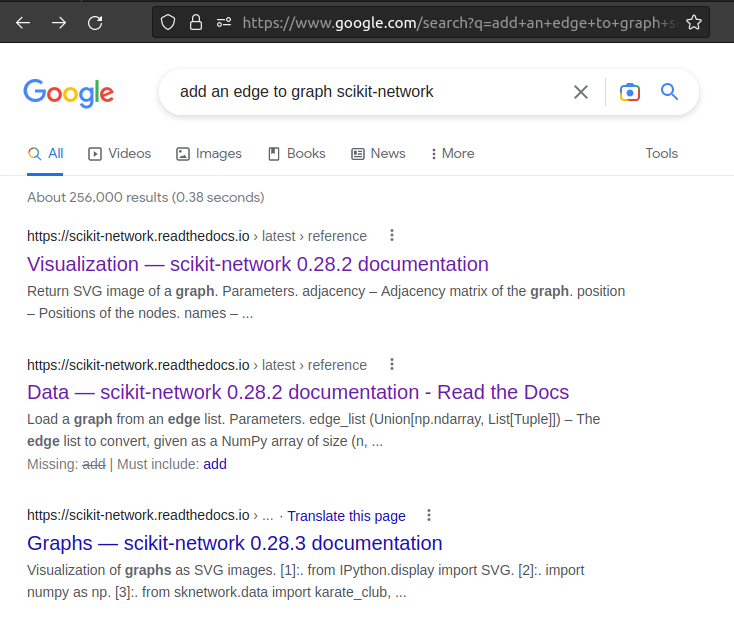
what I was looking forI wanted to use the graph to analyze the sensors logs of trains. I needed to iterate on my tabular data to and by my customize function, add nodes, and link to my graph. So I was looking for a method that enabled me to add edge with more control. And this is my google search for the tutorial that I was looking for Google search1. This is when I google in a general way;
2- Then I tried to be more specified:
The result is general documentation on visualization, different from what I looked for, and then documentation from another library. 3- Again, I tried to be more specific on the library:
What I found:The More related document that I found was this https://scikit-network.readthedocs.io/en/latest/tutorials/data/load_data.html What I would love to see in the documentationA better SEOEven if there was enough documentation, if those would not indexed by search engines, we could not find them. Documents that are not indexed in google ( or other search engines) are like they don't exist. A conceptual manifestoI tried to understand the logic behind the library's abstraction, but it needs to be more explicit. A manifesto/whitepaper that explains the logic of abstraction and the conceptual framework of this library will be really helpful. Multy level of documentation.The actual documentation helped me to understand that we could do everything possible with another framework with this framework. However, if I could have complete use cases both in a simple but low-level and more complex more significant project more in high level. Also, thank you for your reactiveness and open ness to feedback |


Beta Was this translation helpful? Give feedback.
-
|
OK, thanks for your feedback. As for your problem (adding nodes / links), there is indeed no such functions in scikit-network. The reason is that graphs are represented as sparse CSR matrices and that adding nodes / links is time-consuming. The best is to come back to an edge list, as shown here: We will add the corresponding function, hoping that it is later referenced by search engines. Thanks for the other suggestions (in particular, the manifesto and the multi-level documentation). |
Beta Was this translation helpful? Give feedback.


Uh oh!
There was an error while loading. Please reload this page.
-
I am looking for toturial. It is really difficult find any real toturial and official doc are not really practical. Is there in source for this?
@tbonald
Beta Was this translation helpful? Give feedback.
All reactions