Next sections present a diagram and a short description extracted from FIPA website for each Interaction Protocol. Take into account that exceptions have not been included in this document. They can be found, for each protocol, in the links above.
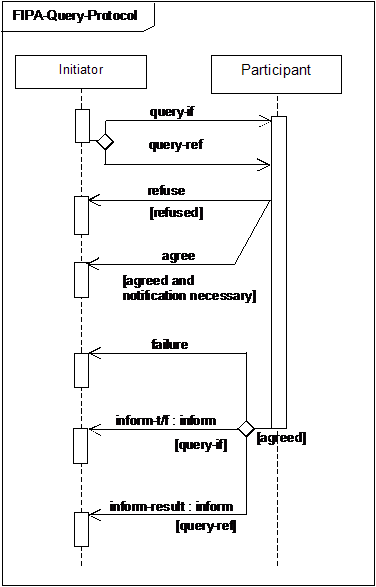
inform action using one of two query communicative acts, query-if or query-ref. The query-if communication is used when the Initiator wants to query whether a particular proposition is true or false and the query-ref communication is used when the Initiator wants to query for some identified objects. The Participant processes the query-if or query-ref and makes a decision whether to accept or refuse the query request. If the Participant makes a refuse decision, then “refused” becomes true and the Participant communicates a refuse. Otherwise, “agreed” becomes true.
If conditions indicate that an explicit agreement is required (that is, “notification necessary” is true), then the Participant communicates an agree. The agree may be optional depending on circumstances, for example, if the requested action is very quick and can happen before a time specified in the reply-by parameter. If the Participant fails, then it communicates a failure.
In a successful response, the Participant replies with one of two versions of inform:
-
The Participant uses an
inform-t/fcommunication in response to aquery-ifwhere the content of theinform-t/fasserts the truth or falsehood of the proposition, or, -
The Participant returns an
inform-resultcommunication in response to aquery-refand the content of theinform-resultcontains a referring expression to the objects for which the query was specified.
Any interaction using this interaction protocol is identified by a globally unique, non-null conversation-id parameter, assigned by the Initiator. The agents involved in the interaction must tag all of its ACL messages with this conversation identifier. This enables each agent to manage its communication strategies and activities, for example, it allows an agent to identify individual conversations and to reason across historical records of conversations.
There is also the request interaction protocol, which similar to this one except for the pre-condition. In request the action, if agreed, should be performed inmediately and it is not necessary to check anything. I would say Request protocol can be reproduced by Request when along a pre-condition that holds always true.
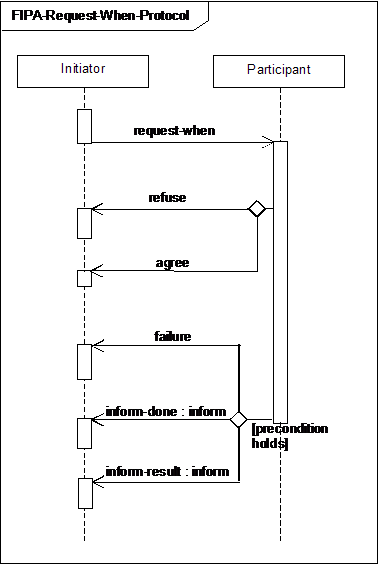
Description extracted from FIPA website:
The initiator uses the request-when action to request that the participant do some action once a given precondition becomes true. If the requested agent understands the request and does not initially refuse, it will agree and wait until the precondition occurs. Then, it will attempt to perform the action and notify the requester accordingly.
If after the initial agreement the participant is no longer able to perform the action, then it will send a failure action to the initiator. Once the action has completed and the failure, inform-done, or inform-result has been sent, the conversation ends.
Any interaction using this interaction protocol is identified by a globally unique, non-null conversation-id parameter, assigned by the Initiator. The agents involved in the interaction must tag all of its ACL messages with this conversation identifier. This enables each agent to manage its communication strategies and activities, for example, it allows an agent to identify individual conversations and to reason across historical records of conversations.
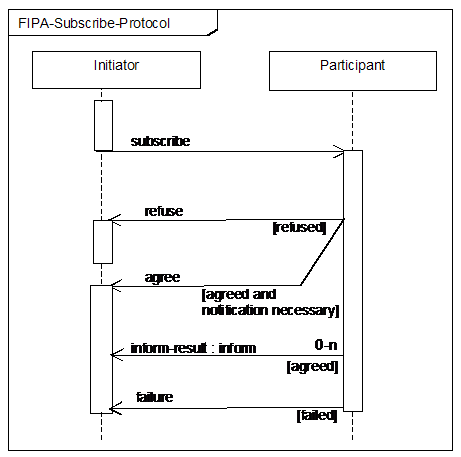
Description extracted from FIPA website:
The Initiator begins the interaction with a subscribe message containing the reference of the objects in which they are interested. The Participant processes the subscribe message and makes a decision whether to accept or refuse the query request. If the Participant makes a refuse decision, then “refused” becomes true and the Participant communicates a refuse. Otherwise, ”agreed” becomes true.
If conditions indicate that an explicit agreement is required (that is, “notification necessary” is true), then the Participant communicates an agree. The agree may be optional depending on circumstances, for example, if the requested action is very quick and can happen before a time specified in the reply-by parameter.
In a successful response, the Participant replies with an inform-result communication with the content being a referring expression to the subscribed objects. The Participant continues to send inform-result messages as the objects denoted by the referring expression change. If at some point after the Participant agrees, it experiences a failure, then it communicates this with a failure message, which also terminates the interaction. Otherwise, the interaction may be terminated by the Initiator using the cancel meta-protocol as described in Section 1.2.
Any interaction using this interaction protocol is identified by a globally unique, non-null conversation-id parameter, assigned by the Initiator. The agents involved in the interaction must tag all of its ACL messages with this conversation identifier. This enables each agent to manage its communication strategies and activities, for example, it allows an agent to identify individual conversations and to reason across historical records of conversations. Additionally, because it may be important to preserve the sequence of the inform-result messages, it is important that the message transport used for this IP preserve the ordering of messages.
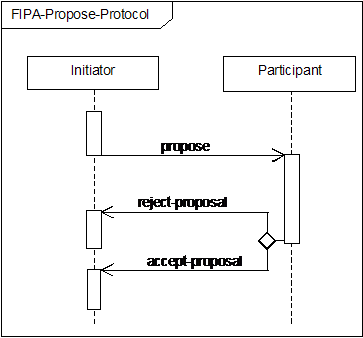
Description extracted from FIPA website:
The Initiator sends a propose message to the Participant indicating that it will perform some action if the Participant agrees. The Participant responds by either accepting or rejecting the proposal, communicating this with the accept-proposal or reject-proposal communicative act, accordingly. Completion of this IP with an accept-proposal act would typically be followed by the performance by the Initiator of the proposed action and then the return of a status response.
Any interaction using this interaction protocol is identified by a globally unique, non-null conversation-id parameter, assigned by the Initiator. The agents involved in the interaction must tag all of its ACL messages with this conversation identifier. This enables each agent to manage its communication strategies and activities, for example, it allows an agent to identify individual conversations and to reason across historical records of conversations.
There is a more complex version called Iterated Contract Net.
This protocol handles a deadline to avoid the situation where the initiator is waiting for responses indefinitely.
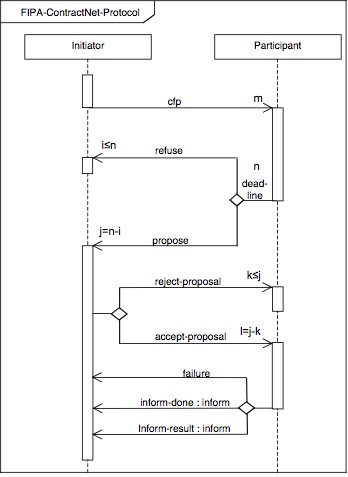
Description extracted from FIPA website:
The Initiator solicits m proposals from other agents by issuing a call for proposals (cfp) act, which specifies the task, as well any conditions the Initiator is placing upon the execution of the task. Participants receiving the call for proposals are viewed as potential contractors and are able to generate n responses. Of these, j are proposals to perform the task, specified as propose acts.
The Participant’s proposal includes the preconditions that the Participant is setting out for the task, which may be the price, time when the task will be done, etc. Alternatively, the i=n-j Participants may refuse to propose. Once the deadline passes, the Initiator evaluates the received j proposals and selects agents to perform the task; one, several or no agents may be chosen. The l agents of the selected proposal(s) will be sent an accept-proposal act and the remaining k agents will receive a reject-proposal act . The proposals are binding on the Participant, so that once the Initiator accepts the proposal, the Participant acquires a commitment to perform the task. Once the Participant has completed the task, it sends a completion message to the Initiator in the form of an inform-done or a more explanatory version in the form of an inform-result. However, if the Participant fails to complete the task, a failure message is sent.
Note that this IP requires the Initiator to know when it has received all replies. In the case that a Participant fails to reply with either a propose or a refuse act, the Initiator may potentially be left waiting indefinitely. To guard against this, the cfp act includes a deadline by which replies should be received by the Initiator. Proposals received after the deadline are automatically rejected with the given reason that the proposal was late. The deadline is specified by the reply-by parameter in the ACL message.
Any interaction using this interaction protocol is identified by a globally unique, non-null conversation-id parameter, assigned by the Initiator. The agents involved in the interaction must tag all of its ACL messages with this conversation identifier. This enables each agent to manage its communication strategies and activities, for example, it allows an agent to identify individual conversations and to reason across historical records of conversations.
In the case of 1:N interaction protocols or sub-protocols the Initiator is free to decide if the same conversation-id parameter should be used or a new one should be issued. Additionally, the messages may specify other interaction-related information such as a timeout in the reply-by parameter that denotes the latest time by which the sending agent would like to have received the next message in the protocol flow.
- RPC
- Introspection (rpc like)
- Event Ingest (rpc like)
- Reactive Stream
- Pipeline
- Observe Projection.
Left to right data process. Have an orchestrating service be able to arrange dynamic pipelines of processes, anaologous to the Unix pipeline.
Needs to have an agent be able to coordinate multiple other services, send data to the first in the pipeline, and then observe results from the last service. Data will then be passed between the other services without reference to the orchestrating agent.
Photon has a projection system. It also has stream replay.
It would be useful to have some method of combining the two systems so that Photon can manage the state, while the observing agent can be notified of changes as rapidly as possible and not have to rebuild state.
Maintain the projection on the server side, and have thate state pushed into any subscribing service. This would require some form of delta to be calculated on the projection to make it performance, but would be fairly easy to implement on the client.
A simpler system would be to subscribe to a projection, you then get the state as the first item, possibly with the projection function as well. From that point on, the local service will receive the raw events, and be able to calculate the state locally.
This would be simpler to arrange, but has the potential of losing coherence without some form of consistency check back to the source projection.