If your GraphQL schema has a nullable field, dillonkearns/elm-graphql will generate a corresponding Maybe for that field in the response.
The best way to get rid of these Maybes is to make the fields non-nullable (for example, turn a string field into a string! field or a [int] into a [int!]!).
If you are unable to change your schema and make the nullable fields non-nullable, you can use the Graphql.Field.nonNullOrFail function (see the Graphql.Field docs). Be aware that the entire response will fail to decode if you do get a null back in a field where you used nonNullOrFail.
Again, ideally you could change your schema (e.g. [string]! becomes [string!]!). If that's not possible, take a look at the Graphql.Field.nonNullElementsOrFail function to turn a List (Maybe something) into a List something (see the Graphql.Field docs).
Why do I get an error when I don't provide an Optional Argument? According to the schema it's optional.
This is very common, if you look at your schema you will probably find that the optional argument is marked as nullable (i.e. it doesn't end with a !). And in GraphQL, a nullable argument is exactly what an optional argument is, see http://facebook.github.io/graphql/October2016/#sec-Required-Non-Null-Arguments
Arguments can be required. Arguments are required if the type of the argument is non‐null. If it is not non‐null, the argument is optional.
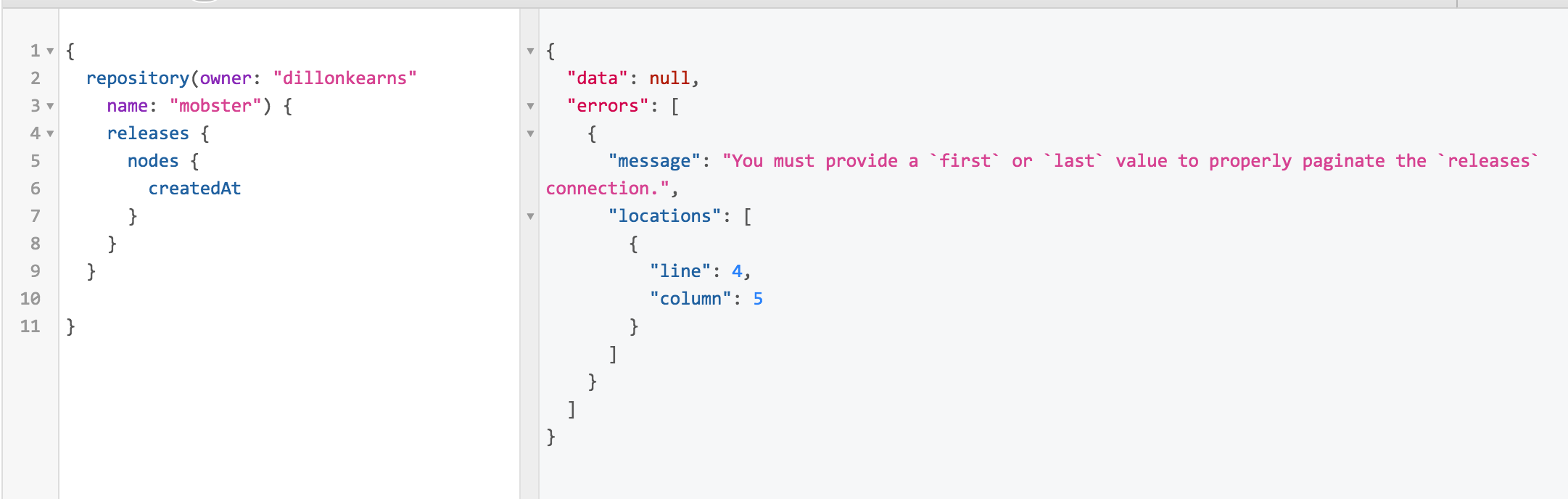
But even though the schema lists the argument as optional (i.e. nullable), it's common to throw a runtime error and say that it's invalid. A common reason for this is that you must pass in "one of the following...", so no individual argument is required, but if you don't provide one it will throw a runtime error. Here's an example from the Github API (you can reporduce it yourself by running this query in the Github Explorer):
Why is the OptionalArgument union type used instead of Maybe?
An optional argument can be either present, absent, or null, so using a Maybe does not fully capture the GraphQL concept of an optional argument. For example, you could have a mutation that deletes an entry if a null argument is provided, or does nothing if the argument is absent. See The official GraphQL spec section on null for details.
My recommendation is to keep them in their own module. I have an example of this with ElmReposRequest.elm. That query module is consumed by the GithubComplex.elm module.
Some GraphQL names are invalid in Elm, and others are not idiomatic and would sound awkard in the context of Elm code.
For example, it is conventional to name a Union's values with all caps in GraphQL, like a union Episode with values NEWHOPE, EMPIRE, JEDI. dillonkearns/elm-graphql will generate the following union type type Episode = Empire | Jedi | Newhope. If you follow the GraphQL naming conventions, dillonkearns/elm-graphql will generate nice names that follow Elm naming conventions.
Elm also has to avoid reserved words in the language like, so it would convert a field name like module or import into module_ and import_ (See dillonkearns#41 for more in-depth discussion of this). If you want more details on the normalization behavior you can take a look at the normalization test suite.
What if you have two names that dillonkearns/elm-graphql normalizes to the same thing, like a field called user and User (which would both turn into user? This is possible, but indicates that you are not following GraphQL conventions. Consider using a different naming convention. If you have a compelling reason for your naming, open an issue so we can discuss the normalization strategy.
Take a look at the dillonkearns/elm-graphql Elm 0.19 upgrade guide.
Yes, you can read about why the name changed here).
You may notice that "Show Aliases" is unchecked by default in the demos in the examples folder.
Aliases are just a tool for telling GraphQL what field to return your data back under
in the JSON response. But with dillonkearns/elm-graphql, you're not dealing with
JSON directly. You just use map2 or SelectionSet.succeed or SelectionSet.with functions
to build up data structures. The JSON response details are all handled under the hood by
the library.
Sometimes GraphQL requires you to use aliases to make sure you don't make ambiguous
queries. For example, if you make a request asking for avatar(size: SMALL) and
avatar(size: LARGE) in the same request, then you will need to use an alias
since they can't both come back under the JSON field avatar with more than
one avatar data in the response.
We hide aliases by default in this demos to reduce noise. But note that these request may be invalid without the aliases, so check "Show Aliases" if you would like to copy-paste the queries and execute them yourself.
You can read more about how aliases are used under the hood in this blog
post
about the dillonkearns/elm-graphql internals.