-
Notifications
You must be signed in to change notification settings - Fork 0
Expand file tree
/
Copy pathmarkdown
More file actions
176 lines (94 loc) · 4.81 KB
/
markdown
File metadata and controls
176 lines (94 loc) · 4.81 KB
1
2
3
4
5
6
7
8
9
10
11
12
13
14
15
16
17
18
19
20
21
22
23
24
25
26
27
28
29
30
31
32
33
34
35
36
37
38
39
40
41
42
43
44
45
46
47
48
49
50
51
52
53
54
55
56
57
58
59
60
61
62
63
64
65
66
67
68
69
70
71
72
73
74
75
76
77
78
79
80
81
82
83
84
85
86
87
88
89
90
91
92
93
94
95
96
97
98
99
100
101
102
103
104
105
106
107
108
109
110
111
112
113
114
115
116
117
118
119
120
121
122
123
124
125
126
127
128
129
130
131
132
133
134
135
136
137
138
139
140
141
142
143
144
145
146
147
148
149
150
151
152
153
154
155
156
157
158
159
160
161
162
163
164
165
166
167
# Core 3
## Functions
A function is a one to one mapping
### Domain and range of a function
The domain of a function is the set of valid input values
A function is defined by both a rule and a domain
### Inverse of a function
An inverse function is such that $ff^{-1} (x) = f^{-1} f(x) = x$
For a function to have a valid inverse function, it must be a one to one mapping
## Transformations and the modulus function
### Translations
Translating the function $y = f(x)$ by the vector $\begin{bmatrix} a \\ b \end{bmatrix}$ gives $y = f(x-a) +b$
$y = kf(x)$ is a stretch of $y = f(x)$ by a factor of $k$ in the $y$ direction
$y = f\left(\frac x k \right)$ is a stretch y a factor of $k$ in the $y$ direction
Reflecting $y=f(x)$ in the y axis gives $y=f(-x)$
The modulus of a function is given by:
$$|f(x)| = \left\{
\begin{array}{ll}
f(x) & \quad f(x) \geq 0 \\
-f(x) & \quad f(x) < 0
\end{array}
\right.
$$
## Inverse trigonometric functions
$\operatorname{asin}(x)$ has domain $-1 \leq x \leq 1$ and range of $-\frac{\pi}{2} \leq \operatorname{asin}(x) \leq \frac{\pi}{2}$
$\operatorname{acos}(x)$ has domain $-1 \leq x \leq 1$ and range of $0\leq \operatorname{acos}(x) \leq \frac{\pi}{2}$
$\operatorname{atan}(x)$ has domain $x \in \mathbb{R}$ and range of $-\frac{\pi}{2} \leq \operatorname{atan}(x) \leq \frac{\pi}{2}$
## Trig identities
$$\begin{align}
&\sin(x)^2 + \cos(x)^2 = 1 \\
&1 + \cot(x)^2 = \operatorname{cosec}(x)^2 \\
&1 + \tan(x)^2 = \sec(x)^2\end{align}$$
## Calculus
### Log rules
$$\begin{align}
&\ln(a) + \ln(b) = \ln(ab) \\
&\ln(a) - \ln(b) = \ln\left(\frac{a}{b}\right) \\
&n\ln(a) = \ln(a^n)\\
&\log_a b = \frac{\log_c(a)}{\log_c(b)}
\end{align}$$
### Differentials and integrals
$$\begin{alignat*}{3}
&\frac{d}{dx} e^x = e^x \quad &&\int e^x dx = e^x + C \\
&\frac{d}{dx} e^{ax + b} = ae^{ax+b} \quad &&\int e^{ax+b} dx = \frac{1}{a} e^{ax+b} + C\\
&\frac{d}{dx} e^{f(x)} = f'(x)e^{f(x)} \quad &&\int e^{f(x)} dx = \frac{1}{f'(x)} e^{f(x)} + C \\
&\frac{d}{dx} \ln(x) = \frac{1}{x} \quad &&\int \frac{1}{x} dx = \ln(x) + C \\
&\frac{d}{dx} \sin(x) = cos(x) \quad &&\int \sin(x) = dx = -\cos(x) + C \\
&\frac{d}{dx} cos(x) = -\sin(x) \quad &&\int \cos(x) dx = \sin(x) + C\end{alignat*}$$
### The chain rule
$$\frac{dy}{dx}\ = \frac{dy}{du} \frac{du}{dx}$$
### The product rule
$$ \frac{d}{dx} f(x) g(x) = f(x)g'(x) + f'(x)g(x) $$
or
$$\frac{d}{dx} uv = uv' + vu'$$
### The quotient rule
$$\frac{d}{dx} \frac{f(x)}{g(x)} = \frac{g(x)f'(x) - f(x)g'(x)}{g(x)^2}$$
or
$$\frac{d}{dx} \frac{u}{v} = \frac{vu' - uv'}{v^2}$$
### Integration by inspection and substitution
$$\begin{align} &\int \cos(ax + b) dx = \frac{1}{a} \sin(ax + b) + C \\
&\int \sin(ax + b) dx = -\frac{1}{a} \cos(ax + b) + C \\
&\int \sec(ax + b)^2 dx = \frac{1}{a}\tan(ax + b) + C \\
&\int \frac{f'(x)}{f(x)} dx = ln|f(x)| + C \end{align}$$
### Integration by parts and standard integrals
$$\int f(x) \frac{d}{dx} g(x)\ dx = f(x)g(x) - \int g(x) \frac{d}{dx} f(x) \ dx$$
More simply
$$\int u \frac{dv}{dx} \ dx = uv - \int v \frac{du}{dx} \ dx$$
In general it is easier to make $u$ the simpler part of the given integrand.
### Volume of a revolution
The volume of a function $y = f(x)$ rotated fully around the $x$ axis is given by
$$V = \int _a ^b \pi y^2 \ dx$$
To find the volume of a revolution around the $y$ axis, rearrange the function to the form $x = g(y)$.
## Numerical solutions and iterative methods
### Iteration
Iteration requires a formula in the form $X_{n+1} = f(x_n)$
An iterative formula converges if $|f'(x)| < 1$ | for certain values of x
If the iteration converges to a limit the limit can be found by setting $x_{n+1} = x_n = L$
### Trapezium rule
$$\int _a ^b y\ dx \approx \frac{b-a}{n} [y_0 + y_n + 2(y_1 + ... + y_{n-1})]$$
If $y$ tends upwards the rule will overestimate, and if $y$ tends downwards the rule will underestimate.
### Mid-Ordinate rule
$$\int _a ^b y\ dx \approx \frac{b-a}{n} (y_{\frac{1}{2}} + y_{\frac{3}{2}} + ... + y_{n - \frac{3}{2}} + y_{n - \frac{1}{2}}) $$
Where $n$ is even.
### Simpson's rule
$$\int _a ^b y\ dx \approx \frac{b-a}{3n} [y_0 + y_n + 4(y_1 + y_3 + ... + y_{n-1}) + 2(y_2 + y_4 + ... + y_{n-2})]$$
### Cobweb diagram
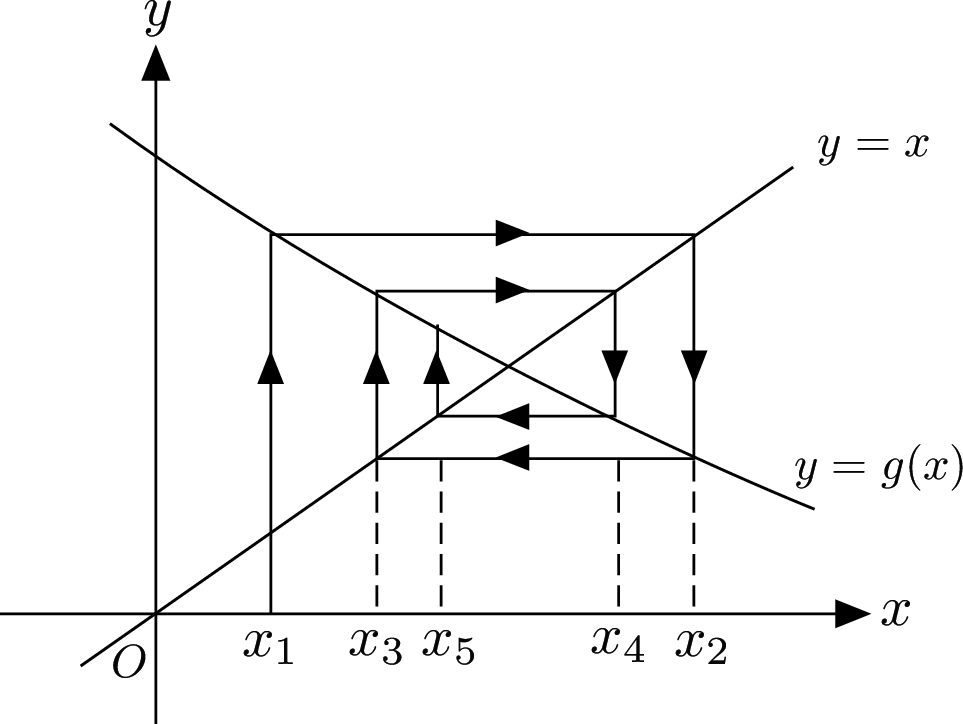
Plot the two functions
A cobweb diagram is plotted by drawing up from the first x value, before rotating around, alternating between each of the functions for each value of x.
This is more appropriate when the values converge around the root rather than towards it.
### Staircase diagram
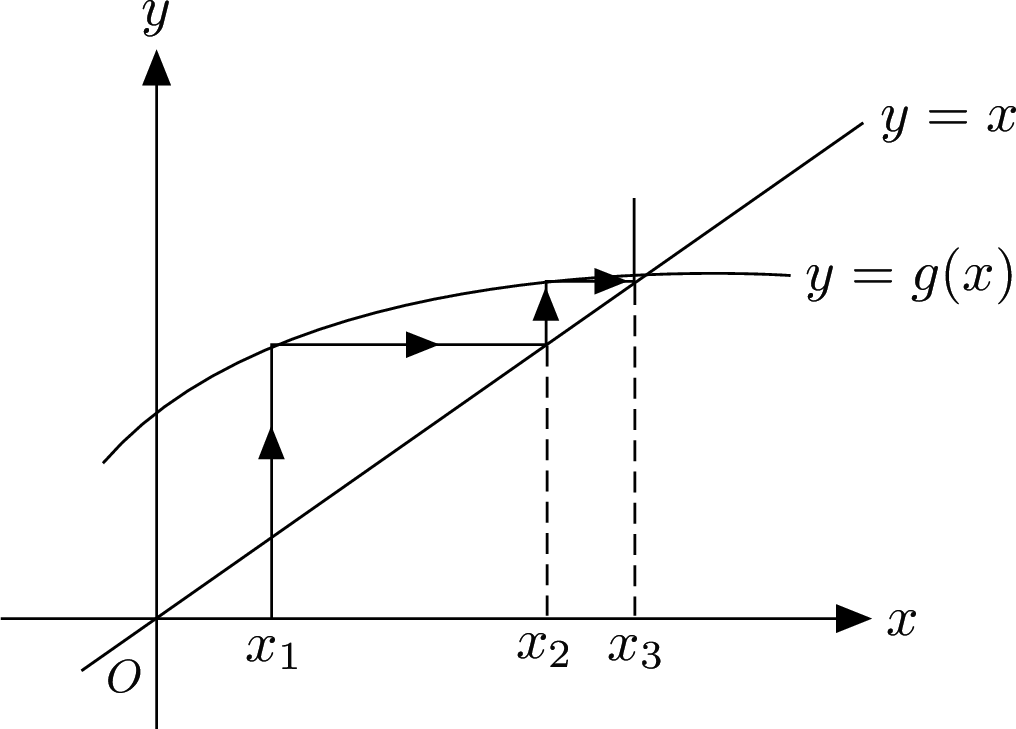
Plot the two functions
A staircase is plotted by drawing a line up from each x value to one of the functions, and then drawing across to the next intersect with the other function.