- 15-20 minutes
- Rough structure:
- What is the question, problem, or challenge
- How did you structure your code to answer the question, solve the problem or meet the challenge
- What did you learn using your code?
- All team members need to participate in the presentation
- You are welcome to use whatever visuals you'd like (Powerpoint slides, websites, images, etc.)
- For this portion of the grade, I'll be looking for clarity and a well-designed presentation
- While there are not specific guidelines for the number of lines of code you need to have, the scope of the project should represent significant effort over several weeks.
- All team members should contribute roughly equally. I should see commits from all team members in the code repository.
- The code itself should be clearly laid out and well commented. I shouldn't have to struggle to understand what you're trying to do.
- The code should be accompanied by some sort of README that tells a future user (or your future self) what the goal is and how to run the code to answer the question, solve the problem, etc. This explanation should be higher level than the comments in the code itself.
The Problem - Testing Against a Discrete Uniform Distribution

    Someone is trying to convince you to gamble with them in a dice game. To
    convince you that their die is not fake and has all six numbers on it,
    they give you the outcomes of 100 previous rolls.

    Are you willing to wager a serious amount of money in this game if the
    outcome depends on the coin being fair?

    >>> rolls = np.array([4, 6, 5, 5, 5, 5, 2, 5, 1, 5, 1, 6, 5, 2, 2, 2, 1, 6,
    1, 2, 3, 2, 5, 6, 2, 2, 3, 1, 2, 3, 3, 1, 1, 4, 1, 2, 2, 5, 2, 1, 3, 2,
    1, 1, 5, 5, 1, 5, 2, 3, 1, 1, 3, 3, 4, 4, 4, 1, 1, 2, 2, 6, 4, 1, 4, 6,
    3, 2, 4, 1, 4, 2, 6, 1, 3, 6, 1, 5, 3, 1, 1, 3, 1, 5, 6, 3, 2, 1, 3, 3,
    2, 1, 6, 1, 3, 1, 5, 4, 2, 2])

    HINT: Try simulating rolls of a fair dice and comparing them to these
    outcomes. How are you doing the comparison?

Solution 1: Using the Bootstrap

    As we talked about last week, the bootstrap is a very flexible approach
    to estimating a confidence interval on the sum (or something related to
    the sum, like the mean) for a set of values drawn from an unknown
    distribution. If our die is fair, the values 1-6 should occur with equal
    frequency, so the expected mean is:

    1(1/6) + 2(1/6) + 3(1/6) + 4(1/6) + 5(1/6) + 6(1/6) = 3.5

    So if the 95% confidence interval on our observed mean excludes 3.5, we
    can be confident that the die is not fair. The estimated mean can be
    calculated as:

    >>> empMean = np.mean(rolls)
    >>> print(empMean)   # 2.9399999999999999

    The 95% confidence interval can then be estimated using the bootstrap as
    follows:

    >>> bootNum = 1000
    >>> bootMeans = np.zeros(bootNum)
    >>> for bootRep in range(bootNum):
    >>>     bootMeans[bootRep] = np.mean(np.random.choice(rolls,len(rolls)))
    >>> bootMeans = np.sort(bootMeans)
    >>> confInterval = (bootMeans[int(np.floor(bootNum*0.025))],bootMeans[int(np.ceil(bootNum*0.975))])
    >>> print(confInterval)  # (2.6099999999999999, 3.27)

    Since the 95% confidence interval does not include 3.5, we have evidence
    that the coin is biased towards small values.

Solution 2: A Hypothesis Test

    In standard (known as frequentist) hypothesis testing, we begin with a
    default explanation (a null hypothesis) for what might be true and see if
    our data can reject this null. In our case, the null hypothesis is that
    our die is fair. We expect roughly equal frequencies of all values from
    1-6 in a large number of rolls. However, small numbers of rolls will
    vary from the expected proportions just due to chance. We need to ask if
    the deviations we see from equal proportions are more than we should
    reasonably expect if our die is fair.

    First, we need to generate a series of potential observations (in this
    case 1,000) if our null hypothesis is true:

    # Define our number of simulations
    >>> nullSims = 1000

    # Create an array of zeros
    >>> nullRolls = np.zeros((nullSims,100))

    # Simulate sets of 100 rolls, and add them to our array
    >>> for sim in range(nullSims):
    >>>     nullRolls[sim] = np.random.randint(1,7,100)

    Now we need some way to quantitatively compare our observed data to
    those simulated from our null distribution. To do this, we need to
    define a value that we can calculate for each data set. These values
    are known as test statistics. For instance, we could use either the
    number of 1s or the number of 6s (or any other number on a die face) as
    test statistics.

    Let's count the number of 1s and 6s in each of our simulated datasets.

    >>> simCounts_one = np.zeros(nullSims)
    >>> simCounts_six = np.zeros(nullSims)
    >>> for sim in range(nullSims):
    >>>     simCounts_one[sim] = sum(nullRolls[sim] == 1)
    >>>     simCounts_six[sim] = sum(nullRolls[sim] == 6)

    Now let's count the numbers of 1s and 6s in our observed rolls.

    >>> empCount_one = sum(rolls == 1)
    >>> empCount_six = sum(rolls == 6)

    Now we need to figure out how our observed values compare to the
    simulations. First, let's calculate how what percentage of simulated
    counts are less than (or equal to) our observed count for each number.
    This is an estimate of the lower one-tailed p-value.

    >>> lowOneTail_one = sum(simCounts_one <= empCount_one)/nullSims
    >>> print(lowOneTail_one)  # ~0.99
    >>> lowOneTail_six = sum(simCounts_six <= empCount_six)/nullSims
    >>> print(lowOneTail_six)  # ~0.05

    To get an intuitive sense for what these p-values mean, let's plot the
    simulated values relative to the empirical values.

    # Import pyplot
    >>> import matplotlib.pyplot as plt

    # Plot histogram of simulated 1 counts and compare to empirical
    >>> plt.hist(simCounts_one)
    >>> plt.axvline(x=empCount_one,color="red",linewidth=5.0)
    >>> plt.show()

    # Plot histogram of simulated 6 counts and compare to empirical
    >>> plt.hist(simCounts_six)
    >>> plt.axvline(x=empCount_six,color="red",linewidth=5.0)
    >>> plt.show()

    Looking at the counts of individual values can be useful, because it can
    tell us not only if our die is biased, but also HOW it is biased. However,
    looking at each value individually means that we're not able to use all
    of the information at once. Ideally, we'd like some way to do a general
    test of all values at once. The special statistic known as the chi-squared
    statistic is one way to do just that. To calculate this value, we use this
    formula (https://en.wikipedia.org/wiki/Chi-squared_test)

    [(observed_count - expected_count)^2] / expected_count

    and sum across all possible values. Let's write a function to do this:

    >>> def calcChiSq(rollVals,expProbs):
    >>>     counts = [0,0,0,0,0,0]
    >>>     for i in range(6):
    >>>         counts[i] = sum(rollVals == i+1)
    >>>     chiSqVal = 0.0
    >>>     for i in range(len(counts)):
    >>>         expCount = sum(counts) * expProbs[i]
    >>>         chiSqVal += (((counts[i] - expCount) ** 2) / expCount)
    >>>     return chiSqVal

    Now that we've got a function to calculate chi-squared values, let's
    compare the empirical value of this statistic to the values from the
    simulated datasets.

    >>> equalProbs = [1/6,1/6,1/6,1/6,1/6,1/6]

    >>> empChiSq = calcChiSq(rolls,equalProbs)

    >>> simChiSqs = []
    >>> for i in range(nullSims):
    >>>     simChiSqs.append( calcChiSq(nullRolls[i],equalProbs) )

    Now let's visually compare the simulated and empirical chi-squared values.

    >>> plt.hist(simChiSqs)
    >>> plt.axvline(x=empChiSq,color="red",linewidth=5.0)
    >>> plt.show()

    Because chi-squared values always get bigger as our observed and expected
    counts become more different, we are always interested in the upper
    one-tailed p-value. In this case, we can calculate it as:

    >>> upperOneTail_chiSq = sum(simChiSqs >= empChiSq)/nullSims
    >>> print(upperOneTail_chiSq)  # ~0.02
import numpy as np
-
Discrete Uniform
- Can take any set of values, depending on those specified by the user. All values have equal probability.
np.random.randint(low,high,size)- Draws numbers from a discrete uniform distribution of integers between low and high. size indicates the number of values to draw.
np.random.choice(arrayOfValues,size)- Draws values from an array, by default with equal probability. This array can hold any type of variable. Again, size indicates the number of values that are drawn.
-
Bernoulli
- This distribution takes the value 1 with probability p and the value 0 with probability 1-p. An outcome of 1 is often termed success and 1-p termed failure. Think of a coin flip. Only the values 0 or 1 can result from a Bernoulli trial.
np.random.binomial(size,n=1,p)- The Bernoulli distribution is a special case of the binomial when there's only one trial (
n=1).
-
Binomial
- This distribution models the number of successes in multiple Bernoulli trials, where the probability of success is p. Therefore, this distribution can take any value between 0 and the total number of trials (n).
np.random.binomial(size,n,p)
-
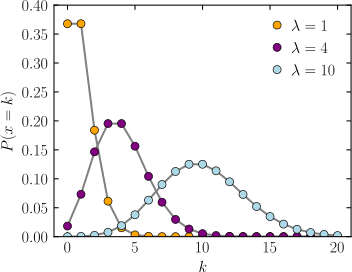
Poisson
- This distribution models the number of events that occur in a given amount of time if there's a constant probability of an event occurring (for instance, the number of messages you receive if the senders are independent of one another). As with the binomial, this distribution can take any value greater than or equal to 0.
np.random.poisson(lambda,size)- lambda is the rate parameter of the Poisson. Higher rates result in more events per unit time or space.
-
Geometric
- This distribution (on the left, below) models the number of Bernoulli trials that must be run before the first success. Therefore, it can take values greater than or equal to 1.
np.random.geometric(p,size)- p is the probability of success in each trial


- Normal
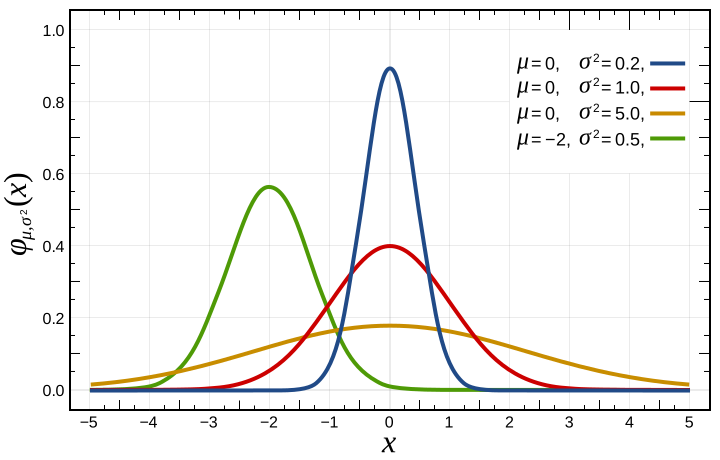
- This distribution can take any continuous value. Because of the Central Limit Theorem, this is a very commonly used distribution. Remember that the Central Limit Theorem says that the sum of a large number of random variables drawn from any distribution will approximate a Normal. So, anything in the real world that is the sum of many small effects can be modeled with a Normal. For instance, think about an organismal trait like height whose value is affected by many different genes.
np.random.normal(loc,scale,size)- loc is the mean of the Normal and scale is its standard deviation (i.e., its width or spread).
- Exponential
- The exponential distribution is commonly used to describe the amount of time that elapses between independent events that each have a constant probability of occurring. It is closely tied to the Poisson. For a given amount of time, the Poisson describes how many events are expected to occur, and the exponential describes how much time elapses between them.
np.random.exponential(scale,size)- scale is a parameter that controls the spread of the distribution. Higher scale values result in distributions with more variance. scale is the inverse of the rate, which describes how fast the events are expected to occur.

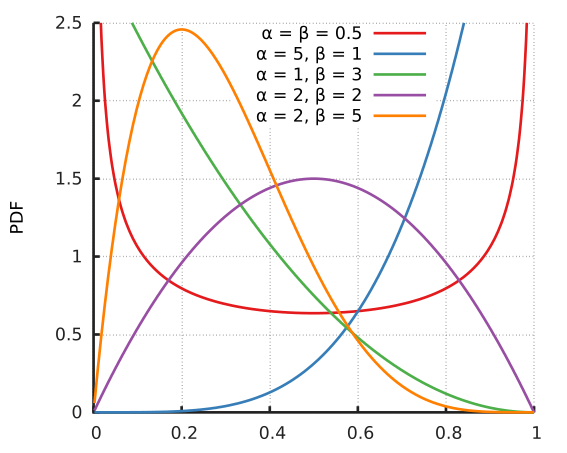
- Beta
- The beta distribution is bounded by 0 and 1, but can take many different shapes (flat, unimodal, bimodal, etc.). The overall shape of the distribution is controlled by two shape parameters - alpha and beta. In general, small values of the shape parameters (< 1) put more probability on values near 0 and 1. Large values put more probability on intermediate values.
np.random.beta(a,b,size)- a and b are the two shape parameters.