What does it mean that web sockets are bidirectional? Why is this useful?
- Bidirectional means that the server can send real-time updates asynchronously, without requiring the client to submit a request each time. This is useful in videogames, realtime messaging apps, or any other use case where realtime data flow is important.
Does socket.io use HTTP? Why?
- socket.io tries to make a Web Socket connection as it's first priotiry, if that is not available due to browser or firewalls, then it falls back on a HTTP connection as a failsafe. source
- also sounds like it might try to make a HTTP request first, when once connected "Upgrade" to a web socket, since if a web socket connection is rejected it can cause a delay of up to 10 seconds for the user. source
What happens when a client emits an event?
- its basically sending a Node.js EventEmitter, for listeners to capture
What happens when a server emits an event?
- works the same way as the client
What happens if a client “misses” an event?
- By default, any event emitted while the Socket is not connected will be buffered until reconnection.
How can we mitigate this?
- by using volitile events or emptying the internal buffer upon reconnection
Socket
- A socket is one endpoint of a two-way communication link between two programs running on the network. A socket is bound to a port number so that the TCP layer can identify the application that data is destined to be sent to. source
Web Socket
- A web socket is a communication protocol, that unlike HTTP is bidirectional. It starts with ws:// or wss:// and is stateful, meaning it will stay active until terminated. source
Socket.io
- Socket.IO is a library that enables real-time, bidirectional and event-based communication between the browser and the server source
Client
- A computer accessing a server.
Server
- dedicated computer or computer that plays a role to provide services to clients
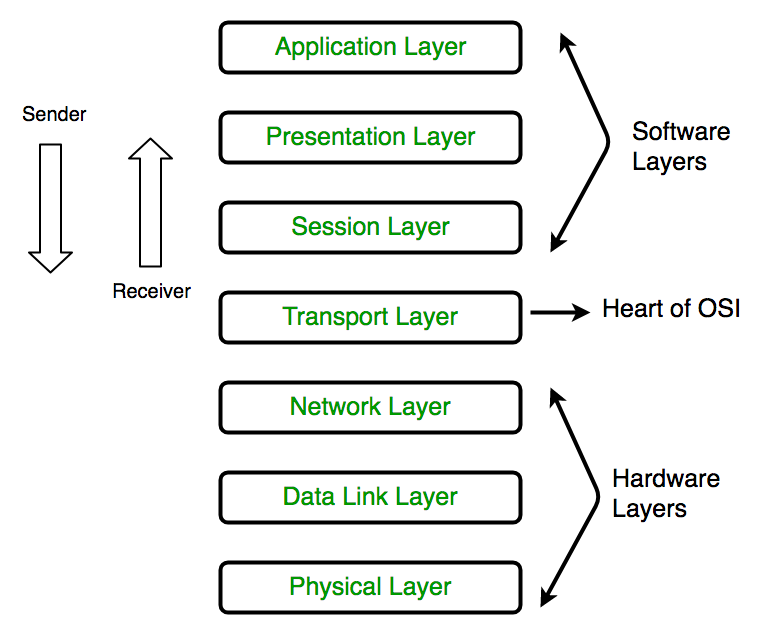
OSI Model
- Open Systems Interconnection (not currently used on Internet) source
TCP Model
- Transmission Control Protocol/Internet Protocol 4 layers:
- Process/Application Layer
- Host-to-Host/Transport Layer
- Internet Layer
- Network Access/Link Layer
- source
TCP
- a connection-oriented protocol. Connection-orientation means that the communicating devices should establish a connection before transmitting data and should close the connection after transmitting the data. source
UDP
- Datagram-oriented protocol. This is because there is no overhead for opening a connection, maintaining a connection, and terminating a connection. UDP is efficient for broadcast and multicast types of network transmission. source
Packets
- are used to break data down into smaller pieces for faster transmission, which is then reassembled upon reciept
Which 3 things had you heard about previously and now have better clarity on?
- Socket.io, TCP Model, UDP
Which 3 things are you hoping to learn more about in the upcoming lecture/demo?
- Socket.io, Web Sockets, Packets
What are you most excited about trying to implement or see how it works?
- Socket.io